Mammals Guide
Donkey
What Is a Donkey? The donkey (Equus africanus asinus) is a domesticated member of the horse family, Equidae, descended from the African wild ass of northeastern Africa. Kept by people for roughly 5,000 to 6,000 years, it …
At a glance
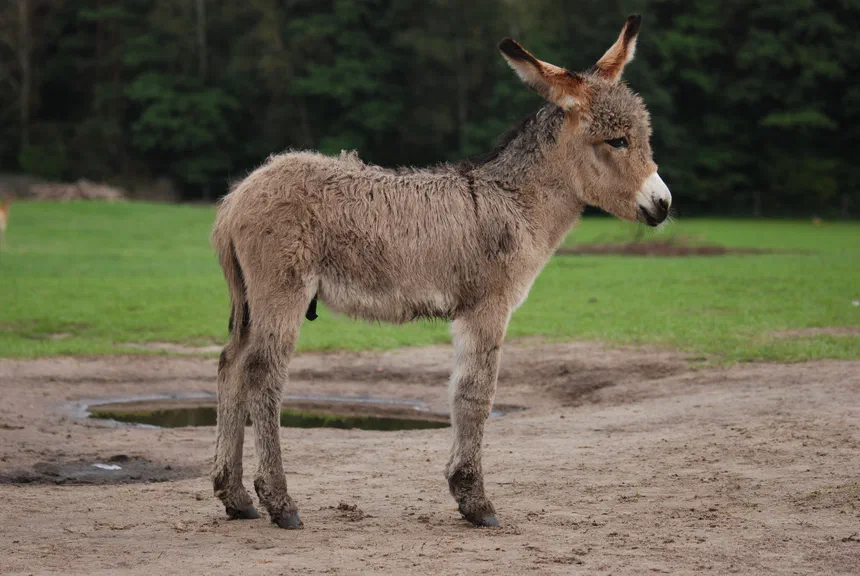
Image: Lilly M — CC BY-SA 3.0 · source
What Is a Donkey?
The donkey (Equus africanus asinus) is a domesticated member of the horse family, Equidae, descended from the African wild ass of northeastern Africa. Kept by people for roughly 5,000 to 6,000 years, it is prized as a hardy pack animal, a working companion, and, increasingly, a household pet. A male is called a jack, a female a jenny, and a young donkey a foal.
Appearance and Identification
Donkeys are built for endurance rather than speed. They typically stand between 0.9 and 1.6 meters at the shoulder, though breeds range from tiny miniature donkeys under a meter tall to large mammoth breeds. Coats come in shades of gray, brown, black, and occasionally white, usually with a paler muzzle, eye rings, and belly. Many individuals show a distinctive dark “cross” marking, a stripe running along the spine crossed by another over the shoulders. Compared with horses, donkeys have longer ears, an upright mane without a forelock, smaller hooves, and a tail that ends in a tuft rather than flowing hair. Their loud, unmistakable call is known as a bray.
Habitat and Range
As a fully domesticated animal, the donkey is found on every inhabited continent, wherever people farm or move goods. Its wild ancestor evolved in the arid landscapes of northeastern Africa, and that heritage shows: donkeys tolerate heat, sparse vegetation, and limited water better than most livestock. They thrive in drylands, semi-arid grasslands, and rocky scrub, which is why they remain vital across Africa, the Middle East, Central Asia, and Latin America. Feral populations, descended from escaped or released stock, persist in places such as the American Southwest and the Australian outback.
Diet
Donkeys are herbivores adapted to poor, fibrous forage. They graze grasses and browse on shrubs, herbs, and woody plants, and their efficient digestion lets them extract nutrients from material that would leave a horse undernourished. In managed care they do best on grass hay or straw with limited access to rich pasture, since lush grass and grain can cause obesity and painful hoof conditions such as laminitis. Constant access to clean water and, in many regions, a salt or mineral supplement supports their health.
Behavior
Donkeys are intelligent, curious, and famously deliberate. Their reputation for stubbornness is better understood as a strong sense of self-preservation: rather than fleeing blindly when startled, a donkey tends to freeze and assess the situation, and it will refuse a task it judges unsafe. They are social animals that form strong bonds with companions, sometimes grieving when a close partner is lost, and they communicate through brays, body posture, and ear movements. Because of their calm, protective nature, donkeys are often kept alongside sheep or goats as guardians against predators such as coyotes and foxes.
Life Cycle and Reproduction
A jenny usually carries a single foal after a long gestation of about 11 to 14 months, giving birth to a well-developed youngster that can stand and nurse within a few hours. Foals are weaned at roughly five to six months and reach sexual maturity within a couple of years, though responsible breeders wait longer. Donkeys are long-lived for a working animal, commonly reaching 25 to 30 years and occasionally beyond. When bred with horses they produce hybrids: a jack crossed with a mare yields a mule, while a stallion crossed with a jenny yields a hinny. These hybrids are almost always sterile.
Conservation Status
The domestic donkey itself is not assessed by the IUCN, as it is a domesticated animal with a global population in the tens of millions. Its wild ancestor, the African wild ass (Equus africanus), is a different matter: it is listed as Critically Endangered, with only a few hundred individuals surviving in the Horn of Africa. Domestic donkeys face their own pressures, notably a large international trade in their hides, which has driven sharp population declines in some countries and prompted new welfare and trade regulations.
Frequently Asked Questions
Are donkeys and mules the same animal? No. A donkey is a species in its own right, while a mule is a hybrid produced by crossing a male donkey with a female horse. Mules are typically sterile.
Why are donkeys considered stubborn? What looks like stubbornness is really caution. A donkey stops and evaluates a situation before acting and will not move if it senses danger, a trait that kept its desert ancestors alive.
How long do donkeys live? With good care, donkeys commonly live 25 to 30 years, and some individuals reach their forties.