Mammals Guide
Dingo
What Is a Dingo? The dingo (Canis lupus dingo) is a wild dog native to Australia and the continent’s largest land predator. Descended from early domestic dogs that arrived with seafaring people thousands of years ago, it …
At a glance
What Is a Dingo?
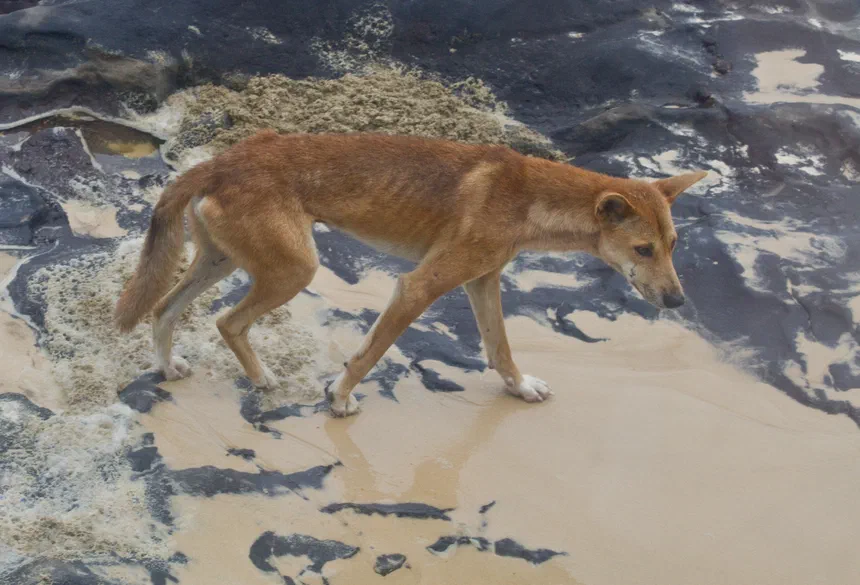
The dingo (Canis lupus dingo) is a wild dog native to Australia and the continent’s largest land predator. Descended from early domestic dogs that arrived with seafaring people thousands of years ago, it has lived independently of humans for so long that it has taken on the look and habits of a wild canid. Dingoes occupy a special place in Australian ecosystems and in Aboriginal culture, where they have long been companions, hunters, and figures of legend.
Appearance and Identification
The dingo is a lean, athletic dog with a broad head, erect ears, a fairly long muzzle, and a bushy tail. Its coat is most often sandy ginger or reddish-tan, though black-and-tan and creamy white variants also occur, and many individuals show white markings on the feet, chest, and tail tip. Adults typically measure about 85 to 120 centimeters in head-and-body length, stand roughly 50 to 60 centimeters at the shoulder, and weigh between 12 and 20 kilograms, with males generally larger than females. Compared with domestic dogs, dingoes have a more wolf-like build, wider skulls, and unusually flexible wrists and necks that let them turn their heads and climb in ways ordinary dogs cannot. Distinguishing pure dingoes from dingo-dog hybrids by sight alone can be difficult, which complicates both study and conservation.
Habitat and Range
Dingoes live throughout mainland Australia, from the arid deserts of the interior to tropical wetlands, alpine areas, grasslands, and the edges of forests. They are absent from Tasmania, which they never reached, and their distribution on the mainland is shaped in part by the dingo fence, one of the longest barriers in the world, built to keep them out of southeastern sheep country. Closely related wild dogs also occur across parts of Southeast Asia. Within their range, dingoes are highly adaptable, ranging over large territories and drawing on scarce water in dry regions.
Diet
The dingo is primarily a carnivore and an opportunistic hunter. Its diet is dominated by mammals, including kangaroos, wallabies, rabbits, wombats, and smaller rodents, but it also takes birds, reptiles, and insects, and readily scavenges carrion when the chance arises. Small prey is usually caught by lone animals, while larger targets such as adult kangaroos are typically pursued by cooperating pack members. In areas altered by people, dingoes may also feed on livestock and human refuse, a habit that puts them in conflict with farmers. As a top predator, the dingo helps regulate populations of herbivores and introduced species.
Behavior
Dingoes are intelligent and social, though their grouping is flexible. Some live largely solitary lives while others form stable packs of several related individuals that share and defend a territory. Packs are organized around a dominant breeding pair, and members communicate through scent marking and a range of vocalizations. Unlike domestic dogs, dingoes rarely bark; instead they howl, often in chorus, to keep in contact across distances and to advertise their presence to neighbors. They are most active around dawn, dusk, and at night, and are known for their curiosity and problem-solving ability.
Life Cycle and Reproduction
Dingoes usually breed once a year, with mating concentrated in the cooler months. After a gestation of about nine weeks, the female gives birth in a den, often a hollow log, cave, or enlarged burrow, to a litter that commonly numbers four to six pups. In an established pack, typically only the dominant pair breeds, and other members may help feed and guard the young. Pups are weaned at around two months and begin accompanying adults on hunts as they grow, reaching independence within their first year and sexual maturity at one to two years. In the wild dingoes generally live about seven to ten years, though survival varies with food, drought, and human pressures.
Conservation Status
The dingo is assessed as Vulnerable by the IUCN, and its long-term future is clouded by interbreeding with domestic and feral dogs, which threatens to dilute the genetically distinct wild population. Control programs using fencing, trapping, and poison baiting, aimed at protecting livestock, also reduce dingo numbers in many regions. At the same time, ecologists increasingly recognize the dingo’s value as an apex predator that can suppress invasive foxes and cats and help keep grazing pressure in check. Balancing these roles with the concerns of pastoralists remains a central challenge in Australian wildlife management.
Frequently Asked Questions
Is a dingo a dog or a wolf? The dingo is a type of wild dog descended from early domestic dogs, but after thousands of years living independently in Australia it behaves much like a wild canid and is often treated as its own distinct form.
Why do dingoes howl instead of bark? Dingoes communicate mainly by howling, which carries far across open country and helps pack members stay in contact and mark territory; barking, so common in domestic dogs, is rare in dingoes.
Are dingoes dangerous to people? Dingoes generally avoid humans, but individuals that lose their fear through feeding can become bold, so people are strongly advised never to feed them and to keep a respectful distance, especially where dingoes and tourists mix.