Mammals Guide
Kirk's Dik-dik
What Is a Kirk’s Dik-dik? Kirk’s dik-dik (Madoqua kirkii) is one of the smallest antelopes in the world, a delicate, big-eyed browser of Africa’s dry scrublands. Its unusual name is said to echo the alarm call the …
At a glance
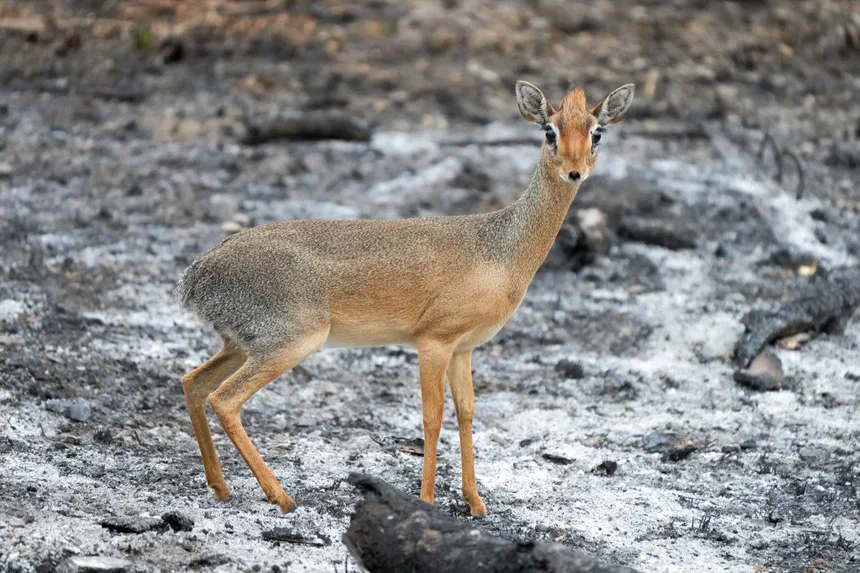
Image: Giles Laurent — CC BY-SA 4.0 · source
What Is a Kirk’s Dik-dik?
Kirk’s dik-dik (Madoqua kirkii) is one of the smallest antelopes in the world, a delicate, big-eyed browser of Africa’s dry scrublands. Its unusual name is said to echo the alarm call the animals make when startled, a sharp “zik-zik” whistle as they dash for cover. Despite their tiny size, dik-diks are hardy survivors of some of the continent’s most arid country.
Appearance and Identification
Standing only about knee-high to a person, Kirk’s dik-dik has a soft, grizzled gray-brown coat over the back and sides, fading to white or cream on the belly, chin, and inner legs. A patch of reddish or rusty fur often marks the crown, sometimes raised into a small crest. The muzzle ends in a slightly elongated, flexible snout that helps cool the blood and reduce water loss. Large dark eyes are ringed by a conspicuous band of pale skin, and a black preorbital gland sits as a dark spot just below the inner corner of each eye. Only males grow horns, which are short, ridged spikes usually just 3-11 cm long and often partly hidden by the crown tuft.
Habitat and Range
Kirk’s dik-dik lives in dry, brushy landscapes across two separated areas of Africa: one population in East Africa (chiefly Tanzania, Kenya, and Somalia) and another in the southwest (Namibia and southern Angola). It favors thornbush thickets, scrub, and dense woodland edges where low cover provides shade and escape routes. These antelopes avoid tall, open grassland, sticking to habitats with plenty of shrubs. They are remarkably independent of open water and can meet much of their moisture needs from the plants they eat.
Diet
As dedicated browsers, dik-diks feed selectively on the leaves, tender shoots, buds, flowers, and fruit of shrubs and low trees, along with some herbs. Their small, pointed muzzle lets them pick out the most nutritious, easily digested plant parts. Because they extract water from their food and produce very concentrated urine and dry dung, they can go long stretches without drinking. Feeding tends to peak in the cooler hours of morning and evening, with rest and rumination during the heat of the day.
Behavior
Kirk’s dik-diks are typically seen alone or in monogamous pairs, sometimes accompanied by a single offspring. A pair defends a small, well-defined territory, which both partners mark using dung middens and a sticky black secretion from the preorbital glands smeared onto twigs. They are most active around dawn and dusk and shelter in shade during midday heat. When alarmed, a dik-dik freezes, then bursts away in a zigzagging run, giving its distinctive whistling call, which also warns other animals of danger.
Life Cycle and Reproduction
Pairs form lasting bonds and may stay together for years. After a gestation of roughly 5.5 to 6 months, the female usually gives birth to a single fawn, and a pair may raise two young per year where conditions allow. Newborns lie hidden in vegetation for the first weeks while the mother returns to nurse. Young dik-diks grow quickly and reach breeding age within their first year, at which point parents drive them out of the territory to find mates and ranges of their own.
Conservation Status
The IUCN lists Kirk’s dik-dik as Least Concern. It remains widespread and locally common across much of its range, and it adapts reasonably well to bushland altered by grazing livestock. Localized pressures include hunting for meat and skins, habitat loss, and predation by cats, jackals, eagles, and pythons, but none currently threaten the species as a whole.
Frequently Asked Questions
Why is it called a dik-dik? The name imitates the shrill “zik-zik” or “dik-dik” alarm whistle the animals make when they flee from danger.
How big is a Kirk’s dik-dik? It is one of the smallest antelopes, standing only about 35-45 cm at the shoulder and weighing roughly 3-7 kg.
Do dik-diks need to drink water? Not much. They obtain most of their moisture from the plants they browse and are well adapted to survive in dry country with little or no free water.