Mammals Guide
Dhole
What Is a Dhole? The dhole (Cuon alpinus), also called the Asiatic wild dog or whistling dog, is a highly social wild canid native to Asia. It is the sole living member of its genus and stands apart from wolves, foxes, …
At a glance
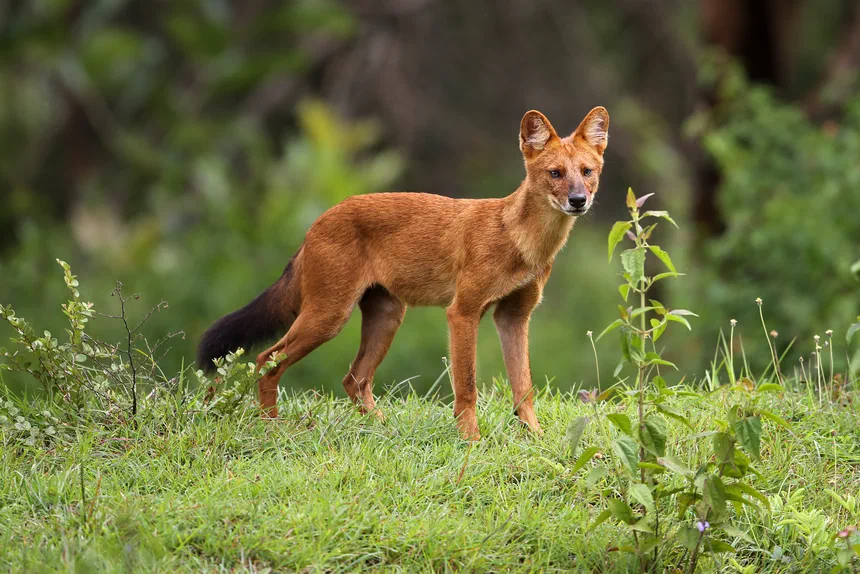
Image: Davidvraju — CC BY-SA 4.0 · source
What Is a Dhole?
The dhole (Cuon alpinus), also called the Asiatic wild dog or whistling dog, is a highly social wild canid native to Asia. It is the sole living member of its genus and stands apart from wolves, foxes, and jackals in both anatomy and behavior. Living and hunting in cooperative packs, the dhole is one of Asia’s most efficient predators.
Appearance and Identification
Dholes have a distinctive rusty-red to reddish-brown coat, though animals in northern or higher-elevation ranges tend to be paler and grayer. The chest and underparts are lighter, and the muzzle is often shaded with darker markings. The most striking feature is a long, bushy tail tipped in black, which the animal carries low or curled during travel. A dhole typically measures around three feet from head to rump, with a tail adding roughly one to one and a half feet, and weighs between 22 and 44 pounds. Compared to a domestic dog, dholes have a shorter, broader muzzle, rounded ears, and a lean, athletic build. Uniquely among canids, they have fewer molars and a specialized dental structure suited to a highly carnivorous lifestyle.
Habitat and Range
Dholes occupy a wide variety of habitats across their range, from dense tropical and dry deciduous forests to alpine meadows, grasslands, and scrub-covered hills. They are found in scattered populations from India and the Himalayan foothills eastward through Southeast Asia and into parts of China. Historically their range was far larger, extending across much of central and northern Asia, but habitat loss and human pressure have fragmented and reduced it dramatically. Today, protected reserves in India and parts of Southeast Asia hold some of the most important remaining populations.
Diet
The dhole is an obligate carnivore that preys mainly on medium to large hoofed animals such as deer, wild boar, and occasionally wild goats and antelope. Because they hunt in packs, dholes can take down prey many times heavier than an individual dog. They rely on stamina and coordination rather than a single killing bite, wearing down prey through persistent pursuit. Smaller mammals, rodents, and even berries or insects may supplement the diet when larger prey is scarce.
Behavior
Dholes are intensely social animals that live in packs typically ranging from about five to a dozen members, though larger groups sometimes form. They communicate through a remarkable range of sounds, including the eerie whistle that gives them the nickname “whistling dog,” which helps coordinate movement across dense cover. Packs cooperate closely, sharing food and defending kills. They are generally active during the day, especially in the cool hours of morning and evening. Despite their formidable hunting ability, dholes are shy and elusive around humans and are rarely seen even where they are relatively common.
Life Cycle and Reproduction
Within a pack, usually a single dominant female breeds, though other members help raise the young. After a gestation of roughly two months, a litter of several pups is born in a den, often a burrow or a sheltered hollow among rocks. The whole pack participates in caring for the young, bringing food and guarding the den. Pups are weaned over the first couple of months and gradually join the pack in hunting as they mature. In the wild, dholes generally live around eight to ten years.
Conservation Status
The dhole is classified as Endangered by the IUCN, with populations continuing to decline. The main threats include habitat loss and fragmentation, depletion of the wild prey they depend on, persecution by people, disease transmitted from domestic dogs, and conflict at the edges of human settlements. Conservation efforts focus on protecting large connected habitats, maintaining healthy prey populations, and reducing disease risk. Because dholes need extensive territory and abundant prey, safeguarding them also helps protect entire forest ecosystems.
Frequently Asked Questions
Are dholes dogs? They belong to the dog family (Canidae) but are a distinct wild species, not closely related to domestic dogs and unable to interbreed with them.
Why are dholes called whistling dogs? Packs use a distinctive whistle-like call to stay in contact and coordinate while moving through thick forest.
Are dholes dangerous to people? No. Dholes are shy and tend to avoid humans, and unprovoked attacks on people are essentially unknown.