Mammals Guide
Desert Cottontail
What Is a Desert Cottontail? The desert cottontail (Sylvilagus audubonii) is a small, familiar rabbit of the arid and semi-arid country of western North America. Also called Audubon’s cottontail, it belongs to the family …
At a glance
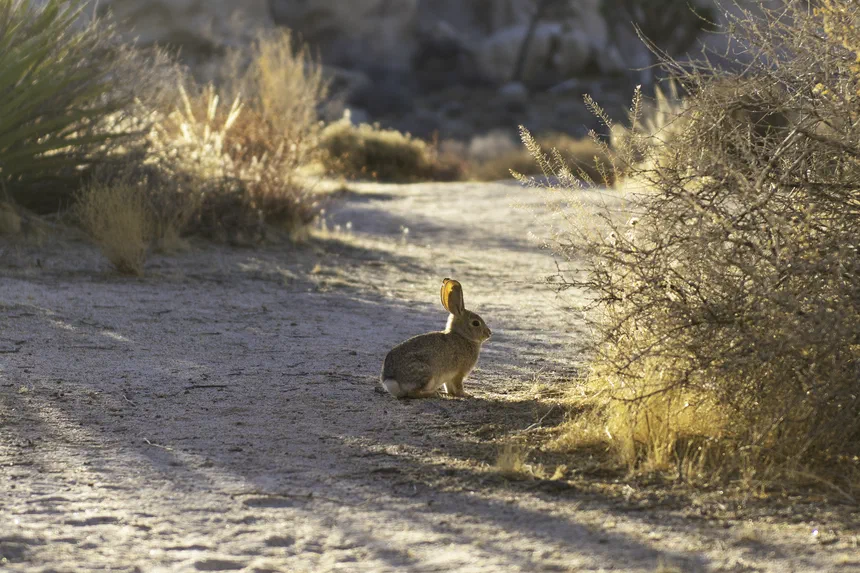
Image: Joshua Tree National Park — Public domain · source
What Is a Desert Cottontail?
The desert cottontail (Sylvilagus audubonii) is a small, familiar rabbit of the arid and semi-arid country of western North America. Also called Audubon’s cottontail, it belongs to the family Leporidae and is one of several closely related cottontail species. Its name comes from the fluffy, cotton-like underside of its short tail.
Appearance and Identification
The desert cottontail is a medium-sized cottontail with grayish-brown to sandy fur on its back, a paler gray-white belly, and a rounded tail that flashes white beneath when the animal runs. Its most distinctive features are its relatively large, thinly furred ears, which help radiate excess body heat in hot climates. Adults typically measure about 14 to 17 inches (36 to 42 cm) in length and weigh roughly 1.5 to 2.6 pounds (0.7 to 1.2 kg). Males and females look alike, though females tend to be slightly larger. The large dark eyes are set high on the head, giving a wide field of view to watch for predators.
Habitat and Range
This rabbit ranges across much of the western and south-central United States, from Montana and the Great Plains south through the Southwest and into northern and central Mexico. It favors dry, open landscapes including deserts, grasslands, sagebrush flats, and brushy scrub, and often lives near creosote, mesquite, or cactus that provide both food and shelter. Desert cottontails are frequently seen along riverbanks, canyon bottoms, and the edges of agricultural land, and they readily adapt to suburban gardens and parks where cover is available.
Diet
The desert cottontail is a strict herbivore. Its diet is dominated by grasses and leafy green plants, but it also eats forbs, twigs, bark, cactus, and the occasional fallen fruit or cultivated vegetable. Like other rabbits, it practices coprophagy, re-ingesting soft nighttime droppings to extract additional nutrients from tough plant material. Because it obtains much of its water from the moisture in vegetation, it can survive long periods without drinking free water, an advantage in its dry habitat.
Behavior
Desert cottontails are most active in the cooler hours of early morning and evening, resting in shade or shallow scrapes during the heat of the day. Unlike jackrabbits, which rely on speed over open ground, cottontails tend to freeze when threatened and then bolt in a zigzag dash for the nearest cover. They are more tolerant of one another than many rabbits and are sometimes seen feeding in loose groups. When alarmed, they may thump a hind foot, and they can climb sloping tree trunks or leap onto low branches to escape or reach food.
Life Cycle and Reproduction
Desert cottontails are prolific breeders, and in warm regions they may reproduce through much of the year. After a gestation of about 26 to 30 days, the female gives birth to a litter of roughly 2 to 4 young, though litters can be larger. The nest is a shallow, fur-lined depression hidden in vegetation. Newborns are altricial, born blind and nearly hairless, but they develop quickly and leave the nest within about two weeks. A female may produce several litters in a single year, which offsets the heavy losses this species suffers to predators.
Conservation Status
The desert cottontail is listed as Least Concern by the IUCN. It is widespread and common throughout its range, with a large and stable population, and it tolerates human-altered landscapes well. As a key prey animal, it supports many predators including coyotes, bobcats, foxes, hawks, owls, and snakes. No major conservation concerns affect the species as a whole, though local numbers rise and fall with rainfall, food availability, and disease.
Frequently Asked Questions
Is the desert cottontail the same as a jackrabbit? No. Jackrabbits are hares, with much longer ears and legs and young that are born furred and mobile. Desert cottontails are true rabbits and are smaller, with shorter ears and helpless newborns.
Do desert cottontails need to drink water? Rarely. They get most of their moisture from the plants they eat and can go long stretches without drinking, which suits their dry habitats.
Are desert cottontails active during the day? They are most active at dawn and dusk. During hot daytime hours they usually rest in shade or a shallow form to avoid overheating.