Mammals Guide
Deer Mouse
What Is a Deer Mouse? The deer mouse (Peromyscus maniculatus) is a small, widespread rodent native to much of North America. It belongs to the genus Peromyscus, the New World mice, and is named for its agile, deer-like …
At a glance
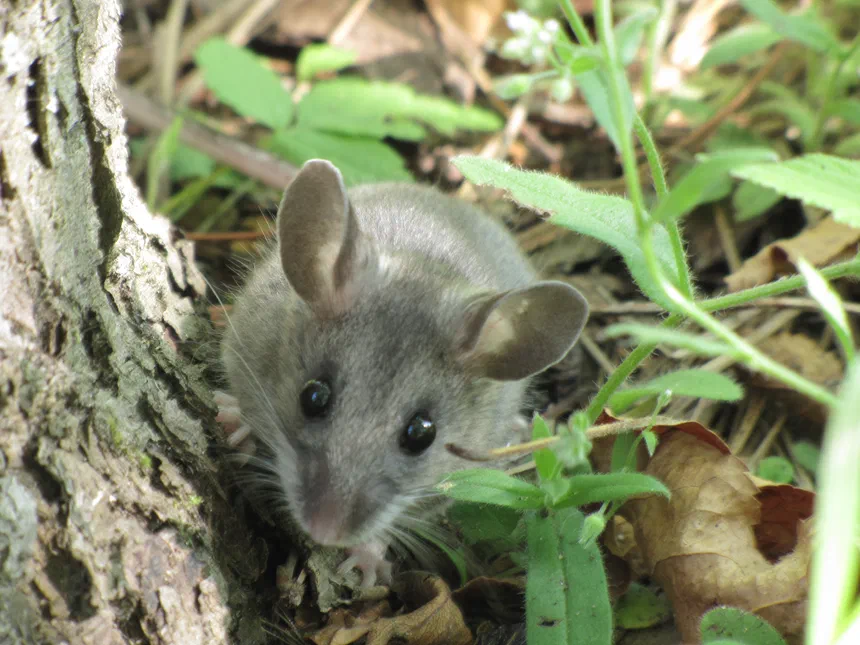
Image: Seney Natural History Association — CC BY-SA 2.0 · source
What Is a Deer Mouse?
The deer mouse (Peromyscus maniculatus) is a small, widespread rodent native to much of North America. It belongs to the genus Peromyscus, the New World mice, and is named for its agile, deer-like coloring and quick movements. Despite its modest size, it is one of the most abundant and ecologically important mammals across the continent.
Appearance and Identification
Deer mice are compact rodents with large, dark, prominent eyes and big, thinly furred ears. Their fur is soft and typically grayish-brown to reddish-brown on the back and sides, contrasting sharply with a clean white belly, throat, and feet. The tail is often distinctly bicolored, dark above and pale below. Adults generally measure around 12 to 20 centimeters in total length, roughly half of which is tail, and weigh in the range of 10 to 30 grams. Coloring varies geographically, with woodland populations tending to be darker and prairie forms lighter.
Habitat and Range
Few North American mammals occupy as broad a range as the deer mouse. The species is found from northern Canada and Alaska south through the United States and into Mexico. It thrives in an extraordinary variety of environments, including grasslands, deciduous and coniferous forests, deserts, brushy areas, alpine meadows, and farmland. Deer mice also readily move into sheds, barns, cabins, and homes, especially as temperatures drop in autumn and winter. This adaptability across elevations and climates helps explain their remarkable abundance.
Diet
Deer mice are opportunistic omnivores with a diet that shifts by season and locality. Seeds and nuts form a dietary staple, supplemented by fruits, berries, fungi, and green plant material. They also consume insects and other invertebrates, particularly in spring and summer when such prey is plentiful. Like many rodents, deer mice cache surplus food in burrows or sheltered nooks to draw on during lean months. Their foraging plays a meaningful role in dispersing seeds and fungal spores.
Behavior
These mice are chiefly nocturnal, spending daylight hours resting in nests built from shredded plant fibers, fur, and other soft materials tucked into burrows, logs, or wall cavities. They are agile climbers and capable jumpers, moving nimbly through vegetation. Deer mice are generally more tolerant of one another during cold weather, sometimes huddling communally to conserve warmth. Home ranges are modest, and individuals communicate through scent as well as high-pitched vocalizations. As a major prey item for owls, foxes, snakes, weasels, and many other predators, deer mice occupy a central place in food webs.
Life Cycle and Reproduction
Deer mice are prolific breeders, which offsets their high mortality rate. Where climate permits, breeding can occur across much of the year, with females producing several litters annually. After a gestation of roughly three weeks, a litter of about three to six young is born blind and hairless. The pups develop quickly, are weaned within a few weeks, and may reach breeding age in as little as six to eight weeks. Few individuals survive a full year in the wild, though captives can live considerably longer.
Conservation Status
The deer mouse is classified as Least Concern by the IUCN. It is abundant, widespread, and highly adaptable, facing no significant conservation threats. Populations can fluctuate with food supply and weather but remain robust overall. The species is, however, of note to public health: deer mice are a primary reservoir for hantaviruses in North America, and contact with their droppings or urine can pose a risk to people, warranting caution when cleaning infested structures.
Frequently Asked Questions
Are deer mice dangerous to humans? They are not aggressive, but they can carry hantavirus and other pathogens. Care should be taken to ventilate and safely clean areas with droppings rather than sweeping dust into the air.
How can you tell a deer mouse from a house mouse? Deer mice have a sharply two-toned coat, a clean white belly and feet, and a bicolored tail, while house mice are more uniformly gray-brown with a nearly hairless, single-colored tail.
How long do deer mice live? Most survive less than a year in the wild due to heavy predation, though individuals in protected conditions can live several years.