Mammals Guide
Damaraland Mole-Rat
What Is a Damaraland Mole-Rat? The Damaraland mole-rat (Fukomys damarensis) is a burrowing rodent native to the arid regions of southern Africa. It is one of only two mammals known to be eusocial, meaning it lives in …
At a glance
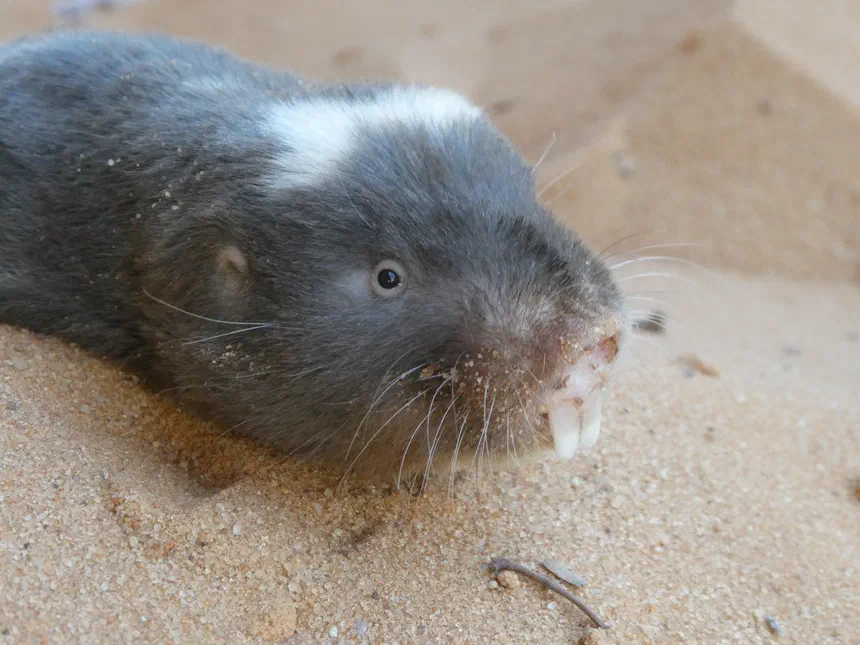
Image: Albert Lechêne — CC BY-SA 4.0 · source
What Is a Damaraland Mole-Rat?
The Damaraland mole-rat (Fukomys damarensis) is a burrowing rodent native to the arid regions of southern Africa. It is one of only two mammals known to be eusocial, meaning it lives in cooperative colonies built around a single breeding female and dependent, non-reproducing helpers, much like social insects.
Appearance and Identification
Damaraland mole-rats are stout, cylindrical rodents adapted for a life spent almost entirely underground. They typically measure around 15 to 20 centimeters in body length and weigh somewhere between 100 and 280 grams, with the breeding queen usually being the largest and heaviest individual in a colony. Their skin ranges from pinkish-brown to a slate-gray tone and is covered with only sparse, fine hair, and many individuals show a distinctive white patch on the top of the head. Their eyes are tiny and vision is poor, but their sense of touch and smell is acute. Prominent, ever-growing incisors project in front of the lips, allowing the animal to dig without swallowing soil.
Habitat and Range
This species occupies the sandy and arid to semi-arid soils of southern Africa, with a range that includes parts of Namibia, Botswana, Zambia, Zimbabwe, and northern South Africa. They favor loose, workable soils in savanna and scrubland where they can excavate extensive tunnel systems. A single colony’s network of burrows can stretch for well over a kilometer in total length, connecting foraging areas, food stores, nesting chambers, and latrines. Because they rarely surface, their presence is often revealed only by mounds of pushed-up soil.
Diet
Damaraland mole-rats are strict herbivores that feed on the underground storage organs of plants, including roots, tubers, corms, and bulbs. Large tubers are an especially valuable resource, and the mole-rats will nibble away at them gradually while often leaving the plant alive, allowing the food source to regenerate. Because rain is unpredictable in their habitat, colonies store surplus food in dedicated chambers to buffer against lean periods. They obtain most of their water from the moisture in the plant tissue they consume.
Behavior
The defining trait of this species is its eusocial organization. A colony may contain anywhere from a handful to around forty individuals, but typically only one female and one or two males reproduce. The remaining animals act as workers, cooperating to dig tunnels, gather food, care for pups, and defend the burrow. Digging is a team effort: individuals form a chain to move soil back through the tunnel and out to the surface. This cooperative labor is thought to be essential for surviving in hard, dry soils where food is patchy and digging is energetically costly. Non-breeding members suppress their own reproduction while they remain in the natal colony.
Life Cycle and Reproduction
Reproduction is monopolized by the dominant queen, who mates with one or a few breeding males. After a gestation of roughly three months, she gives birth to a litter that commonly numbers two to five pups, though larger litters occur. The young are weaned within a few weeks and are cared for by older siblings and other colony members. Non-breeding helpers remain physiologically capable of reproduction but stay reproductively dormant unless they disperse and found or join a new colony, often after rains soften the soil enough to allow travel. Breeding individuals are notably long-lived for rodents of their size, with lifespans that can reach 15 years or more.
Conservation Status
The Damaraland mole-rat is currently listed as Least Concern by the IUCN. It has a wide distribution across southern Africa, occurs in a number of protected areas, and faces no major range-wide threats. Its subterranean lifestyle also shields it from many pressures that affect surface-dwelling wildlife. As with many burrowing species, localized populations could be affected by intensive land conversion, but no significant population decline is currently recognized.
Frequently Asked Questions
Are Damaraland mole-rats blind? Not completely. Their eyes are very small and vision is poor, but they can perceive light. They rely mainly on touch, smell, and vibration to navigate their dark tunnels.
Why are they called eusocial? Like ants, bees, and naked mole-rats, they live in colonies where a single female breeds and the rest act as non-reproducing helpers who share the work of digging, foraging, and raising young.
Do they ever come above ground? Rarely. They spend nearly their entire lives underground, surfacing only briefly, most often when young animals disperse to establish new colonies after rain.