Mammals Guide
Dall Sheep
What Is a Dall Sheep? The Dall sheep (Ovis dalli) is a wild mountain sheep native to the subarctic ranges of Alaska and northwestern Canada. It is best known for the pure white coat of its northern populations and for …
At a glance
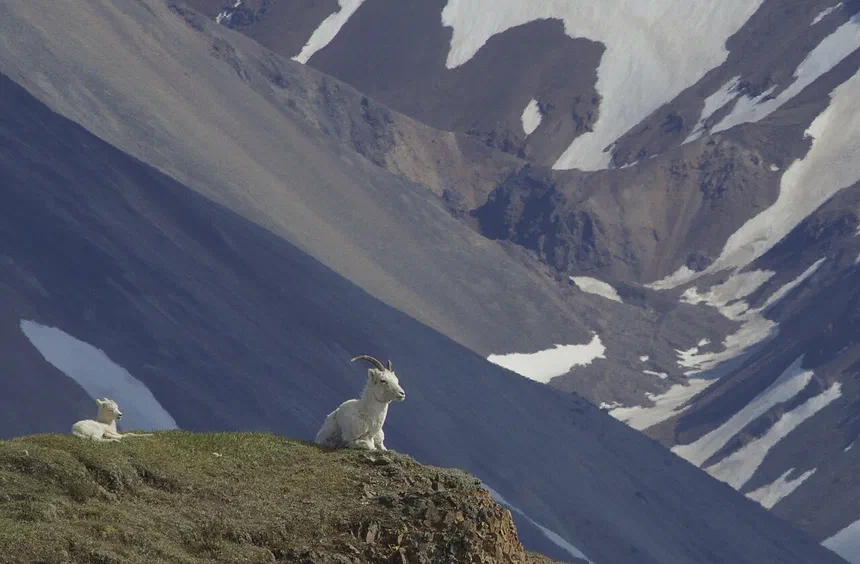
Image: Gregory "Slobirdr" Smith — CC BY-SA 2.0 · source
What Is a Dall Sheep?
The Dall sheep (Ovis dalli) is a wild mountain sheep native to the subarctic ranges of Alaska and northwestern Canada. It is best known for the pure white coat of its northern populations and for the heavy, spiraling horns carried by mature rams. Closely related to the bighorn sheep, it is one of North America’s most iconic high-country mammals.
Appearance and Identification
Dall sheep are medium-sized, sturdily built animals adapted to rugged terrain. Northern populations are almost entirely white, while a darker southern form, sometimes called the Stone sheep, ranges from slate gray to nearly black with a paler rump and muzzle. Adults stand roughly 0.8 to 1 meter at the shoulder and measure about 1.3 to 1.8 meters in body length.
Both sexes grow horns, but they differ sharply. Rams develop massive, amber-colored horns that curl back and around in a broad spiral, reaching a full circle in older males. Ewes have shorter, more slender, gently curved horns. Growth rings, or annuli, on the horns can be used to estimate an animal’s age. The hooves are hard-edged yet somewhat flexible, giving reliable grip on rock.
Habitat and Range
This species lives in mountainous country across Alaska, the Yukon, and parts of British Columbia and the Northwest Territories. Dall sheep favor a combination of open alpine ridges and meadows for feeding set close to steep, rocky slopes and cliffs that serve as escape terrain from predators. They generally avoid dense forest, preferring high, exposed ground where they can see danger approaching.
Seasonal movements are often modest, with animals shifting between higher summer feeding areas and lower, wind-swept winter ranges where snow is thin enough to expose forage.
Diet
Dall sheep are herbivores that graze and browse on a range of alpine plants. In summer they feed heavily on grasses, sedges, and broad-leaved flowering plants, building fat reserves during the short growing season. In winter their diet narrows to dried grasses, lichens, and woody shrubs found on slopes swept clear of deep snow. Many animals visit natural mineral licks in late spring to obtain salts and minerals.
Behavior
Dall sheep are social and typically live in loosely organized bands. Ewes, lambs, and young animals form nursery groups, while mature rams tend to gather in separate bachelor bands for much of the year. They are active mainly during daylight, alternating between feeding and resting.
Sharp eyesight and a preference for open ground help them detect wolves, coyotes, bears, and golden eagles, and they flee toward cliffs where their climbing ability gives them an advantage. Among rams, social rank is closely tied to horn size. During the autumn rut, males clash by rearing up and driving their horns together in loud head-to-head contests.
Life Cycle and Reproduction
Mating takes place in late autumn, generally November to early December. After a gestation of roughly six months, ewes give birth in late spring, usually to a single lamb. Females often seek out steep, secluded ground to lamb, which helps shield newborns from predators.
Lambs can stand and move within a day and follow their mothers closely, nursing for several months while gradually shifting to plant foods. Ewes typically first breed at two to three years of age. Rams may be capable of breeding earlier but usually do not compete successfully until they are older and have grown larger horns. In the wild, Dall sheep commonly live about 10 to 15 years, with survival strongly influenced by winter severity and predation.
Conservation Status
The Dall sheep is currently listed as Least Concern by the IUCN, and populations across its remote northern range remain relatively secure. Numbers can nonetheless fluctuate sharply with harsh winters, deep or icy snow, and disease. Climate-driven changes to alpine vegetation and snow conditions, along with regulated hunting, are the main factors wildlife managers monitor to keep populations stable.
Frequently Asked Questions
Are Dall sheep the same as bighorn sheep? No, though they are close relatives. Both belong to the group of North American wild sheep, but Dall sheep are generally smaller, live farther north, and northern populations are white rather than brown.
Why are many Dall sheep pure white? The white coat of northern populations blends with snowy, high-elevation surroundings for much of the year. Southern Stone sheep of the same species are much darker.
How do Dall sheep survive on cliffs? Their hard-edged, flexible hooves grip rock well, and their strong climbing ability lets them retreat to steep terrain that most predators cannot follow.