Mammals Guide
Coyote
What Is a Coyote? The coyote (Canis latrans) is a medium-sized member of the dog family, Canidae, native to North and Central America. Highly adaptable and intelligent, it has expanded its range dramatically over the …
At a glance
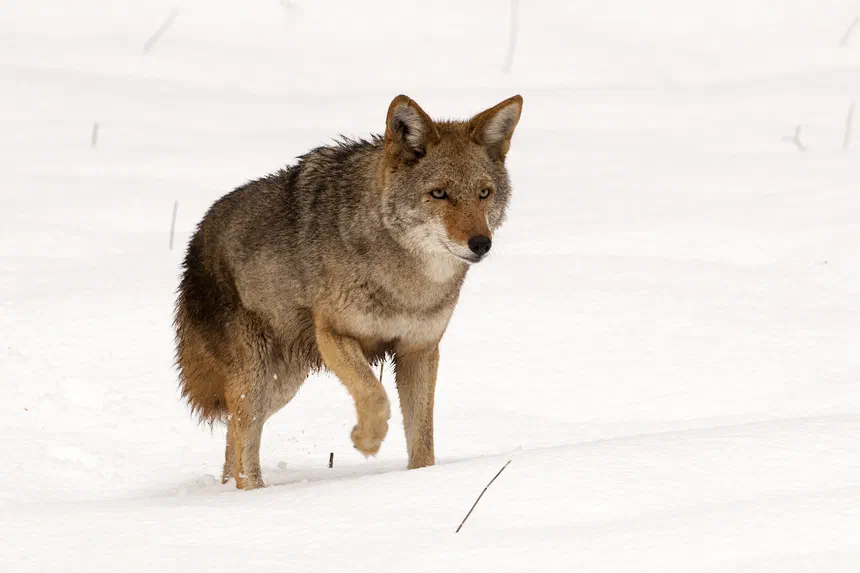
Image: Yathin S Krishnappa — CC BY-SA 3.0 · source
What Is a Coyote?
The coyote (Canis latrans) is a medium-sized member of the dog family, Canidae, native to North and Central America. Highly adaptable and intelligent, it has expanded its range dramatically over the past century and now thrives in habitats ranging from remote deserts to busy city neighborhoods. Its scientific name means “barking dog,” a nod to its varied and far-carrying vocalizations.
Appearance and Identification
The coyote resembles a slender, medium-sized dog with a narrow, pointed muzzle, large erect ears, and keen yellow eyes. Its coat is typically grayish-brown to yellowish-gray, often with rust-colored legs, ears, and flanks and a paler throat and belly, though color varies with region and season. The bushy tail is carried low, especially when running, and usually ends in a black tip. Adults generally measure about 75 to 100 centimeters in head-and-body length, stand roughly 45 to 55 centimeters at the shoulder, and weigh between 7 and 20 kilograms, with northern animals tending to be larger than those in the south. The coyote is easily confused with wolves and domestic dogs but is smaller and more lightly built than a gray wolf and runs with its tail held down rather than straight out.
Habitat and Range
Coyotes occupy an enormous geographic range that stretches from Alaska and northern Canada south through the United States and Mexico into Central America as far as Panama. They are habitat generalists, living in prairies, deserts, mountains, forests, farmland, and increasingly in suburban and urban environments. Historically associated with the open plains of the American West, the coyote spread eastward across the continent during the twentieth century, filling ecological space left by the decline of larger predators such as wolves. This flexibility in habitat use is a key reason the species has flourished where many other carnivores have declined.
Diet
The coyote is an opportunistic omnivore with a remarkably broad diet. Small mammals such as mice, voles, ground squirrels, and rabbits form the bulk of its food, but it also hunts birds, reptiles, amphibians, and insects, and readily eats fruit, berries, and grasses when available. Coyotes will scavenge carrion, including deer carcasses, and in some areas they cooperate to bring down larger prey such as deer or pronghorn fawns. In urban settings they may exploit human-associated foods, including garbage, pet food, and small pets left outdoors. This dietary versatility allows the coyote to shift its feeding habits with the seasons and with local conditions.
Behavior
Coyotes are intelligent, wary, and highly communicative. They are famous for their vocalizations, which include howls, yips, barks, and group “yip-howls” that help family members keep in contact and advertise territory. Social organization is flexible: coyotes may live alone, in mated pairs, or in small family packs, depending on food supply and habitat. They are most active at dawn, dusk, and night, particularly near people, and they use scent marking to define territories. Swift runners capable of reaching around 60 kilometers per hour in short bursts, they hunt by stalking and pouncing, and they sometimes form loose hunting partnerships with badgers to catch burrowing rodents.
Life Cycle and Reproduction
Coyotes typically form monogamous breeding pairs that may remain together for several years. Mating occurs in late winter, and after a gestation of about 60 to 63 days the female gives birth in a den to a litter that usually numbers four to seven pups, though larger litters occur when food is plentiful. Both parents help raise the young, and older offspring or other pack members may assist in feeding and guarding the pups. The young are born blind and helpless, emerge from the den after a few weeks, and are weaned by about two months of age. Juveniles begin to disperse in the fall, sometimes traveling long distances to establish their own territories. Most wild coyotes live around six to eight years, though many die younger.
Conservation Status
The coyote is listed as Least Concern by the IUCN and is one of the few large carnivores whose numbers and range have expanded in the modern era. Despite widespread hunting, trapping, and control programs across its range, coyote populations have proven resilient, in part because heavy persecution can trigger compensatory increases in litter size and pup survival. Their success has also brought them into greater contact with people, raising management questions in cities and suburbs. Overall, the coyote is in no danger of extinction and remains a common and ecologically important predator throughout the Americas.
Frequently Asked Questions
Are coyotes dangerous to humans? Attacks on people are rare, as coyotes are usually shy and avoid humans, but individuals that become accustomed to human food can lose their wariness, so feeding them should always be avoided.
How is a coyote different from a wolf? Coyotes are considerably smaller and more slightly built than gray wolves, with narrower muzzles and larger ears relative to the head, and they typically run with the tail held low rather than level.
Why do coyotes howl at night? Howling and group yip-howls help family members locate one another, reunite after hunting, and signal their presence to neighboring coyotes defending nearby territories.