Mammals Guide
Cougar
What Is a Cougar? The cougar (Puma concolor) is a large, slender cat native to the Americas, also widely known as the puma, mountain lion, panther, or catamount. Despite its size, it is not classified among the “big …
At a glance
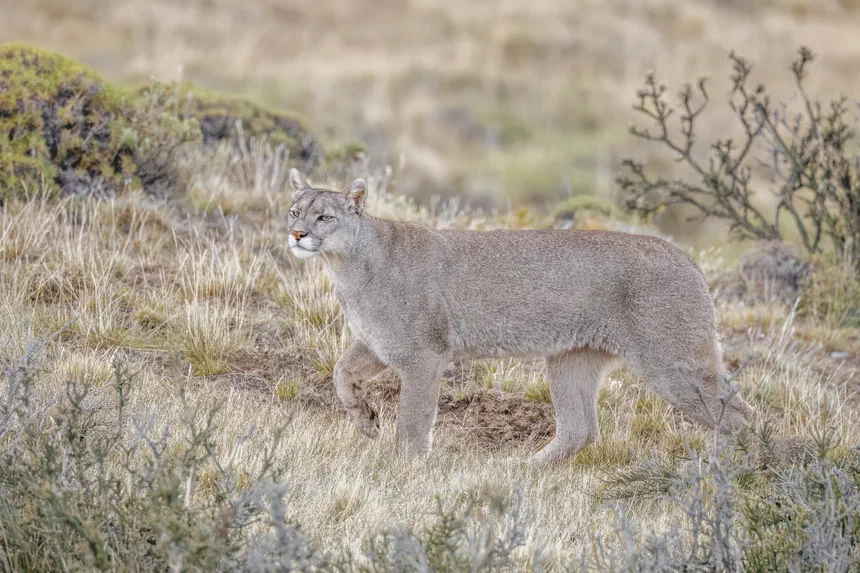
Image: Charles J. Sharp — CC BY-SA 4.0 · source
What Is a Cougar?
The cougar (Puma concolor) is a large, slender cat native to the Americas, also widely known as the puma, mountain lion, panther, or catamount. Despite its size, it is not classified among the “big cats” of the genus Panthera, and it is more closely related to smaller felines. It holds the record for the widest geographic range of any wild land mammal in the Western Hemisphere.
Appearance and Identification
Cougars have a sleek, muscular build with a small, rounded head, short muzzle, and powerful hindquarters that give them exceptional leaping ability. Their coat is typically a uniform tawny or grayish-buff color, with a lighter cream or white throat, chest, and belly, and dark markings on the muzzle, ears, and tail tip. Adults lack the spots and rosettes seen in some other wildcats, though kittens are born spotted and blue-eyed, losing these markings as they mature. Males are noticeably larger than females, and body size increases with distance from the equator. A long, heavy tail, often measuring more than half the body length, aids balance during climbing and pursuit.
Habitat and Range
Few mammals occupy as broad a range of environments as the cougar. It is found from the Canadian Yukon down through the western United States, Central America, and along the length of South America to the southern Andes and Patagonia. Within this vast territory it inhabits montane forests, lowland rainforests, arid deserts, brushlands, swamps, and open grasslands. The primary requirements are adequate cover for stalking prey and a sufficient population of large herbivores. In the eastern United States, breeding populations were largely eliminated, though the Florida panther persists as a small, isolated subpopulation.
Diet
The cougar is an obligate carnivore and an ambush predator. Deer of various species form the mainstay of its diet across much of its range, supplemented by elk, wild sheep, and, farther south, guanacos and other native ungulates. Where large prey is scarce, cougars readily take smaller animals such as raccoons, hares, rodents, and even insects. A hunting cougar relies on stealth, creeping close before delivering a short, explosive rush and a killing bite to the neck or throat. After a kill, it often drags the carcass to a sheltered spot and covers it with leaves and debris, returning to feed over several days.
Behavior
Cougars are solitary and largely territorial, with males maintaining large home ranges that may overlap those of several females. They communicate through scent marks, scrapes, and vocalizations, and are known for a wide repertoire of sounds, including purrs, hisses, and eerie screams, though they cannot roar. Primarily active at dawn, dusk, and night, they are secretive and rarely seen by people. Superb athletes, cougars can leap remarkable horizontal and vertical distances, climb trees with ease, and swim when necessary.
Life Cycle and Reproduction
Breeding can occur year-round, though births often peak in warmer months. After a gestation of roughly three months, a female gives birth to a litter of one to six kittens, typically two or three, in a hidden den among rocks or dense vegetation. The young are born blind and helpless, opening their eyes after about two weeks. They nurse for two to three months and remain with their mother for one to two years, learning to hunt before dispersing to establish their own territories. Females usually reach breeding age by two to three years.
Conservation Status
The cougar is listed as Least Concern by the IUCN, reflecting its wide distribution and adaptability. Nevertheless, many regional populations face pressure from habitat loss, fragmentation, vehicle collisions, and conflict with livestock owners. The Florida panther remains endangered, with only a small population surviving in the southeastern United States. Wildlife corridors, regulated hunting, and coexistence programs are important tools for maintaining healthy cougar populations.
Frequently Asked Questions
Is a cougar the same as a mountain lion? Yes. Cougar, mountain lion, puma, panther, and catamount are all common names for the same species, Puma concolor.
Can cougars roar? No. Unlike lions and tigers, cougars lack the specialized throat structure needed to roar, but they produce purrs, hisses, and distinctive screams.
Are cougars dangerous to humans? Attacks on people are very rare. Cougars are shy and generally avoid humans, though caution is warranted in areas where they live.