Mammals Guide
Cotton-Top Tamarin
What Is a Cotton-Top Tamarin? The cotton-top tamarin (Saguinus oedipus) is a small New World monkey named for the flowing shock of white hair that fans back from its head. One of the world’s smallest primates, it lives …
At a glance
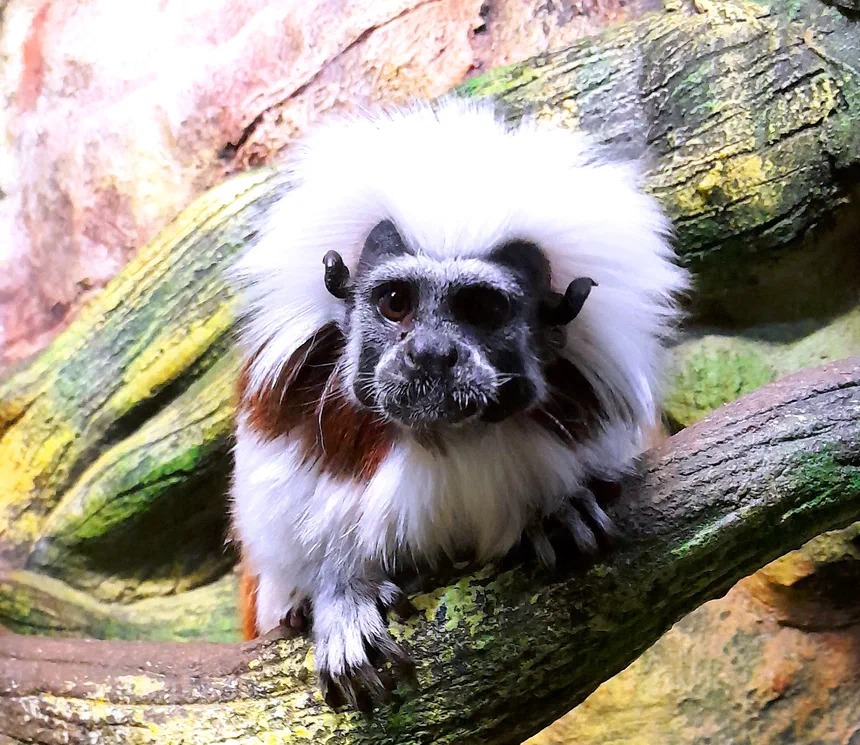
Image: Turtolt — CC BY-SA 4.0 · source
What Is a Cotton-Top Tamarin?
The cotton-top tamarin (Saguinus oedipus) is a small New World monkey named for the flowing shock of white hair that fans back from its head. One of the world’s smallest primates, it lives only in a narrow region of northwestern Colombia and is instantly recognized by its punk-like white crest.
Appearance and Identification
This tiny monkey weighs less than a pound and would fit comfortably in a person’s hands. Its most striking feature is the long, wispy crown of white hair that sweeps back from the forehead over the shoulders. The face is largely bare and dark, framed by that pale crest. The back and shoulders are a mottled brown, while the chest, belly, and inner limbs are creamy white. The rump and upper thighs carry rusty-orange tones. A long, non-prehensile tail, brown at the base and darkening toward the tip, helps with balance among the branches. Like other tamarins and marmosets, cotton-tops have claw-like nails on most digits rather than flat nails, an adaptation that helps them cling to tree trunks.
Habitat and Range
The cotton-top tamarin has one of the most restricted ranges of any primate. It is found only in northwestern Colombia, between the Atrato and Magdalena rivers and the Andes. There it occupies both humid tropical forest and drier deciduous woodland, spending most of its time in the lower and middle levels of the canopy. Much of this forest has been cleared for agriculture and cattle, leaving the species confined to scattered fragments.
Diet
Cotton-top tamarins are opportunistic omnivores. Fruit makes up a large share of the diet, supplemented heavily by insects, which provide protein. They also feed on nectar, tender plant parts, and the sugary gums and saps that seep from tree bark. By moving between fruiting trees and dropping seeds as they travel, these tamarins act as important seed dispersers, helping to regenerate the forests they depend on.
Behavior
These primates are active during the day and highly social, living in cooperative family groups that typically number from about three to nine individuals. Groups defend territories and communicate with a rich repertoire of whistles, chirps, and trills, which researchers have studied as one of the more complex vocal systems among monkeys. Cotton-tops are quick and agile, moving through the branches in short leaps and bounds as they forage. Grooming and shared care of the young help bind the group together.
Life Cycle and Reproduction
Cotton-top tamarins usually have a single dominant breeding female per group, and she commonly gives birth to twins after a gestation of roughly five months. Raising offspring is a group effort: fathers, older siblings, and other group members carry the infants, share food, and help with care, easing the heavy burden of transporting two young at once. Youngsters are weaned within a few months and reach maturity at around one to two years of age. In the wild, individuals may live into their early teens, and captive animals can live longer.
Conservation Status
The cotton-top tamarin is listed as Critically Endangered by the IUCN. Widespread deforestation across its small Colombian range, combined with a long history of capture for the exotic pet trade and past use in biomedical research, has reduced wild numbers dramatically. Today only a few thousand mature individuals are thought to remain. Conservation programs led by Colombian and international groups focus on protecting remaining forest, restoring habitat corridors, and working with local communities to reduce pressure on the species.
Frequently Asked Questions
Why is it called a cotton-top? The name comes from the long, fluffy plume of white hair that fans back over its head and shoulders, resembling a tuft of cotton.
How big is a cotton-top tamarin? Very small. The body is only about 8 to 10 inches long, and the whole animal weighs roughly one pound or less, making it one of the smallest monkeys.
Where do they live? They are found only in a small area of tropical and dry forest in northwestern Colombia, which makes them especially vulnerable to habitat loss.