Mammals Guide
Common Wombat
What Is a Common Wombat? The common wombat (Vombatus ursinus) is a sturdy, burrowing marsupial native to southeastern Australia and Tasmania. Also called the bare-nosed wombat, it is the largest of the burrowing wombats …
At a glance
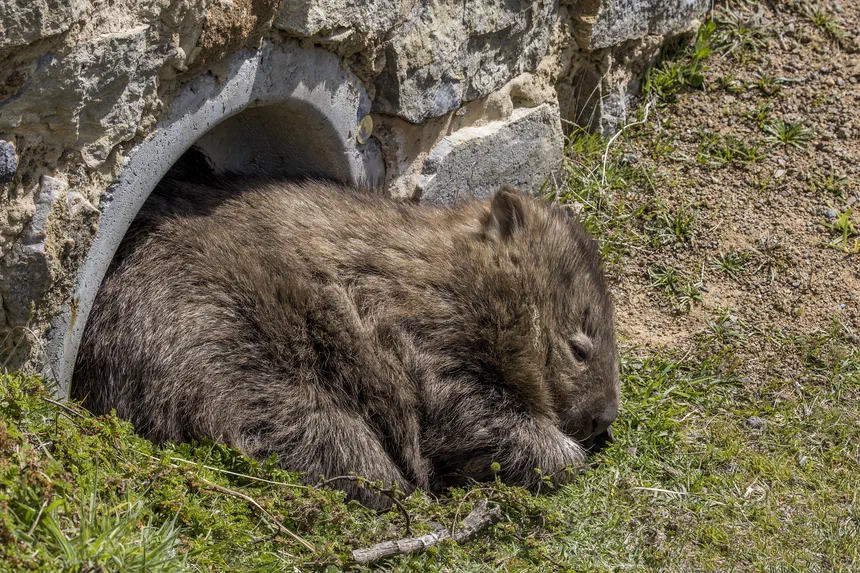
Image: Charles J. Sharp — CC BY-SA 4.0 · source
What Is a Common Wombat?
The common wombat (Vombatus ursinus) is a sturdy, burrowing marsupial native to southeastern Australia and Tasmania. Also called the bare-nosed wombat, it is the largest of the burrowing wombats and one of the world’s biggest burrowing mammals. Like kangaroos and koalas, it is a marsupial, carrying and nursing its young in a pouch.
Appearance and Identification
The common wombat has a compact, barrel-shaped body, short powerful legs, and a stubby tail that is largely hidden by fur. Adults typically measure about 3 to 3.9 feet (0.9 to 1.2 m) in head-body length and weigh roughly 48 to 77 pounds (22 to 35 kg), giving them a low, muscular build ideal for digging.
Its coarse fur ranges from sandy brown and gray to nearly black, helping it blend into varied terrain. The “bare-nosed” name refers to its hairless, granular nose, which distinguishes it from the hairy-nosed wombats. Wombats have small eyes, rounded ears, and strong claws on broad feet suited to excavating soil. Their rodent-like incisors grow continuously and are worn down by chewing tough vegetation.
Habitat and Range
Common wombats occur across southeastern mainland Australia, including parts of New South Wales, Victoria, and southeastern South Australia, as well as throughout Tasmania and some Bass Strait islands. They favor temperate forests, woodlands, heathlands, and coastal scrub, and can also be found in alpine and subalpine country.
The species depends on terrain where it can dig. Wombats construct extensive burrow systems, sometimes many meters long with multiple entrances and chambers. These burrows provide shelter from heat and predators and maintain a stable temperature, allowing the animal to conserve energy in both hot summers and cold winters.
Diet
The common wombat is a strict herbivore. Its diet consists mainly of native grasses, along with sedges, roots, tubers, and occasionally bark and shrubs. It uses its ever-growing front teeth to clip vegetation close to the ground and grinds the fibrous material with its cheek teeth.
Wombats have an exceptionally slow digestive system, which can take many days to process food. This efficient digestion lets them extract maximum nutrients and water from low-quality forage, an adaptation that helps them survive in dry conditions and go long periods with little drinking water.
Behavior
Common wombats are mostly solitary and primarily nocturnal, though in cooler weather they may emerge to feed during the day. They spend the hot daylight hours resting underground and become active at dusk to graze, often traveling well-worn paths between burrows and feeding grounds.
Though they appear slow and clumsy, wombats can run in short bursts at surprising speed when alarmed. They are territorial around their burrows and mark their range with distinctive cube-shaped droppings, an unusual trait thought to help scent-mark prominent spots. When threatened, a wombat may retreat into its burrow and use its tough, cartilage-reinforced rump to block the entrance.
Life Cycle and Reproduction
Common wombats can breed at various times of year, though timing varies with region and conditions. After a short gestation of roughly three to four weeks, the female gives birth to a single tiny, undeveloped young that crawls into her backward-facing pouch. The rear-opening pouch keeps soil out while the mother digs.
The joey remains in the pouch for around six months, then continues to nurse and follow its mother for several more months before becoming independent. Wombats generally reach sexual maturity at around two years of age. In the wild they may live roughly 5 to 15 years, with individuals in captivity sometimes living considerably longer.
Conservation Status
The common wombat is listed as Least Concern on the IUCN Red List, reflecting a broad range and generally stable overall numbers. It remains widespread across much of southeastern Australia and Tasmania.
Local populations still face pressures, however. Vehicle collisions kill many wombats near roads, and habitat loss, competition with livestock, and historical persecution have reduced numbers in some areas. Sarcoptic mange, a disease caused by parasitic mites, can devastate local populations and is a growing conservation concern.
Frequently Asked Questions
Why do wombats produce cube-shaped droppings? Wombats are the only known animals to make cubic feces. The distinctive shape is formed within their intestines and is thought to help the droppings stay in place when used to mark territory on logs, rocks, and other raised surfaces.
Are wombats related to koalas? Yes. Wombats and koalas are both marsupials and are considered close relatives, sharing a common ancestry. Both have backward-facing pouches, an adaptation that suits the wombat’s digging lifestyle.
Are common wombats dangerous to people? Wombats are generally shy and avoid humans, but they are powerful animals. If cornered or handled, they can charge, bite, or scratch, so wild wombats are best observed from a distance.