Mammals Guide
Common Duiker
What Is a Common Duiker? The common duiker (Sylvicapra grimmia), also called the gray or bush duiker, is a small antelope found across much of sub-Saharan Africa. It is the most widespread of the duiker family and the …
At a glance
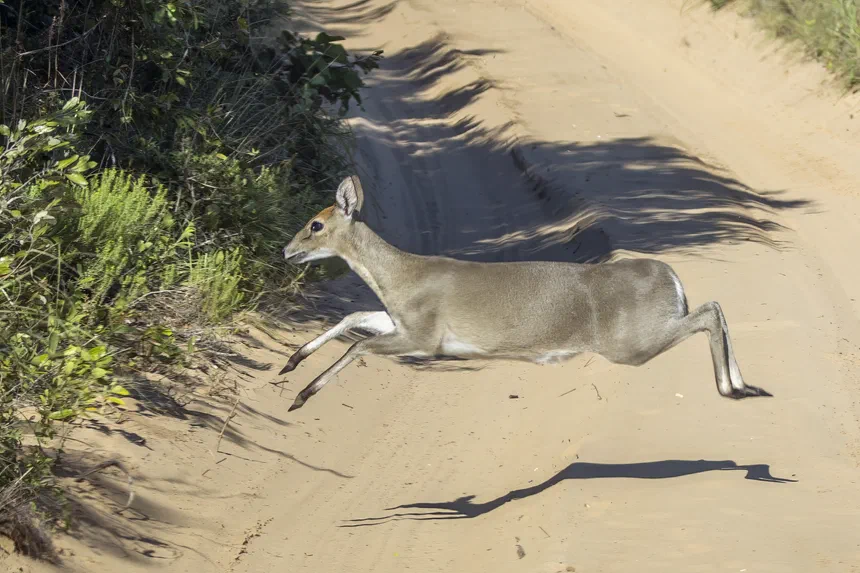
Image: Charles J. Sharp — CC BY-SA 4.0 · source
What Is a Common Duiker?
The common duiker (Sylvicapra grimmia), also called the gray or bush duiker, is a small antelope found across much of sub-Saharan Africa. It is the most widespread of the duiker family and the only one that regularly lives in open savanna rather than dense forest. Its name comes from the Afrikaans word for “diver,” a nod to the way it plunges into cover when startled.
Appearance and Identification
The common duiker is a compact, lightly built antelope standing roughly 45 to 60 centimeters at the shoulder and weighing somewhere between 10 and 25 kilograms, with considerable variation across its wide range. Coat color ranges from grizzled grayish-brown to a warmer reddish-yellow, fading to whitish on the belly and inner legs. A distinctive dark band often runs down the front of the face. Only males typically carry the short, straight, spike-like horns, which usually measure around 7 to 18 centimeters, though horned females occasionally occur. A tuft of hair rises between the ears, and a conspicuous slit-like scent gland sits below each eye.
Habitat and Range
This adaptable antelope occupies a broad swath of sub-Saharan Africa, from Senegal in the west to Ethiopia and down through eastern and southern Africa to the Cape. Unlike its forest-dwelling relatives, the common duiker favors savanna woodland, scrub, bushland, and the edges of forests, wherever there is enough cover to hide in. It tolerates a wide range of altitudes and can persist near farmland and settlements, which helps explain its enduring success across such varied landscapes.
Diet
The common duiker is primarily a browser, feeding on leaves, shoots, fruit, flowers, seeds, and bark rather than grass. It is notably more omnivorous than most antelopes and will readily eat insects, and it has been recorded taking small birds, eggs, lizards, and even carrion on occasion. This dietary flexibility allows it to thrive in habitats where food quality shifts through the seasons. Duikers obtain much of their water from their food and can survive long stretches without drinking.
Behavior
Common duikers are largely solitary and secretive, most active around dawn, dusk, and through the night, though they may feed by day where undisturbed. When alarmed, an individual freezes and then bolts in a series of diving, zigzagging leaps into thick cover, giving the animal its name. Males are territorial and mark their range using the scent glands beneath the eyes. Both sexes are generally quiet, but they can produce loud bleats when caught by a predator. They fall prey to leopards, pythons, large eagles, jackals, and other carnivores.
Life Cycle and Reproduction
Common duikers form loose, temporary pairings for breeding and can reproduce throughout the year in much of their range, sometimes producing more than one calf annually. After a gestation of roughly five to seven months, a single calf is born and remains hidden in vegetation for its first weeks while the mother returns to nurse. Young grow quickly, and females may reach breeding condition within their first year. In the wild, individuals typically live around 8 to 12 years, with some surviving longer in protected settings.
Conservation Status
The IUCN lists the common duiker as Least Concern. Its remarkable adaptability, varied diet, and tolerance of human-altered landscapes have allowed populations to remain widespread and generally stable. It is hunted for bushmeat across much of its range and can be regarded as a crop pest in farming areas, but these pressures have not, so far, threatened the species as a whole. Local declines occur where hunting is intense, yet the common duiker remains one of Africa’s most successful small antelopes.
Frequently Asked Questions
Why is it called a “duiker”? The name comes from the Afrikaans and Dutch word for “diver,” describing how the animal dives headlong into dense brush to escape danger.
Do both males and females have horns? Usually only males grow the short, spike-like horns, though horned females turn up occasionally in some populations.
Is the common duiker endangered? No. It is classified as Least Concern by the IUCN, thanks to its wide range, flexible diet, and ability to live alongside people.