Mammals Guide
Collared Peccary
What Is a Collared Peccary? The collared peccary (Dicotyles tajacu) is a medium-sized, pig-like mammal native to the Americas. Although it resembles a wild boar, it belongs to a separate New World family, the …
At a glance
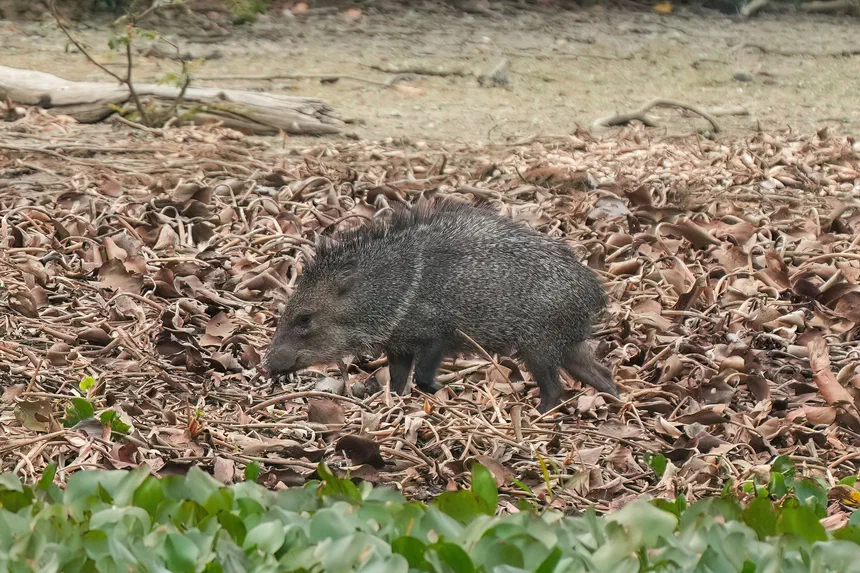
Image: Giles Laurent — CC BY-SA 4.0 · source
What Is a Collared Peccary?
The collared peccary (Dicotyles tajacu) is a medium-sized, pig-like mammal native to the Americas. Although it resembles a wild boar, it belongs to a separate New World family, the Tayassuidae, and is not a true pig. It is also widely known as the javelina.
Appearance and Identification
Collared peccaries have a stocky body covered in coarse, bristly hair that is grizzled grayish-black in color. A band of paler fur runs across the shoulders and around the neck, forming the “collar” that gives the animal its name. Adults typically measure about 3 to 3.3 feet (90 to 100 cm) in length and stand roughly 20 to 24 inches (50 to 60 cm) at the shoulder, weighing between 35 and 60 pounds (16 to 27 kg). They have a large head, a flexible snout ending in a disk-like nose, short slender legs, and straight upper canine teeth that point downward rather than curving outward like a boar’s tusks. A scent gland on the lower back produces a musky odor used in communication.
Habitat and Range
The species is remarkably adaptable and occupies a wide range of environments. Its distribution stretches from the southwestern United States, including Arizona, New Mexico, and Texas, southward through Mexico and Central America and into much of South America. Collared peccaries thrive in desert scrub, thorn forest, tropical rainforest, dry woodland, and grassland. In arid regions they often rely on prickly pear cactus for both food and moisture, while in the tropics they use dense vegetation for cover.
Diet
Collared peccaries are opportunistic omnivores with a diet dominated by plant material. They feed heavily on roots, bulbs, tubers, fruits, seeds, and green vegetation, and in the desert they consume large quantities of prickly pear pads and fruit despite the spines. Their strong jaws and grinding teeth let them process tough, fibrous foods. They also eat invertebrates, small vertebrates, eggs, and carrion when the opportunity arises, and they use their tough snouts to root through soil and leaf litter in search of food.
Behavior
These animals are highly social and live in cohesive herds that usually number from about 5 to 15 individuals, though larger groups occur. Herd members forage, rest, and travel together and recognize one another largely through scent, rubbing their scent glands on rocks, vegetation, and each other to maintain a shared group odor. Peccaries are most active during the cooler parts of the day, shifting toward dawn and dusk in hot climates. When threatened, a herd may bunch together, clatter its teeth, and release strong musk; peccaries can defend themselves with their sharp canines, though they more often flee. Their eyesight is relatively poor, so they depend heavily on smell and hearing.
Life Cycle and Reproduction
Collared peccaries can breed throughout the year, with births often peaking during seasons of greater rainfall and food abundance. After a gestation period of roughly 140 to 150 days, a female typically gives birth to two young, though litters of one to three occur. The precocial newborns can walk within hours and follow the herd soon after birth. They are weaned within a couple of months and reach sexual maturity at around 11 months to a year. In the wild, collared peccaries commonly live about 8 to 12 years, and individuals in captivity may live considerably longer.
Conservation Status
The collared peccary is listed as Least Concern by the IUCN. It has a broad geographic range, occupies many habitat types, and maintains large, stable populations across much of that range. It is hunted for meat and hides in many areas and is sometimes viewed as an agricultural nuisance, but these pressures have not caused broad declines. Localized threats include habitat loss and unregulated hunting, yet overall the species remains common and widespread.
Frequently Asked Questions
Is a collared peccary the same as a pig? No. Although peccaries look and behave somewhat like pigs, they belong to a different New World family and differ in tooth structure, scent glands, and stomach anatomy.
Are javelinas dangerous to people? They generally avoid humans and prefer to flee, but a cornered or startled peccary can bite. Problems usually arise only when animals are fed or feel trapped.
Why do they smell so strong? A gland on the lower back releases a musky secretion that peccaries use to mark territory, recognize herd mates, and reinforce group bonds.