Mammals Guide
Clouded Leopard
What Is a Clouded Leopard? The clouded leopard (Neofelis nebulosa) is a medium-sized wild cat native to the forests of Southeast Asia and the eastern Himalayas. Despite its name, it is not closely related to the true …
At a glance
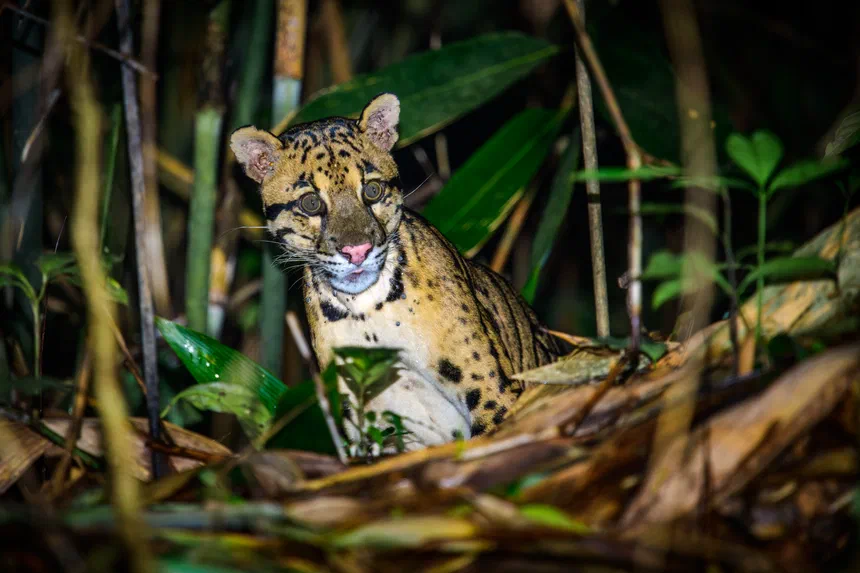
Image: Rushenb — CC BY-SA 4.0 · source
What Is a Clouded Leopard?
The clouded leopard (Neofelis nebulosa) is a medium-sized wild cat native to the forests of Southeast Asia and the eastern Himalayas. Despite its name, it is not closely related to the true leopard and instead belongs to its own genus, Neofelis. It is best known for the large, cloud-like markings that give the species its common name and for being one of the most accomplished climbers among cats.
Appearance and Identification
The clouded leopard is instantly recognizable by its distinctive coat, which is patterned with large, irregular blotches edged in dark brown or black and filled with a paler tawny or grayish tone. These “cloud” shapes run along the body and give way to solid spots on the head and legs. The cat has a stocky, muscular build, short legs, broad paws, and an exceptionally long tail that can nearly equal the length of its body, helping it balance in the trees. Relative to its body size, the clouded leopard has the longest canine teeth of any living cat, a feature that has drawn frequent comparisons to the extinct saber-toothed cats.
Habitat and Range
Clouded leopards inhabit a range of forested environments, favoring dense tropical and subtropical evergreen forests but also occurring in dry woodlands, mangroves, and grasslands near forest cover. Their range extends across mainland Southeast Asia, including parts of Nepal, Bhutan, northeastern India, Myanmar, Thailand, and southern China, as well as the Malay Peninsula. The closely related Sunda clouded leopard, found on Borneo and Sumatra, is now recognized as a separate species. Clouded leopards are highly arboreal and spend much of their time in the canopy, though they also travel and hunt on the ground.
Diet
As an obligate carnivore, the clouded leopard preys on a variety of animals. Its diet includes tree-dwelling and ground species such as gibbons and other primates, small deer, wild pigs, squirrels, birds, and porcupines. Powerful limbs and a long tail allow it to ambush prey from branches or stalk quietly through the undergrowth. Flexible ankle joints let it climb down trees head-first and even hang from branches by its hind feet, giving it access to prey and escape routes that many other cats cannot reach.
Behavior
Clouded leopards are solitary and secretive, and much of their behavior in the wild remains poorly documented. They are thought to be most active during the twilight hours and at night, resting in trees during the heat of the day. Their remarkable climbing ability is aided by rotating hind limbs, sharp retractable claws, and their balancing tail. Individuals communicate through scent marking and a range of vocalizations, including growls, hisses, and a soft chuffing sound used in friendly contexts.
Life Cycle and Reproduction
Female clouded leopards give birth after a gestation period of roughly three months, typically producing a litter of one to five cubs, with two being common. Cubs are born blind and helpless, with darker, more solid markings that develop into the adult cloud pattern as they mature. They are weaned at a few months of age and reach independence within the first year or two of life. Sexual maturity is generally reached by around two years. In captivity, clouded leopards may live somewhat longer than in the wild, where survival is harder to document.
Conservation Status
The clouded leopard is classified as Vulnerable by the IUCN, with populations declining across much of its range. The primary threats are habitat loss from deforestation and agricultural expansion, along with poaching for its striking pelt, bones, teeth, and other body parts used in illegal wildlife trade. Because the species is so elusive, accurate population estimates are difficult to obtain, which complicates conservation planning. Protected areas, anti-poaching efforts, and captive breeding programs all play a role in ongoing efforts to safeguard the species.
Frequently Asked Questions
Is the clouded leopard a true leopard? No. Despite the name, it belongs to its own genus, Neofelis, and is only distantly related to the leopard (Panthera pardus). It occupies an evolutionary position between the small cats and the big cats.
Why is it such a good climber? Clouded leopards have flexible ankle joints that rotate, short and powerful legs, broad paws, and a very long tail for balance. These adaptations let them climb down trees head-first and hang from branches, abilities that are rare among cats.
Can a clouded leopard roar? No. Clouded leopards cannot roar like lions or tigers, nor do they purr continuously like small cats. They communicate with growls, hisses, mews, and a gentle chuffing sound.