Mammals Guide
Chinese Pangolin
What Is a Chinese Pangolin? The Chinese pangolin (Manis pentadactyla) is a small, scale-covered mammal native to parts of Asia. It belongs to the order Pholidota, a group of insect-eating mammals often described as …
At a glance
What Is a Chinese Pangolin?
The Chinese pangolin (Manis pentadactyla) is a small, scale-covered mammal native to parts of Asia. It belongs to the order Pholidota, a group of insect-eating mammals often described as “scaly anteaters.” Despite the resemblance, pangolins are not closely related to anteaters or armadillos and represent an ancient and distinct branch of the mammal family tree.
Appearance and Identification
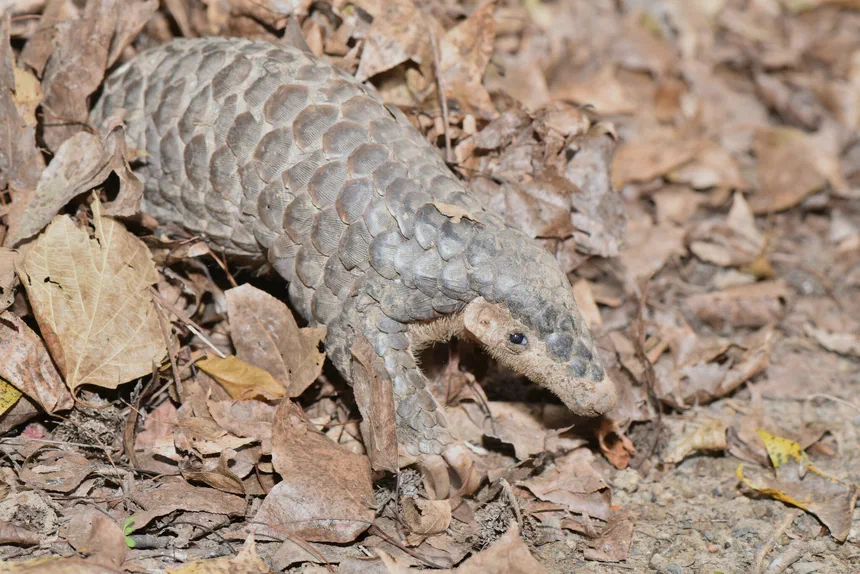
The most striking feature of the Chinese pangolin is its armor of overlapping keratin scales, the same material found in human fingernails and hair. These scales cover the back, sides, limbs, and tail, ranging from grayish-brown to a yellowish or olive tone, while the face and belly remain soft and sparsely haired. Adults typically measure around 40 to 58 centimeters in head-and-body length, with a tail nearly as long, and weigh roughly 2 to 7 kilograms. The animal has a narrow, cone-shaped head, small eyes, short powerful limbs, and long curved claws on the front feet that are well suited to digging. When threatened, it can roll into a tight ball, protecting its vulnerable underside behind a shield of scales.
Habitat and Range
This species occurs across southern China, including Taiwan and Hainan, through the eastern Himalayas of Nepal, Bhutan, and northeastern India, and into parts of mainland Southeast Asia such as Myanmar, Thailand, Laos, and Vietnam. It favors a mix of subtropical and broadleaf forests, bamboo stands, grasslands, and agricultural margins. Compared with some tropical pangolins, the Chinese pangolin tolerates cooler, more temperate conditions and is often found at a range of elevations, from lowlands into hilly and mountainous terrain.
Diet
The Chinese pangolin is a specialized insectivore that feeds almost entirely on ants and termites. It locates nests using a keen sense of smell, then uses its strong claws to break open mounds, logs, and soil. A long, sticky tongue, which can extend well beyond the mouth and is anchored deep within the chest, sweeps up insects and their larvae. Lacking teeth, the pangolin swallows its prey whole, along with small stones and grit that help grind the food in a muscular part of the stomach. A single adult may consume very large numbers of insects each year, making it an important regulator of ant and termite populations.
Behavior
Largely solitary and mostly nocturnal, the Chinese pangolin spends its days resting in burrows it digs or in natural shelters. It is a capable digger and climber, using its prehensile tail for balance and grip when moving through vegetation. Its eyesight is poor, so it relies heavily on smell to navigate and find food. Rather than fighting, a startled pangolin curls into a ball or emits a strong odor from glands near the base of the tail. Its scent-marking and burrowing habits shape how individuals space themselves across the landscape.
Life Cycle and Reproduction
Reproduction in the Chinese pangolin is slow, which contributes to its vulnerability. Females usually give birth to a single offspring after a gestation of several months, though twins are occasionally reported. The newborn, known as a pangopup, is born with soft scales that harden over time. For the first weeks of life it clings to the mother, often riding on the base of her tail as she forages, and it shelters in the burrow between outings. Young pangolins are weaned within a few months and become independent as they mature. In favorable conditions, individuals may live around 15 to 20 years.
Conservation Status
The Chinese pangolin is listed as Critically Endangered by the IUCN, and populations have declined sharply across its range. The main threats are poaching and trafficking, driven by demand for pangolin scales used in some traditional medicines and for meat treated as a luxury food. Habitat loss and its naturally low reproductive rate make recovery difficult. International commercial trade is banned under CITES, and conservation efforts focus on stronger enforcement, reducing consumer demand, protecting habitat, and improving care for rescued animals, which are notoriously hard to keep in captivity.
Frequently Asked Questions
Are pangolin scales made of the same material as fingernails? Yes. The scales are formed from keratin, the same protein that makes up human hair and nails, and they have no proven medicinal value.
Why is the Chinese pangolin so endangered? It is one of the most heavily trafficked wild mammals, hunted for its scales and meat, and its slow reproduction makes it hard for populations to bounce back.
Does the Chinese pangolin have teeth? No. It has no teeth and instead uses a long sticky tongue to gather ants and termites, swallowing small stones that help grind food in its stomach.