Mammals Guide
Chinchilla
What Is a Chinchilla? The chinchilla (Chinchilla lanigera), also called the long-tailed chinchilla, is a small, plush-furred rodent native to the rugged Andes Mountains of South America. Famous for having some of the …
At a glance
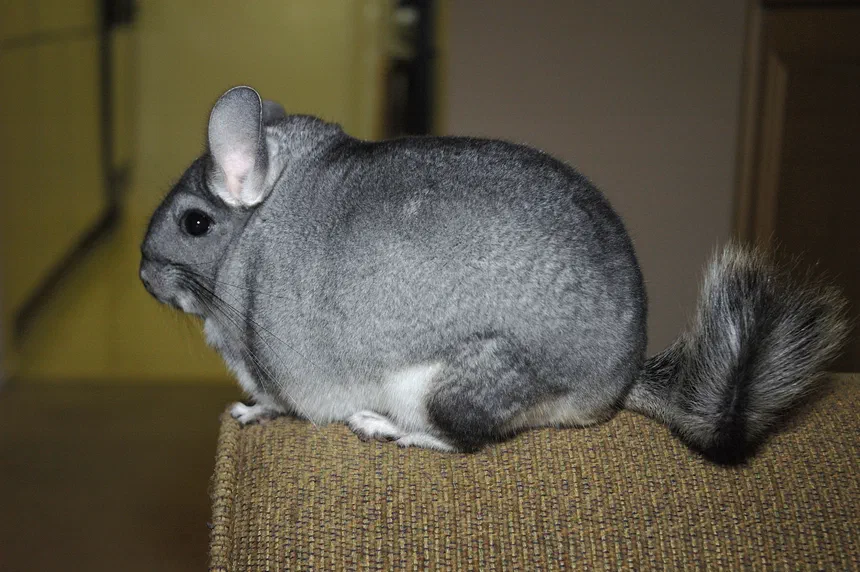
Image: Trurl66 — Public domain · source
What Is a Chinchilla?
The chinchilla (Chinchilla lanigera), also called the long-tailed chinchilla, is a small, plush-furred rodent native to the rugged Andes Mountains of South America. Famous for having some of the densest fur of any land mammal, it is closely related to viscachas and, more distantly, to guinea pigs and porcupines. Once widespread, wild chinchillas are now rare, though the species is bred worldwide as a pet and for the fur trade.
Appearance and Identification
Chinchillas are compact, round-bodied rodents with large heads, big dark eyes, and prominent rounded ears well suited to their alert, nocturnal lifestyle. The body measures roughly nine to fifteen inches, and a long, bushy tail adds several more inches. Most adults weigh between about one and just under two pounds, with females typically a little larger than males.
Their most striking feature is their fur, which is remarkably soft and dense. Where a human hair follicle grows a single strand, a chinchilla’s may sprout fifty or more, giving the coat its plush texture and helping trap warmth in a cold, high-altitude climate. Wild coloration is a bluish- or brownish-gray on the back that fades to a pale cream or white belly. Strong hind legs allow the animal to leap and climb nimbly among rocks.
Habitat and Range
Wild chinchillas live on barren, rocky slopes and scrubby terrain in the mountains of northern Chile, often at elevations of several thousand feet. This is a harsh environment of cold nights, intense sun, and sparse vegetation, where daytime shelter is essential.
They take refuge in crevices, burrows, and gaps beneath boulders, which provide protection from predators and temperature extremes. Historically their range extended more broadly across the Andes, but heavy hunting reduced wild populations to a few scattered colonies.
Diet
Chinchillas are herbivores that feed on a variety of plant material, including grasses, seeds, leaves, and the bark or stems of hardy mountain shrubs. Their continuously growing teeth are well adapted to grinding tough, fibrous vegetation.
To conserve water in their dry habitat, they extract much of the moisture they need from their food. When feeding, a chinchilla often sits upright and holds items in its front paws. In captivity their diet is usually based on grass hay supplemented with specially formulated pellets.
Behavior
Chinchillas are social animals that in the wild live in colonies that may number from a handful to many dozens of individuals. Being active mainly at dusk and during the night helps them avoid both predators and the heat of the day. They communicate through a range of sounds, from soft chirps and squeaks to sharp alarm calls, along with body postures.
One of their most distinctive habits is the dust bath: rather than bathing in water, they roll in fine volcanic dust or ash, which cleans and conditions their exceptionally dense fur and keeps it from becoming matted. Agile and quick, they can jump surprisingly far and will flee into rock crevices at the first sign of danger. When seriously threatened, a chinchilla may release a clump of fur to slip from a predator’s grasp.
Life Cycle and Reproduction
Chinchillas have a comparatively long gestation for their size, lasting around 110 to 120 days, which results in well-developed young. Litters are usually small, typically one to three offspring, called kits, born fully furred with their eyes open and able to move about soon after birth.
The mother nurses the kits for several weeks, and the young mature over the following months, reaching breeding age within their first year. In the wild chinchillas commonly live around eight to ten years, but under attentive care in captivity they often live considerably longer, sometimes reaching their late teens or beyond.
Conservation Status
The wild chinchilla is listed as Endangered on the IUCN Red List. For more than a century the species was hunted intensively for its prized fur, and by the early twentieth century wild populations had collapsed to a fraction of their former numbers. Habitat loss from grazing, mining, and firewood collection continues to threaten the fragmented colonies that remain.
Conservation efforts include legal protection and habitat safeguards in parts of Chile. Ironically, while wild chinchillas remain scarce, the species is abundant in captivity, where millions are kept as pets and farmed animals worldwide.
Frequently Asked Questions
Why is chinchilla fur so soft? Each hair follicle produces many individual strands, packing the coat far more densely than that of most mammals. This adaptation insulates the animal against the cold of its high mountain home and gives the fur its famously plush feel.
Do chinchillas really bathe in dust? Yes. Because their fur is too dense to dry properly if it gets wet, chinchillas clean themselves by rolling in fine dust, which absorbs oil and dirt and keeps the coat healthy.
Are wild chinchillas endangered? They are. Wild populations were devastated by fur hunting and remain fragmented and at risk, so the species is classified as Endangered, even though it is common in captivity.