Mammals Guide
Chimpanzee
What Is a Chimpanzee? The chimpanzee (Pan troglodytes) is a great ape native to the forests and savannas of equatorial Africa. Together with the closely related bonobo, it is one of humanity’s nearest living relatives, …
At a glance
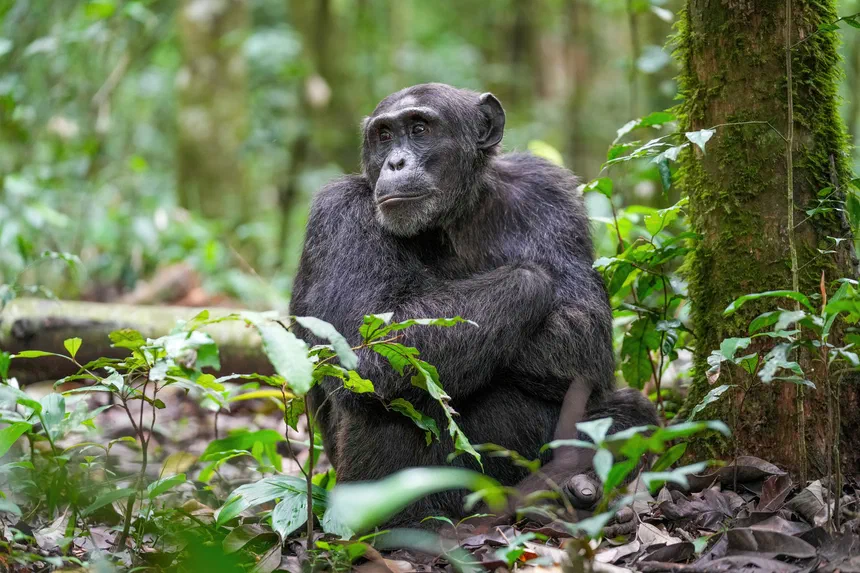
Image: Giles Laurent — CC BY-SA 4.0 · source
What Is a Chimpanzee?
The chimpanzee (Pan troglodytes) is a great ape native to the forests and savannas of equatorial Africa. Together with the closely related bonobo, it is one of humanity’s nearest living relatives, sharing a large share of our DNA. Chimpanzees are renowned for their intelligence, complex societies, and use of tools.
Appearance and Identification
Chimpanzees have a robust, muscular body covered in coarse black to dark brown hair, with a bare face, ears, hands, and feet. The skin of the face ranges from pinkish in youngsters to darker, mottled tones in adults. They have long, powerful arms that are longer than their legs, giving them an arm span greater than their standing height and making them adept climbers and knuckle-walkers. Adults typically stand about 1 to 1.7 meters tall and weigh roughly 30 to 60 kilograms, with males noticeably larger and heavier than females. Their opposable thumbs and big toes allow a precise, dexterous grip, and their expressive faces communicate a wide range of emotions.
Habitat and Range
Chimpanzees live across a broad band of equatorial Africa, from Senegal in the west through the Congo Basin to western Uganda and Tanzania in the east. They occupy a variety of habitats, including dense tropical rainforest, montane forest, swamp forest, and drier woodland and savanna mosaics. Availability of fruiting trees strongly influences where they range, and troops move through large home territories in search of seasonal foods. While they spend considerable time in the trees feeding and building nightly nests, they also travel and forage extensively on the ground.
Diet
Chimpanzees are omnivores with a diet dominated by ripe fruit, supplemented by leaves, seeds, flowers, bark, and pith. They are also active hunters and foragers of animal protein, eating insects such as ants and termites, birds’ eggs, and small to medium-sized mammals. Groups sometimes cooperate to hunt monkeys, notably red colobus, sharing the catch among members. Chimpanzees are famous for their tool use in obtaining food: they strip twigs to “fish” for termites, use stones or wooden hammers to crack nuts, and chew leaves into sponges to soak up water. These behaviors are learned and vary between communities, forming distinct local traditions.
Behavior
Chimpanzees live in fluid social groups called communities, which can number from a couple dozen to well over a hundred individuals. These communities operate on a fission-fusion system, splitting into smaller parties that change in size and membership throughout the day. Males are typically dominant and remain in their birth community, while females often transfer to new groups at maturity. Social bonds are reinforced through grooming, play, and food sharing, but relationships can also be tense, and communities may engage in aggressive, sometimes lethal, territorial encounters. Chimpanzees communicate with an elaborate repertoire of vocalizations, facial expressions, gestures, and postures. Their intelligence is evident in problem solving, self-awareness, and the cultural transmission of tool techniques.
Life Cycle and Reproduction
Chimpanzees reproduce slowly, which shapes much of their social life. Females give birth to a single infant, or occasionally twins, after a gestation of about eight months, with several years typically passing between births. Newborns are helpless and cling to their mothers, riding on her belly and later her back, and they nurse for several years. Young chimpanzees remain closely dependent on their mothers through a long childhood, learning foraging skills, social rules, and tool use by observation. Females generally reach maturity around 11 to 13 years of age. In the wild, chimpanzees commonly live into their 30s and 40s, and some individuals reach even older ages.
Conservation Status
The chimpanzee is classified as Endangered by the IUCN, with populations declining across most of its range. The primary threats are habitat loss and fragmentation from logging, agriculture, and mining, along with poaching for bushmeat and the illegal capture of infants for the pet trade. Infectious diseases, including outbreaks of Ebola, have also devastated some populations. Conservation efforts focus on protecting forests, enforcing anti-poaching laws, and supporting community-based initiatives, but the species’ slow reproduction makes recovery difficult once numbers fall.
Frequently Asked Questions
How closely related are chimpanzees to humans? Chimpanzees are among our closest living relatives, sharing roughly 98 to 99 percent of their DNA with humans and a common ancestor that lived several million years ago.
Do chimpanzees really use tools? Yes. They fashion and use tools to fish for termites, crack nuts, and gather water, and different communities pass down their own distinct tool-use traditions.
Are chimpanzees endangered? Yes. The IUCN lists them as Endangered, mainly due to habitat destruction, poaching for bushmeat, the pet trade, and disease.