Mammals Guide
Cheetah
What Is a Cheetah? The cheetah (Acinonyx jubatus) is a slender, long-legged big cat renowned as the fastest land animal on Earth. It belongs to the cat family Felidae but occupies its own genus, distinguished by a body …
At a glance
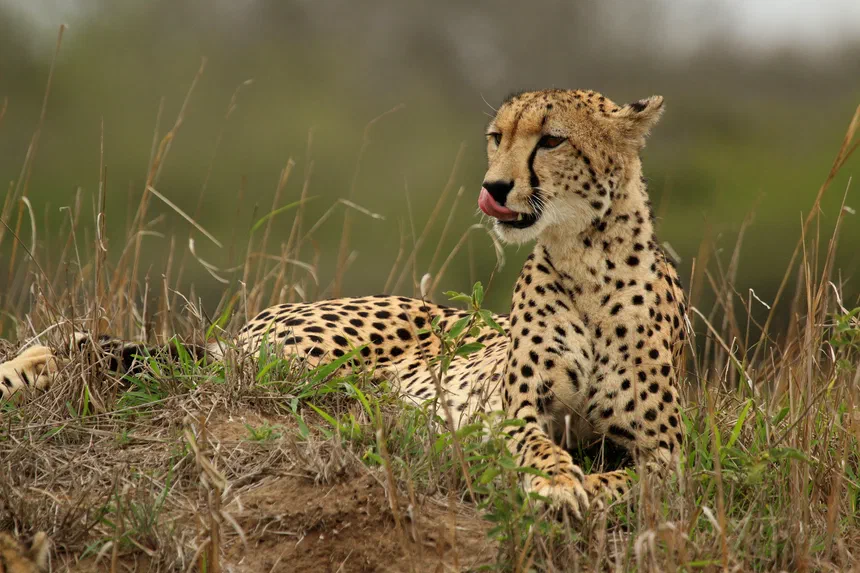
Image: Charles J. Sharp — CC BY-SA 4.0 · source
What Is a Cheetah?
The cheetah (Acinonyx jubatus) is a slender, long-legged big cat renowned as the fastest land animal on Earth. It belongs to the cat family Felidae but occupies its own genus, distinguished by a body built almost entirely for speed rather than power.
Appearance and Identification
The cheetah has a lean, aerodynamic frame with a small rounded head, deep chest, and a narrow waist. Its short tan-to-golden coat is covered in solid black spots, and two dark “tear marks” run from the inner corners of the eyes down to the mouth, likely reducing glare and helping the cat focus on distant prey. The long, muscular tail is banded near the tip and acts as a rudder for balance during high-speed turns. Unlike most cats, cheetahs have only semi-retractable claws, which grip the ground like an athlete’s cleats. A rare variant, the king cheetah, shows blotchy, merged markings caused by a single recessive gene.
Habitat and Range
Cheetahs favor open country where their eyesight and speed give them an advantage: grasslands, savannas, and semi-arid scrub with scattered cover for stalking. Historically they ranged across much of Africa and into Asia, but today the vast majority live in scattered populations across eastern and southern Africa. A small, critically endangered population of the Asiatic subspecies survives in the arid landscapes of central Iran. Much of the species’ range now lies outside protected areas, bringing cheetahs into frequent contact with people and livestock.
Diet
The cheetah is a pure carnivore that hunts mainly small to medium-sized hoofed animals such as gazelles, impala, springbok, and the young of larger antelope. It also takes hares and ground birds. Rather than relying on stealth alone, the cheetah stalks to within striking distance and then unleashes an explosive sprint, tripping prey with a swipe to the hindquarters before delivering a suffocating throat bite. Because a chase overheats the body quickly, cheetahs often rest before eating and frequently lose their kills to stronger competitors like lions and hyenas.
Behavior
Cheetahs are primarily diurnal, hunting in the cooler hours of morning and late afternoon to avoid larger nocturnal predators and the midday heat. They can reach speeds of roughly 60-70 miles per hour in short bursts covering only a few hundred yards, accelerating faster than most sports cars. Social structure is unusual for cats: females are solitary except when raising cubs, while males often form small, lifelong bands called coalitions, typically of brothers, that defend territory together. Cheetahs communicate through chirps, purrs, and a distinctive bird-like call, but they cannot roar.
Life Cycle and Reproduction
After a gestation of roughly three months, a female gives birth to a litter that commonly numbers three to five cubs, though larger litters occur. Newborns have a smoky mantle of long hair along the back that may mimic an aggressive honey badger and offer camouflage. Cub mortality is high, as predators take many young in their first weeks. Surviving cubs stay with their mother for well over a year, learning to hunt, before dispersing. In the wild cheetahs typically live around 8 to 12 years, with females often outliving the more territorial males.
Conservation Status
The cheetah is listed as Vulnerable by the IUCN, and some populations, notably the Asiatic and northwest African groups, are Critically Endangered. Total wild numbers are estimated in the low thousands and continue to decline. Major threats include habitat loss and fragmentation, conflict with farmers protecting livestock, the illegal pet trade, and reduced prey. Low genetic diversity, a legacy of past population bottlenecks, may also make the species more vulnerable to disease. Conservation efforts focus on protecting wide-ranging corridors and reducing human-wildlife conflict.
Frequently Asked Questions
How fast can a cheetah actually run? Cheetahs can hit roughly 60-70 mph in short bursts, but only for a few hundred yards before they must stop and cool down.
Can cheetahs roar like lions? No. Cheetahs lack the specialized voice box structure for roaring; instead they chirp, purr, and make a high-pitched, bird-like call.
Are cheetahs dangerous to people? Cheetahs rarely threaten humans. They are relatively shy compared with other big cats and generally flee rather than confront people.