Mammals Guide
Caribou
What Is a Caribou? The caribou (Rangifer tarandus) is a large deer native to the cold northern regions of the world, where it is also known as the reindeer across Europe and Asia. It is the only deer species in which …
At a glance
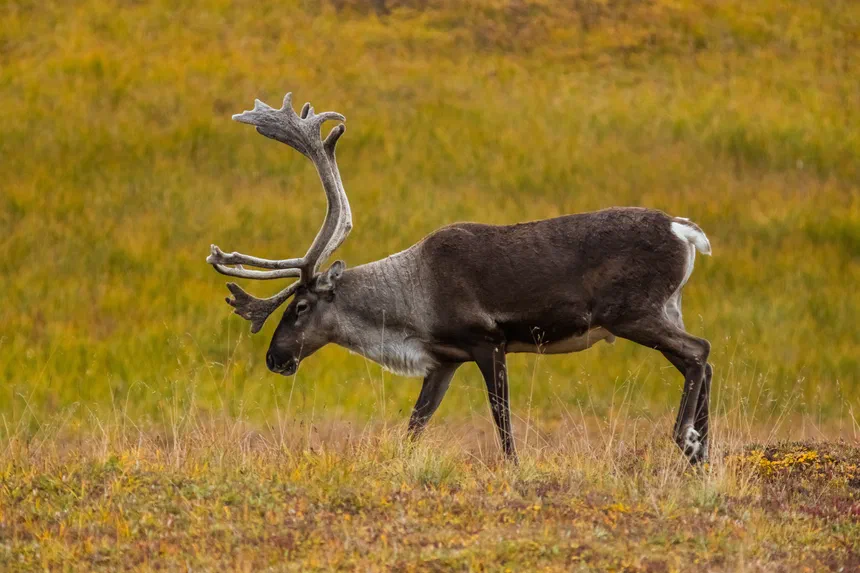
Image: Diego Delso — CC BY-SA 4.0 · source
What Is a Caribou?
The caribou (Rangifer tarandus) is a large deer native to the cold northern regions of the world, where it is also known as the reindeer across Europe and Asia. It is the only deer species in which both males and females grow antlers, and it is superbly adapted to survive some of the harshest climates on Earth.
Appearance and Identification
Caribou have a stocky, powerful build with a broad muzzle and a thick, insulating coat that ranges from brown to grey, usually with paler fur on the neck, underside, and rump. Their hollow guard hairs trap air, providing buoyancy while swimming and warmth in bitter cold. Large, crescent-shaped hooves splay wide to distribute weight on snow and boggy ground and act as scoops for digging. Antlers are distinctive for sweeping forward with flattened, palmate tips, and unusually both sexes carry them, though a bull’s are far larger. Size varies widely by subspecies and region, with animals weighing anywhere from around 60 kilograms in smaller forms to nearly 300 kilograms in the largest bulls.
Habitat and Range
Caribou occupy a circumpolar distribution spanning the Arctic and subarctic. Populations live across northern Canada and Alaska, Greenland, Scandinavia, and Russia, where domesticated and wild reindeer overlap. They inhabit a range of environments including open Arctic tundra, montane slopes, and dense boreal forest. Some herds migrate over vast distances between seasonal ranges, undertaking journeys that rank among the longest overland migrations of any land mammal, while woodland populations tend to be more sedentary.
Diet
As herbivores, caribou browse and graze on a wide variety of plants. In summer they feed heavily on grasses, sedges, willow and birch leaves, mushrooms, and flowering plants. Winter forces a shift to a specialized diet dominated by lichens, particularly the ground lichen commonly called reindeer moss. They use their hooves and muzzles to dig craters through snow to reach this buried forage, and their gut microbes are adapted to digest lichens that most other mammals cannot.
Behavior
Caribou are social animals that gather in herds, which can swell to tens of thousands during migration and calving. Group living offers protection from predators such as wolves and bears, since many eyes improve detection and sheer numbers dilute individual risk. They are strong swimmers, readily crossing rivers and lakes, and move almost constantly in search of fresh forage. A soft clicking sound produced by tendons in their feet helps herd members stay in contact and may signal an individual’s size to rivals. Their eyes can shift color seasonally, improving vision during the long, dim Arctic winter.
Life Cycle and Reproduction
The breeding season, or rut, occurs in autumn, when bulls compete for access to females through displays and antler clashes. After a gestation of roughly seven and a half months, females give birth in spring, typically to a single calf timed to coincide with the flush of new plant growth. Calves are remarkably precocious, standing within hours and able to run alongside the herd within a day, an essential defense against predators in open terrain. Bulls shed their antlers after the rut, while pregnant females keep theirs through winter, giving them an advantage at feeding craters. Wild caribou generally live around 8 to 15 years.
Conservation Status
The IUCN lists Rangifer tarandus as Vulnerable, reflecting widespread and often steep declines across many herds. Threats include climate change, which alters snow and ice conditions and disrupts food availability, along with habitat loss from logging, mining, and energy development, increased predation linked to landscape change, and disturbance from roads and industry. Some populations remain abundant, but several migratory and woodland herds have shrunk dramatically, making regional monitoring and habitat protection priorities for conservation.
Frequently Asked Questions
Are caribou and reindeer the same animal? Yes. They are the same species, Rangifer tarandus. “Caribou” is used for wild animals in North America, while “reindeer” is the term used in Europe and Asia and for domesticated herds.
Do both male and female caribou have antlers? Yes. Caribou are unusual among deer in that both sexes grow antlers, though those of adult males are considerably larger.
How do caribou survive the winter? They rely on a thick, air-filled coat, broad hooves for digging and traveling over snow, and a specialized diet of lichens they uncover beneath the snowpack.