Mammals Guide
Caracal
What Is a Caracal? The caracal (Caracal caracal) is a medium-sized wild cat known for its slender build, reddish coat, and dramatic black ear tufts. It ranges widely across Africa, the Arabian Peninsula, and southwestern …
At a glance
What Is a Caracal?
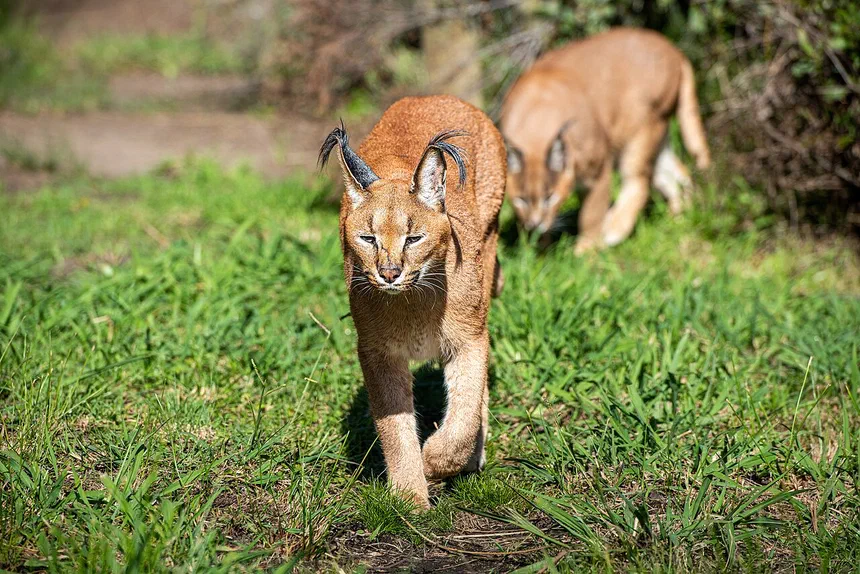
The caracal (Caracal caracal) is a medium-sized wild cat known for its slender build, reddish coat, and dramatic black ear tufts. It ranges widely across Africa, the Arabian Peninsula, and southwestern and Central Asia, where it thrives in dry, open country. Agile and secretive, it is one of the most accomplished hunters among small cats.
Appearance and Identification
The caracal has a sleek, muscular body covered in a uniform tawny to reddish-brown coat, with a whitish chin, throat, and belly. Its most distinctive feature is the pair of long, tufted black ears, tipped with tufts of dark hair that can reach several centimeters in length. The name “caracal” comes from a Turkish phrase meaning “black ear.” Its face carries subtle black markings around the eyes and muzzle. The legs are relatively long, with the hind legs notably powerful, and the tail is fairly short compared with the body. Adults typically measure around 60 to 90 centimeters in body length and stand roughly 40 to 50 centimeters at the shoulder, with males generally larger and heavier than females.
Habitat and Range
Caracals favor dry, semi-arid environments such as savanna, scrubland, semi-desert, and open woodland. They avoid dense tropical forest and true sandy desert but tolerate a wide range of conditions, from rocky hills to farmland edges. Their distribution spans much of Africa, extends through the Arabian Peninsula and the Middle East, and reaches into Central Asia and parts of India. This broad range reflects their adaptability to arid landscapes where prey is available and cover is sufficient for stalking.
Diet
As an obligate carnivore, the caracal hunts a varied menu of small to medium-sized prey. Birds, rodents, hares, and hyraxes form the bulk of its diet, but it is capable of taking larger animals such as small antelope and young gazelle. Caracals are famous for their leaping ability: they can spring several meters into the air to swat birds out of flight with a single strike of a forepaw. Powerful hind legs allow explosive bursts of speed and remarkable vertical jumps, making them highly effective ambush predators. They typically hunt at night, relying on keen hearing and stealth.
Behavior
Caracals are solitary and territorial, with individuals maintaining home ranges that they mark with scent. They are primarily nocturnal, though they may be active at dawn and dusk, especially in cooler seasons. Largely silent, they communicate through scent marking, body posture, and occasional calls. Excellent climbers and jumpers, caracals can retreat into trees to escape larger predators or to cache a kill away from scavengers. Their acute hearing, aided by the mobile tufted ears, helps them detect the faint movements of prey in grass or brush.
Life Cycle and Reproduction
Caracals can breed throughout the year, with mating peaks in some regions tied to prey availability. After a gestation of roughly two to three months, a female gives birth to a litter of usually one to four kittens in a sheltered den, such as an abandoned burrow, rock crevice, or dense thicket. The kittens are born blind and helpless, opening their eyes within the first couple of weeks. They begin taking solid food at around one month and are weaned by a few months of age. Young caracals become independent before their first year is out and reach sexual maturity at roughly one to two years. In the wild, caracals typically live about 10 to 12 years, while individuals in captivity may live considerably longer.
Conservation Status
The caracal is listed as Least Concern on the IUCN Red List, reflecting its wide distribution and adaptability. Populations remain relatively stable across much of Africa, though numbers in North Africa and parts of Asia are smaller and more vulnerable. Threats include habitat loss, hunting, and conflict with farmers, who may kill caracals in retaliation for preying on livestock and poultry. Despite these pressures, the species is not currently considered globally threatened, though local declines are a concern in some areas.
Frequently Asked Questions
Are caracals the same as lynxes? No. Although the caracal was once grouped with lynxes and is sometimes called the “desert lynx,” it belongs to its own genus, Caracal. It is more closely related to the African golden cat and the serval than to true lynxes.
Can caracals be kept as pets? While caracals are sometimes kept in captivity, they are wild animals with specialized needs and strong hunting instincts, making them unsuitable as household pets in most circumstances.
How high can a caracal jump? Caracals are exceptional jumpers and can leap several meters into the air from a standstill, an ability they use to catch birds in flight.