Mammals Guide
Capybara
What Is a Capybara? The capybara (Hydrochoerus hydrochaeris) is the largest living rodent on Earth, a barrel-bodied, semiaquatic mammal native to South America. It belongs to the same broad group as guinea pigs and rock …
At a glance
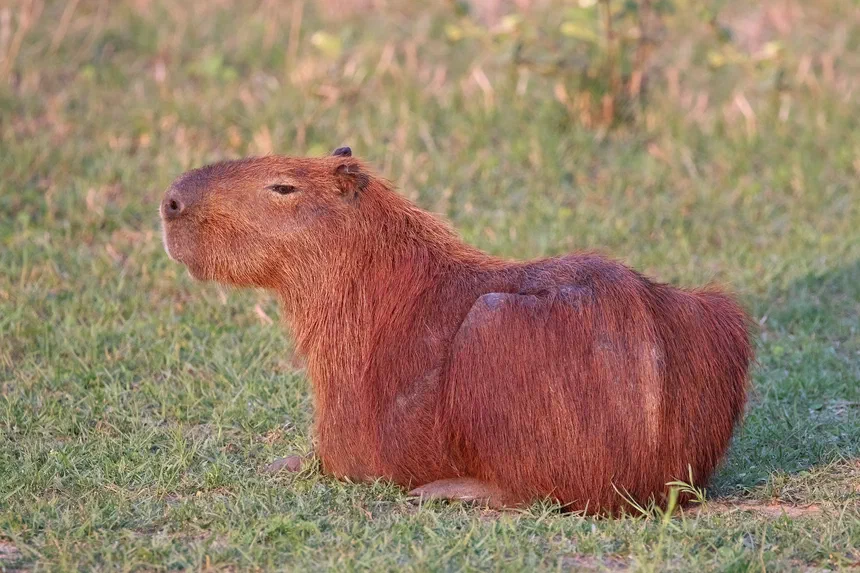
Image: Charles J. Sharp — CC BY-SA 4.0 · source
What Is a Capybara?
The capybara (Hydrochoerus hydrochaeris) is the largest living rodent on Earth, a barrel-bodied, semiaquatic mammal native to South America. It belongs to the same broad group as guinea pigs and rock cavies, and it is closely tied to water throughout its life.
Appearance and Identification
A capybara has a heavy, rounded body set on relatively short legs, giving it a slightly awkward look on land but a smooth, buoyant profile in water. The coarse fur ranges from reddish-brown to grayish, often paler underneath, and it dries quickly after swimming. The head is large and blunt, with small ears, eyes, and nostrils positioned high on the face so the animal can keep them above the surface while mostly submerged. The feet are partially webbed, an adaptation for paddling and for moving across soft, muddy ground. Adults typically stand around 20-24 inches (50-60 cm) at the shoulder and weigh anywhere from roughly 77 to 146 pounds (35 to 66 kg), with females often slightly heavier than males. Males carry a raised, hairless scent gland called a morrillo on top of the snout.
Habitat and Range
Capybaras live across much of South America east of the Andes, from Colombia and Venezuela south through Brazil and the Pantanal wetlands to parts of Argentina and Uruguay. They are never found far from water and favor densely vegetated banks along rivers, lakes, ponds, marshes, and seasonally flooded grasslands. Access to water is essential: it provides drinking, cooling, feeding grounds, and a ready escape route from predators. In some regions capybaras have adapted to human-altered landscapes such as ranchland, rice fields, and even suburban ponds.
Diet
Capybaras are strict herbivores. Their diet centers on grasses and aquatic plants, supplemented by sedges, reeds, fruit, and bark depending on the season. Like rabbits, they practice coprophagy, re-ingesting some of their own droppings to extract additional nutrients and beneficial gut microbes from tough, fibrous plant material. Their cheek teeth grow continuously throughout life, wearing down against the abrasive silica in grasses. A single adult can consume several pounds of vegetation each day, and large groups can shape the plant communities around their favored feeding areas.
Behavior
Capybaras are highly social and usually live in groups of around 10 to 20 individuals, though gatherings can swell to 40 or more in the dry season when animals crowd around shrinking water sources. A typical group includes a dominant male, several females, young, and subordinate males, organized around a loose hierarchy. They communicate through an array of barks, whistles, purrs, and clicks, and they use scent from the morrillo and anal glands to mark territory. Most active around dawn and dusk, they rest during the hottest hours and readily take to the water to cool off or hide. Capybaras are strong swimmers and can stay submerged for several minutes, sometimes resting with only the nostrils exposed.
Life Cycle and Reproduction
Breeding can occur year-round but often peaks with the rainy season, when food is abundant. Mating typically takes place in the water. After a gestation of about 130 to 150 days, the female gives birth on land to a litter that usually numbers around four young, though litters can range from one to eight. The precocial babies are born well developed, with open eyes and full fur, and can walk and nibble grass within days. Females in a group may nurse one another’s offspring, and the young remain within the protective circle of the herd. Capybaras reach sexual maturity at around 12 to 18 months and generally live about 8 to 10 years in the wild, longer in captivity.
Conservation Status
The capybara is listed as Least Concern by the IUCN. It remains widespread and locally common across its range, and its populations are considered stable. Capybaras are hunted for meat and hide in some areas, and in parts of South America they are also managed or ranched. While regional pressures from hunting and habitat loss exist, none currently threaten the species as a whole.
Frequently Asked Questions
Is the capybara really the world’s largest rodent? Yes. No other living rodent grows as large; a big adult can weigh more than an average adult human.
Are capybaras good swimmers? Very. Their webbed feet, buoyant bodies, and high-set eyes and nostrils make them at home in water, where they feed, cool off, and escape predators.
Do capybaras live alone or in groups? They are social animals that live in groups, typically 10 to 20 members, sometimes far larger where water is scarce.