Mammals Guide
Capuchin Monkey
What Is a Capuchin Monkey? Capuchin monkeys are small, agile New World primates known for their intelligence and dexterity. The white-faced capuchin, Cebus capucinus, is one of the best-known species, easily recognized …
At a glance
What Is a Capuchin Monkey?
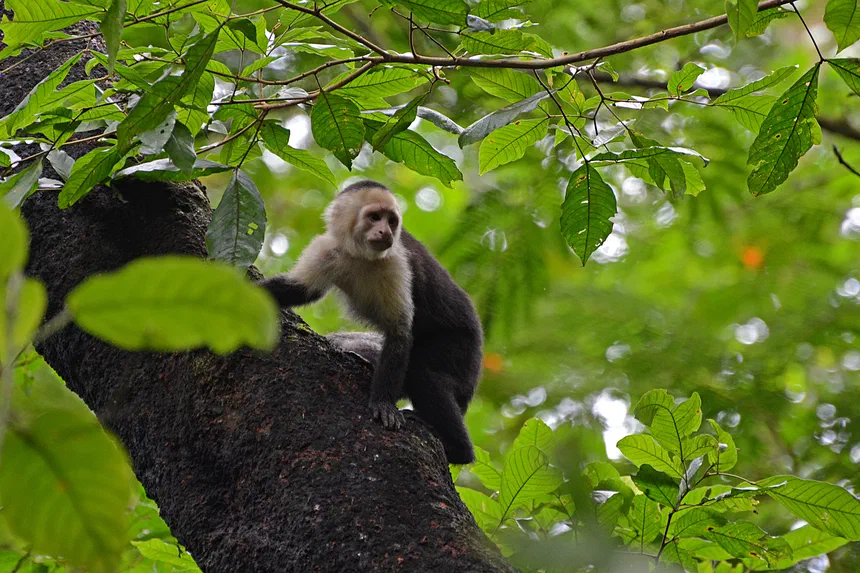
Capuchin monkeys are small, agile New World primates known for their intelligence and dexterity. The white-faced capuchin, Cebus capucinus, is one of the best-known species, easily recognized by its pale face and shoulders set against a darker body. The name “capuchin” comes from the resemblance of their dark cap of fur to the hoods worn by Capuchin friars.
Appearance and Identification
Capuchins are compact monkeys with a rounded head, an expressive face, and a long, muscular tail. The white-faced capuchin has cream to whitish fur on its face, throat, chest, and shoulders, contrasting with a dark brown or black cap, back, and limbs. Adults typically measure about 12 to 22 inches (30 to 56 cm) in head-and-body length, with a prehensile tail that is roughly as long as the body and is often carried curled at the tip. Most individuals weigh between about 3 and 9 pounds (1.4 to 4 kg), with males generally larger than females.
Habitat and Range
White-faced capuchins live in a variety of forested environments across Central America and the far northwest of South America, from Honduras and Nicaragua south through Costa Rica and Panama into Colombia and Ecuador. They occupy tropical rainforest, dry deciduous forest, mangrove, and secondary woodland, spending most of their time in the middle and upper levels of the canopy. Their adaptability to different forest types has helped them persist in areas where other primates struggle.
Diet
Capuchins are opportunistic omnivores with an unusually broad diet. Fruit makes up a large share of their food, supplemented by seeds, flowers, and young leaves. They are also active foragers of animal prey, eating insects, spiders, bird eggs, nestlings, lizards, and small crabs. Capuchins are famous for their problem-solving while feeding: they pound hard-shelled fruits and nuts against branches, roll logs to find grubs, and manipulate objects to extract hidden food. This resourcefulness lets them thrive across seasons when preferred foods run short.
Behavior
These monkeys are highly social, living in mixed groups that usually range from about 10 to 20 individuals led by a dominant male and female. Communication involves a rich repertoire of calls, facial expressions, and gestures. Capuchins are among the most intelligent New World monkeys and are known to use simple tools, such as sticks and stones, in some populations. They also engage in unusual social behaviors, including rubbing plants and other materials over their fur, thought to help with parasites or social bonding. Grooming reinforces alliances and helps keep the group cohesive.
Life Cycle and Reproduction
Females typically give birth to a single infant after a gestation of roughly five to six months, generally at intervals of one to two years. Newborns cling to their mother’s back and are cared for intensively during their first months, with other group members sometimes helping to carry and watch over them. Young capuchins mature slowly for their size, learning foraging and social skills over several years before reaching adulthood. This extended development reflects the species’ reliance on learned behavior. In the wild, capuchins may live around 15 to 25 years, and individuals in captivity can live considerably longer.
Conservation Status
The white-faced capuchin is generally considered relatively widespread, though populations face pressure from habitat loss, forest fragmentation, and capture for the pet trade. Conservation assessments vary among the several capuchin species, and some are more threatened than others. Protecting large, connected areas of forest and reducing illegal trade remain the most important measures for keeping capuchin populations healthy across their range.
Frequently Asked Questions
Are capuchin monkeys intelligent? Yes. They are among the most intelligent New World primates, known for problem-solving, tool use in some populations, and complex social behavior.
What do capuchin monkeys eat? They are omnivores, feeding mainly on fruit and insects but also taking seeds, flowers, eggs, and small animals such as lizards and nestlings.
Where do capuchin monkeys live? White-faced capuchins are found in forests of Central America and northwestern South America, from Honduras through Panama into Colombia and Ecuador.