Mammals Guide
Senegal Bushbaby
What Is a Senegal Bushbaby? The Senegal bushbaby (Galago senegalensis), also called the lesser galago or northern lesser galago, is a small nocturnal primate native to the woodlands and savannas of Africa. Its name comes …
At a glance
What Is a Senegal Bushbaby?
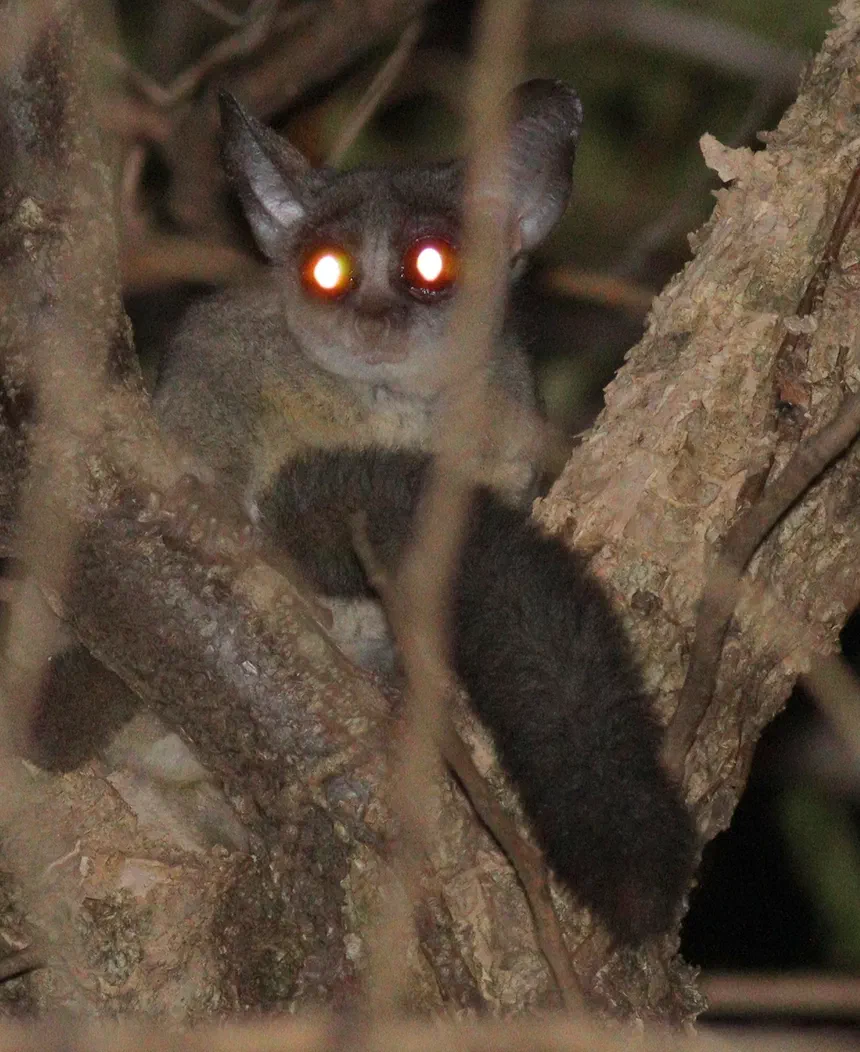
The Senegal bushbaby (Galago senegalensis), also called the lesser galago or northern lesser galago, is a small nocturnal primate native to the woodlands and savannas of Africa. Its name comes from the loud, wailing, child-like cries the animals use to communicate in the dark. Together with other galagos, it belongs to a group of primitive primates called prosimians.
Appearance and Identification
This is a tiny primate, with a head-and-body length of roughly 5 to 8 inches (13 to 21 cm) and a bushy tail that is usually a little longer than the body. Adults typically weigh between 6 and 11 ounces (about 150 to 300 grams). The fur is soft and woolly, ranging from gray to sandy brown on the back with a paler, cream to yellowish underside. The most striking features are the enormous forward-facing eyes, which gather light for night vision, and the large, thin, movable ears that can fold and unfold to track sound. The hind legs are long and powerful, built for leaping, and the fingertips carry flattened pads that help the animal grip branches.
Habitat and Range
The Senegal bushbaby has one of the widest ranges of any African galago, occurring across a broad belt of sub-Saharan Africa from Senegal in the west through parts of East Africa. It favors savanna woodland, dry acacia bush, and the edges of forests, and it tends to avoid dense rainforest interiors. Because it is so adaptable, it can also be found in wooded farmland and gallery forest along rivers. Within these habitats it lives almost entirely in trees and shrubs, sheltering during the day in leafy tangles, tree hollows, or old bird nests.
Diet
Bushbabies are omnivores with a diet that shifts through the seasons. A large share of their food is made up of insects such as beetles, moths, grasshoppers, and caterpillars, which they snatch with quick grabs of the hands. When insects are scarce, particularly in the dry season, they rely heavily on gum and sap that oozes from acacia and other trees, gnawing at the bark to keep the flow going. Fruit and nectar round out the menu. Their diet makes them useful to their ecosystem as both insect controllers and pollinators.
Behavior
The Senegal bushbaby is strictly nocturnal, spending the day asleep and becoming active after dark. It is an extraordinary jumper, able to spring several feet between branches using its coiled hind legs, and it can twist in midair to land accurately. To keep its grip secure, it moistens its hands and feet with urine, a behavior called urine-washing. Bushbabies are largely solitary as they forage but maintain social bonds through scent marking and a rich vocabulary of calls, from soft chirps to the loud cries that give them their name. Females and their young often share a sleeping site.
Life Cycle and Reproduction
Females usually give birth after a gestation of around four months, producing one or two young, and in good conditions may breed twice a year. Newborns are tiny and are carried in the mother’s mouth or left parked on a branch while she feeds nearby. The young develop quickly, clinging to branches within days and beginning to leap within a few weeks. They are weaned at roughly two to three months and reach maturity within their first year. In the wild many bushbabies fall to owls, snakes, and small carnivores, but protected individuals can live well over a decade.
Conservation Status
The Senegal bushbaby is listed as Least Concern by the IUCN. It is widespread, adaptable, and present in many protected areas, so its overall population is considered stable. Localized threats include habitat loss from agriculture and the occasional capture of animals for the pet trade or bushmeat, but none of these currently endanger the species as a whole.
Frequently Asked Questions
Why is it called a bushbaby? The name comes from its loud, plaintive calls that sound like a crying human infant, combined with its habit of living in bushy woodland.
Are Senegal bushbabies good pets? No. They are wild nocturnal primates with specialized diets and social needs, and keeping them is difficult, often illegal, and poor for the animal’s welfare.
How far can a bushbaby jump? Relative to its size it is a remarkable leaper, clearing gaps of several feet in a single bound thanks to its long, muscular hind legs.
References
The conservation status and key facts in this profile are supported by these sources:
- Animal Diversity Web — Galago senegalensis (Senegal galago) (accessed 2026-07-28)
- GBIF — Galago senegalensis (accessed 2026-07-28)
Found an error, source problem, or image concern? Report this page.