Mammals Guide
Brown Hyena
What Is a Brown Hyena? The brown hyena (Parahyaena brunnea) is one of the world’s four living hyena species and the rarest of them. A shaggy, dog-sized carnivore of southern Africa, it is best known as a nocturnal …
At a glance
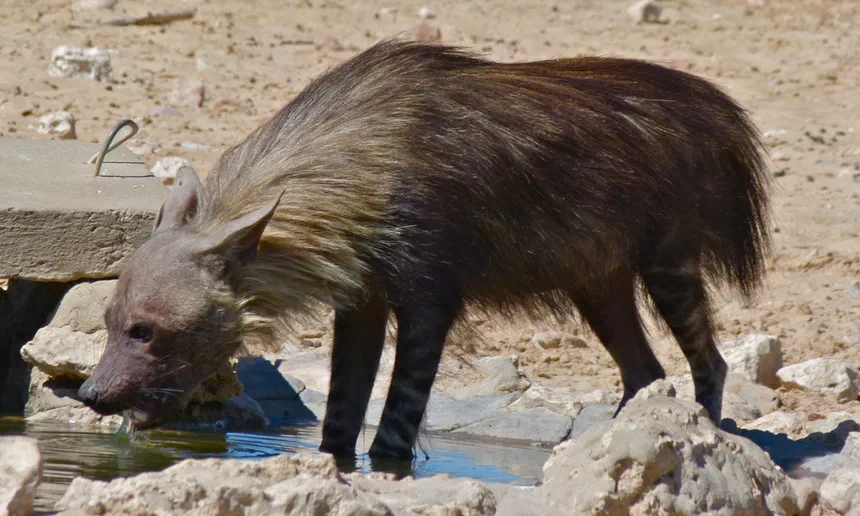
Image: Bernard DUPONT from FRANCE — CC BY-SA 2.0 · source
What Is a Brown Hyena?
The brown hyena (Parahyaena brunnea) is one of the world’s four living hyena species and the rarest of them. A shaggy, dog-sized carnivore of southern Africa, it is best known as a nocturnal scavenger that patrols vast home ranges in search of leftovers from the kills of larger predators.
Appearance and Identification
The brown hyena is easily distinguished by its long, dark, coarse coat, which is especially thick over the back and forms a pale mane of longer hair across the shoulders. The head is grayish, the pointed ears are large, and the lower legs carry faint horizontal stripes on a lighter background. Like all hyenas, its front legs are noticeably longer than the hind legs, giving the back a sloping profile and the animal a distinctive shambling gait. Adults typically measure about 1.1 to 1.4 meters in body length and stand roughly 70 to 80 centimeters at the shoulder, weighing somewhere between 35 and 45 kilograms. Powerful jaws and robust teeth let it crush bone with ease.
Habitat and Range
This species is restricted to southern Africa, where it occurs across Namibia, Botswana, South Africa, Zimbabwe, and parts of neighboring countries. It favors arid and semi-arid country, including the Kalahari, Namib Desert margins, open savanna, and rocky scrubland. A well-known population lives along Namibia’s coast, where the animals scavenge seal colonies and beach carrion. Brown hyenas tolerate very dry conditions and can go long periods drawing most of their moisture from food.
Diet
The brown hyena is primarily a scavenger. Much of its diet is carrion left behind by lions, leopards, cheetahs, and spotted hyenas, and its strong jaws allow it to consume bone, hide, and other tough remains that other animals leave. It supplements this with insects, small mammals, birds, reptiles, eggs, and a surprising amount of wild fruit and vegetable matter, especially wild melons that provide water. It rarely hunts large prey, taking mostly small or vulnerable animals when it does hunt actively.
Behavior
Brown hyenas are mainly nocturnal and can cover long distances each night while foraging alone. Although they feed by themselves, they are surprisingly social and live in loose clans that share and defend a common territory, which they mark with paste from anal glands and with latrine sites. Clan members recognize one another and cooperate to raise young, but they do not hunt together the way some pack predators do. Compared with the noisy spotted hyena, the brown hyena is relatively quiet, communicating largely through scent and body posture rather than loud calls.
Life Cycle and Reproduction
Breeding can occur at any time of year. After a gestation of roughly three months, a female gives birth to a litter of usually two to four cubs in a den, often a burrow or sheltered hollow. Cubs are cared for cooperatively: clan members, including subordinate adults and older siblings, carry food back to the communal den, a behavior that helps pups survive in a landscape where food is patchy. Young are weaned over many months and gradually begin accompanying adults before becoming independent. Some young disperse to find new territory, while others remain within the natal clan.
Conservation Status
The brown hyena is currently listed by the IUCN as Near Threatened. Its total population is relatively small and thinly spread, and it faces pressure from habitat loss, road deaths, and persecution by people who wrongly blame it for livestock losses, even though it is overwhelmingly a scavenger. Large protected areas and private reserves in southern Africa provide important strongholds, and reducing conflict with farmers is a key part of keeping populations stable.
Frequently Asked Questions
Is the brown hyena dangerous to people? No. It is shy, largely nocturnal, and avoids humans; there are essentially no records of it posing a threat to people.
How is it different from the spotted hyena? The brown hyena is smaller, has a long shaggy dark coat and pale shoulder mane, is far more of a scavenger, and is much quieter than the larger, spotted, and highly vocal spotted hyena.
Where can brown hyenas be found? They live only in southern Africa, particularly in the dry regions of Namibia, Botswana, and South Africa, including a notable population along the Namib coast.
References
The conservation status and key facts in this profile are supported by these sources:
- Animal Diversity Web — Brown hyena (Hyaena brunnea) (accessed 2026-07-28)
- GBIF — Parahyaena brunnea (Thunberg, 1820) (accessed 2026-07-28)
Found an error, source problem, or image concern? Report this page.