Mammals Guide
Bonobo
What Is a Bonobo? The bonobo (Pan paniscus) is a great ape and one of humanity’s two closest living relatives, sharing that distinction with the common chimpanzee. Sometimes called the pygmy chimpanzee, it is a slender, …
At a glance
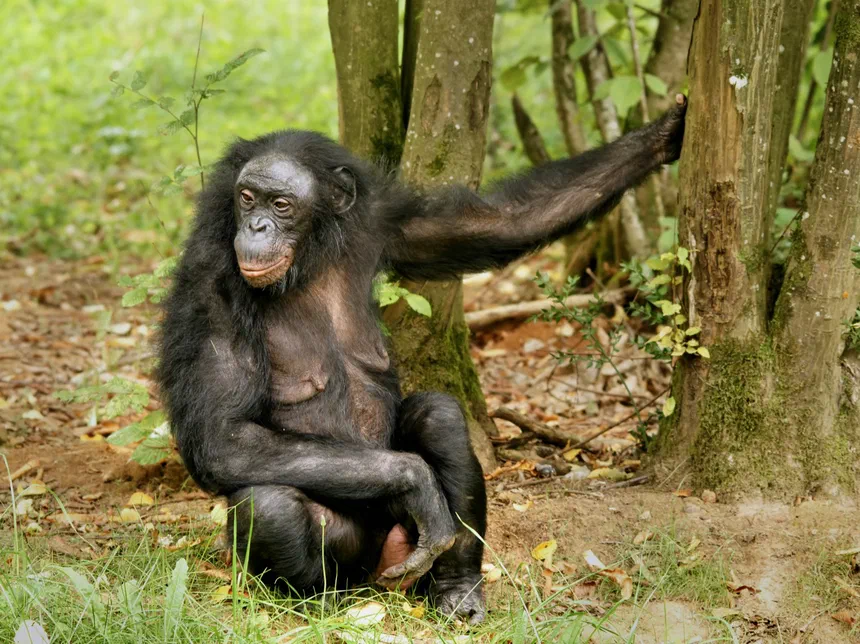
Image: Hans Hillewaert — CC BY-SA 4.0 · source
What Is a Bonobo?
The bonobo (Pan paniscus) is a great ape and one of humanity’s two closest living relatives, sharing that distinction with the common chimpanzee. Sometimes called the pygmy chimpanzee, it is a slender, intelligent primate found only in the forests south of the Congo River in central Africa. Bonobos are famous among scientists for their peaceful, cooperative societies in which social bonds and conflict resolution play a central role.
Appearance and Identification
Bonobos have long, black hair, a dark face with pinkish lips, and a distinctive part in the hair on top of the head. Compared with common chimpanzees, they are more slightly built, with a narrower chest, longer legs, and a more upright posture when standing or walking. Adults typically weigh between 30 and 45 kilograms (66 to 99 pounds), with males somewhat heavier than females. Their long arms and grasping hands and feet make them agile climbers, well suited to moving through the forest canopy.
Habitat and Range
The bonobo lives exclusively in the Democratic Republic of the Congo, within the humid lowland rainforests and seasonally flooded swamp forests of the central Congo Basin. Their range lies entirely south of the Congo River, a natural barrier that historically separated them from common chimpanzees to the north. These forests provide year-round fruit and dense vegetation that support the bonobo’s largely tree-based and ground-foraging lifestyle. Because the species occupies a relatively small and fragmented area, it is especially vulnerable to habitat loss.
Diet
Bonobos are omnivores with a strong preference for ripe fruit, which makes up the bulk of their diet. They supplement fruit with leaves, stems, shoots, seeds, flowers, and pith, and they occasionally eat insects, earthworms, and small vertebrates. Unlike common chimpanzees, bonobos hunt only rarely and are not known for coordinated group hunting of monkeys. They spend much of the day foraging both in the trees and on the forest floor, and food discoveries often become social occasions rather than sources of aggressive competition.
Behavior
Bonobos live in fluid, fission-fusion communities that can number in the several dozens, splitting into smaller parties that forage and regroup throughout the day. Their societies are notable for strong bonds among females and for social systems in which females hold considerable influence. Bonobos are widely recognized for using social and sexual behavior to ease tension, reinforce alliances, and defuse potential conflict, which contributes to their reputation for relatively low levels of aggression. They are highly intelligent, communicate through a rich range of vocalizations and gestures, and have demonstrated problem-solving and tool-use abilities in captivity.
Life Cycle and Reproduction
Female bonobos generally give birth to a single infant after a gestation of roughly eight months. Newborns are highly dependent, clinging to their mothers and nursing for several years, and the interval between births is long, often four to five years or more. Young bonobos mature slowly, learning social and foraging skills through extended contact with their mothers and other group members. The bond between mother and offspring is strong and lasting, and a mother’s social standing can influence the opportunities available to her sons well into adulthood. Bonobos may live to around 40 years in the wild, and sometimes longer under human care.
Conservation Status
The bonobo is classified as Endangered by the IUCN, and its population is thought to be declining. The main threats are poaching for bushmeat and the loss and fragmentation of its forest habitat through logging, agriculture, and human settlement. Political instability within its restricted range has also hampered conservation and long-term monitoring. Protected areas, community-based conservation programs, and anti-poaching efforts are working to safeguard remaining populations, but the species’ slow reproduction makes recovery from losses especially difficult.
Frequently Asked Questions
How are bonobos different from chimpanzees? Bonobos are more slender, have longer legs, and tend to walk upright more often. Socially, they are generally more peaceful, with strong female bonds, whereas common chimpanzee groups are typically male-dominated and more prone to aggression.
Where do bonobos live? They are found only in the Democratic Republic of the Congo, in lowland rainforests south of the Congo River. No wild bonobos exist anywhere else in the world.
Are bonobos endangered? Yes. The IUCN lists bonobos as Endangered, mainly due to hunting and habitat loss across their limited range in central Africa.
References
The conservation status and key facts in this profile are supported by these sources:
- Animal Diversity Web — Pan paniscus (bonobo) (accessed 2026-07-28)
- GBIF — Pan paniscus Schwarz, 1929 (accessed 2026-07-28)
Found an error, source problem, or image concern? Report this page.