Mammals Guide
Bongo
What Is a Bongo? The bongo (Tragelaphus eurycerus) is a large, strikingly patterned forest antelope native to the tropical jungles of Africa. It is the biggest of the continent’s forest-dwelling antelopes and one of the …
At a glance
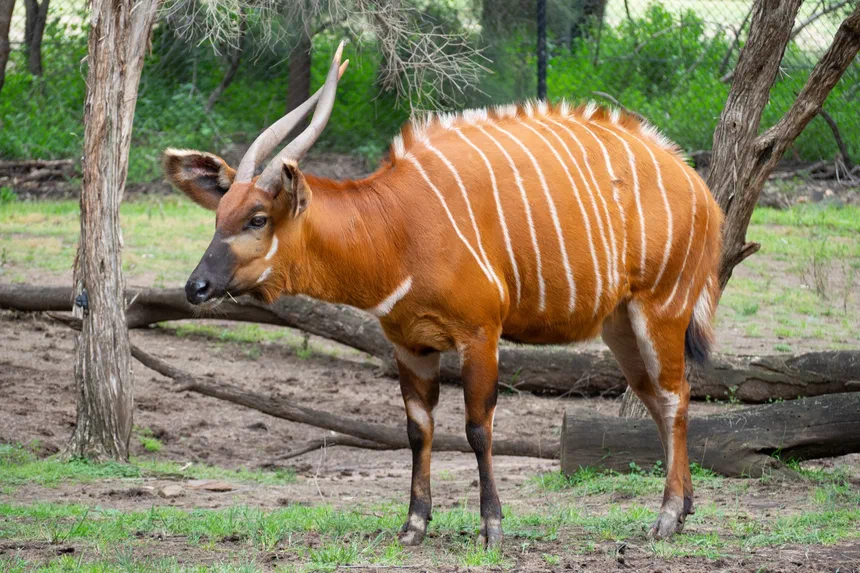
Image: Maksym Kozlenko — CC BY-SA 4.0 · source
What Is a Bongo?
The bongo (Tragelaphus eurycerus) is a large, strikingly patterned forest antelope native to the tropical jungles of Africa. It is the biggest of the continent’s forest-dwelling antelopes and one of the few in which both males and females carry spiraling horns. Two forms are generally recognized: the more widespread lowland (or western) bongo and the critically endangered mountain (or eastern) bongo of Kenya.
Appearance and Identification
Bongos are unmistakable among antelopes. Their coat is a rich chestnut to reddish-brown, marked by 10 to 15 narrow white vertical stripes running down the flanks that help break up the animal’s outline in dappled forest light. The face carries white cheek patches and a pale chevron between the eyes, while the legs show bold black-and-white markings. Both sexes grow long, lyre-shaped horns that spiral in a single twist and can reach around 1 meter in length. Older males often darken with age, sometimes appearing nearly black, and are noticeably heavier and more thickset than females.
Habitat and Range
This antelope is closely tied to dense, humid forest. Lowland bongos inhabit the rainforests of Central and West Africa, from Sierra Leone through the Congo Basin, favoring areas with thick undergrowth, forest clearings, and access to water. The mountain bongo survives only in a few isolated highland forests of central Kenya, where cooler montane conditions and bamboo thickets provide cover. Across their range, bongos rely on natural mineral licks and salt-rich soils, which they visit regularly to supplement their diet.
Diet
Bongos are strict herbivores and primarily browsers. They feed on leaves, twigs, vines, bark, and flowering plants, using their flexible tongues and long horns to pull down and strip vegetation. They also eat roots, fruit, and burnt wood or charcoal after fires, likely for minerals. Regular visits to salt licks provide sodium and other nutrients that forest plants alone cannot supply. Feeding is most active in the cooler hours of dawn, dusk, and night.
Behavior
Bongos are shy, largely nocturnal animals that use their camouflage and caution to avoid predators such as leopards and, historically, humans and large pythons that may take young. Females and their offspring form small, loose herds, sometimes numbering a few dozen individuals, while adult males tend to be solitary and roam over wide areas. When alarmed, a bongo may crash away through the undergrowth with its horns laid back along its shoulders to avoid snagging on branches. Communication includes bleats, snorts, and grunts.
Life Cycle and Reproduction
After a gestation period of roughly 9 to 9.5 months, a female gives birth to a single calf, usually in a secluded spot within dense cover. Newborns stay hidden and quiet for their first weeks while the mother returns to nurse, a strategy that reduces the chance of detection by predators. Calves grow quickly and begin developing horns within a few months. Females reach breeding age at around two years, and in the wild bongos typically live into their teens, though individuals in managed care may live considerably longer.
Conservation Status
The bongo is listed as Near Threatened overall, but the picture varies sharply between the two forms. Lowland populations, while declining, remain relatively widespread. The mountain bongo, by contrast, is Critically Endangered, with only a small number surviving in the wild in Kenya. Habitat loss from logging and agriculture, poaching, and disease transmitted by livestock are the main threats. Conservation efforts include protected reserves, anti-poaching patrols, and captive-breeding and reintroduction programs aimed at restoring mountain bongo numbers.
Frequently Asked Questions
Are male and female bongos easy to tell apart? Both sexes have horns and similar coloring, but males are larger, heavier, and often darken with age, sometimes becoming nearly black, while females stay a brighter reddish-brown.
Why do bongos have stripes? The white vertical stripes act as camouflage, breaking up the body’s outline amid the shifting light and shadows of the forest floor.
How endangered is the bongo? The species as a whole is Near Threatened, but the mountain bongo of Kenya is Critically Endangered, with only a small wild population remaining.
References
The conservation status and key facts in this profile are supported by these sources:
- Animal Diversity Web — Tragelaphus eurycerus (bongo) (accessed 2026-07-28)
- GBIF — Tragelaphus eurycerus (Ogilby, 1837) (accessed 2026-07-28)
Found an error, source problem, or image concern? Report this page.