Mammals Guide
Bobcat
What Is a Bobcat? The bobcat (Lynx rufus) is a medium-sized wild cat native to North America and one of the most widespread felines on the continent. Named for its short, “bobbed” tail, it is a close relative of the …
At a glance
What Is a Bobcat?
The bobcat (Lynx rufus) is a medium-sized wild cat native to North America and one of the most widespread felines on the continent. Named for its short, “bobbed” tail, it is a close relative of the Canada lynx but is generally smaller and more adaptable. Elusive and mostly active at dawn and dusk, bobcats thrive in an unusually wide range of landscapes.
Appearance and Identification
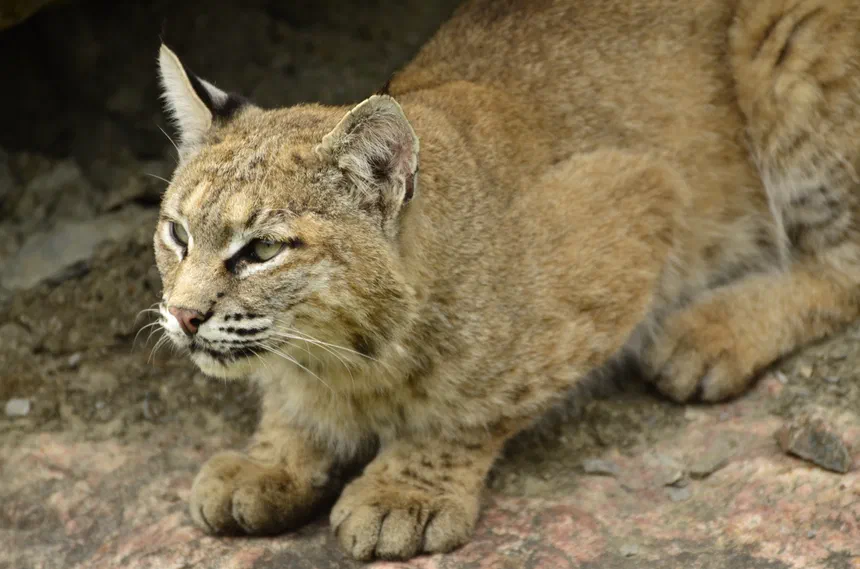
Bobcats are roughly twice the size of a large house cat, standing about 20 inches at the shoulder and measuring 28 to 49 inches from nose to tail tip. Coat color ranges from tan and buff to grayish-brown, patterned with dark spots and streaks that help break up the animal’s outline in dappled cover. Distinctive features include short black ear tufts, a ruff of fur framing the cheeks, and a stubby tail usually 4 to 7 inches long with a black tip that is white on the underside. The eyes are typically pale green or amber, and the underparts are whitish. Coloration tends to be paler and grayer in arid regions and richer and more heavily marked in wetter, forested areas.
Habitat and Range
Few North American mammals occupy as broad a range as the bobcat. Its distribution stretches from southern Canada through most of the contiguous United States and into central Mexico. Bobcats are habitat generalists, living in coniferous and deciduous forests, deserts, chaparral, brushland, swamps, and even the edges of farmland and suburban neighborhoods. They favor areas with dense vegetation, rocky ledges, or thickets that provide cover for hunting and denning. This flexibility has allowed populations to persist and even expand where many other predators have declined.
Diet
The bobcat is a strict carnivore and an efficient ambush hunter. Rabbits and hares form the core of its diet across much of its range, but it readily takes rodents such as mice, voles, and squirrels, along with birds, reptiles, and large insects. When opportunity allows, a bobcat can bring down prey much larger than itself, including young deer, especially in winter when smaller prey is scarce. It hunts by stalking close and then pouncing, relying on keen eyesight and hearing. Bobcats often cache uneaten portions of larger kills, covering them with leaves or snow to return later.
Behavior
Bobcats are solitary and territorial, coming together mainly during the breeding season. Individuals maintain home ranges that they mark with scent, scrapes, and droppings; the ranges of males are larger and may overlap those of several females. They are most active during the twilight hours but adjust their timing to prey availability and human presence. Agile climbers and capable swimmers, bobcats usually rest in rock crevices, hollow logs, or dense brush. Though generally silent, they can produce a range of yowls, hisses, and screams, particularly during the mating season.
Life Cycle and Reproduction
Breeding typically occurs in late winter to early spring. After a gestation of about 60 to 70 days, the female gives birth to a litter of one to six kittens, with two to three being most common. The young are born blind and helpless in a sheltered den and open their eyes at around 10 days. They nurse for roughly two months and begin traveling with their mother to learn hunting skills before dispersing to establish their own territories, usually by their first autumn or winter. Females provide all parental care. In the wild, bobcats commonly live 7 to 12 years, though many die younger.
Conservation Status
The bobcat is listed as Least Concern by the IUCN, reflecting a large, stable, and widely distributed population. It was historically hunted and trapped for its fur, and regulated harvest continues in parts of its range, but populations have generally remained healthy. The main long-term threats are habitat loss and fragmentation, vehicle collisions, and, in some areas, poisoning linked to rodenticides. Overall, the bobcat is considered one of North America’s conservation success stories among wild cats.
Frequently Asked Questions
Are bobcats dangerous to people? Bobcats are shy and generally avoid humans. Attacks on people are extremely rare and are usually linked to sick animals; healthy bobcats prefer to retreat rather than confront.
How can you tell a bobcat from a Canada lynx? Bobcats are smaller, have shorter ear tufts and legs, smaller feet, and a black-tipped tail that is white underneath, whereas the lynx has a fully black tail tip, larger snowshoe-like paws, and longer ear tufts.
Do bobcats live near cities? Yes. Bobcats are adaptable and increasingly turn up in suburban and semi-urban areas, where they hunt rabbits and rodents while mostly staying out of sight.
References
The conservation status and key facts in this profile are supported by these sources:
- Animal Diversity Web — Bobcat (Lynx rufus) (accessed 2026-07-29)
- GBIF — Lynx rufus (Schreber, 1777) (accessed 2026-07-29)
Found an error, source problem, or image concern? Report this page.