Mammals Guide
Blue Whale
What Is a Blue Whale? The blue whale (Balaenoptera musculus) is a marine mammal and the largest animal known to have ever lived, exceeding even the biggest dinosaurs in mass. It belongs to the group of baleen whales …
At a glance
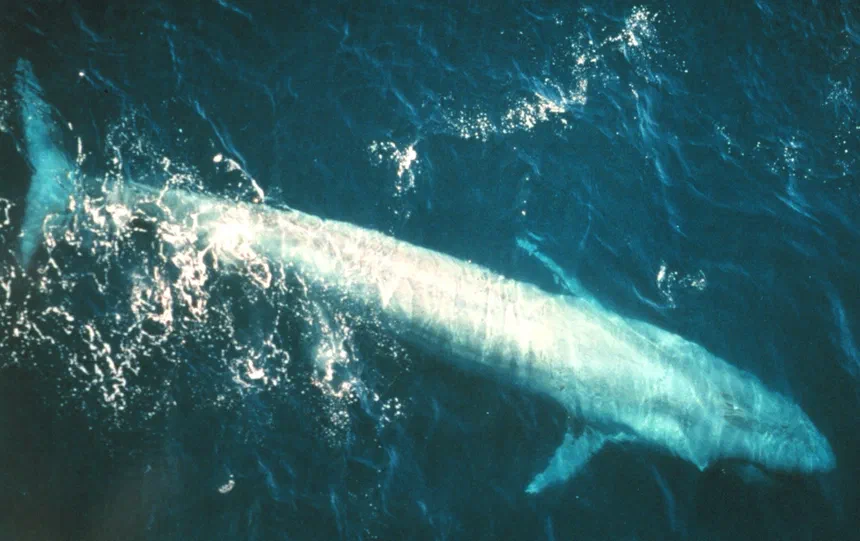
Image: NMFS Northeast Fisheries Science Center (NOAA) — Public domain · source
What Is a Blue Whale?
The blue whale (Balaenoptera musculus) is a marine mammal and the largest animal known to have ever lived, exceeding even the biggest dinosaurs in mass. It belongs to the group of baleen whales called rorquals, which filter tiny prey from seawater rather than hunting individual fish. Despite its enormous size, it feeds almost exclusively on some of the smallest creatures in the ocean.
Appearance and Identification
Blue whales have a long, streamlined body that appears blue-gray underwater but often shows a mottled, lighter pattern when seen up close. The underside can take on a yellowish tinge from microscopic algae, which historically earned the animal the nickname “sulphur-bottom.” The head is broad, flat, and U-shaped when viewed from above, with a single ridge running from the blowholes to the tip of the snout. A small dorsal fin sits far back on the body, and the throat is lined with dozens of expandable grooves that let the mouth balloon outward while feeding. Individuals can reach lengths of around 24 to 30 meters, though most adults fall somewhat below the maximum.
Habitat and Range
Blue whales live in every major ocean, from polar to tropical waters, and are generally creatures of the open sea rather than coastal shallows. Many populations undertake long seasonal migrations, spending summers feeding in cold, productive waters near the poles and moving toward warmer regions in winter to breed and give birth. They tend to travel alone or in small, loose groups, and their distribution closely follows the availability of their prey.
Diet
The blue whale is a carnivore with an extraordinarily specialized diet built almost entirely around krill, small shrimp-like crustaceans that swarm in dense clouds. To feed, the whale lunges into a swarm with its mouth open, taking in an enormous volume of water and prey, then pushes the water back out through fringed plates of baleen that trap the krill inside. During peak feeding season an adult may consume several tons of krill per day, storing energy as blubber to sustain long migrations and fasting periods.
Behavior
Blue whales are generally slow, deliberate swimmers, though they can accelerate to considerable speeds when disturbed. They are among the loudest animals on Earth, producing very low-frequency calls that can travel across great distances underwater and are thought to help individuals communicate over the vast open ocean. Dives typically last several minutes to around ten or more, and the whale announces its return to the surface with a tall, columnar blow of misty spray that can rise many meters into the air.
Life Cycle and Reproduction
Females usually give birth to a single calf after a gestation of roughly 10 to 12 months, generally producing young only once every two to three years. Newborn calves are already among the largest babies in the animal kingdom and grow at a remarkable pace, nursing on extremely rich, fatty milk and gaining substantial weight each day. Calves are weaned at around six to eight months, by which time they have grown large enough to begin feeding independently. Blue whales are long-lived animals, with lifespans commonly estimated at several decades and potentially exceeding eighty years.
Conservation Status
Blue whales were hunted intensively during the era of industrial whaling, and their global numbers were reduced dramatically before international protections took effect. The species is currently listed as Endangered by the IUCN, and while some populations show signs of slow recovery, others remain very small. Ongoing threats include ship strikes, entanglement in fishing gear, ocean noise that can interfere with communication, and shifts in krill availability driven by changing ocean conditions.
Frequently Asked Questions
How big is a blue whale? Adults can reach around 30 meters (roughly 98 feet) and weigh in the neighborhood of 150 tons or more, making them the largest animals known to have ever lived.
What do blue whales eat? Their diet is composed almost entirely of krill, tiny crustaceans that they filter from seawater using baleen plates, sometimes consuming several tons in a single day.
Are blue whales endangered? Yes. After heavy losses from commercial whaling, blue whales are classified as Endangered, and they continue to face threats from ship strikes, entanglement, and environmental change.
References
The conservation status and key facts in this profile are supported by these sources:
- Animal Diversity Web — Balaenoptera musculus (blue whale) (accessed 2026-07-29)
- GBIF — Balaenoptera musculus (Linnaeus, 1758) (accessed 2026-07-29)
Found an error, source problem, or image concern? Report this page.