Mammals Guide
Blackbuck
What Is a Blackbuck? The blackbuck (Antilope cervicapra) is a medium-sized antelope native to the grasslands and open plains of the Indian subcontinent. It is the sole living member of the genus Antilope and is instantly …
At a glance
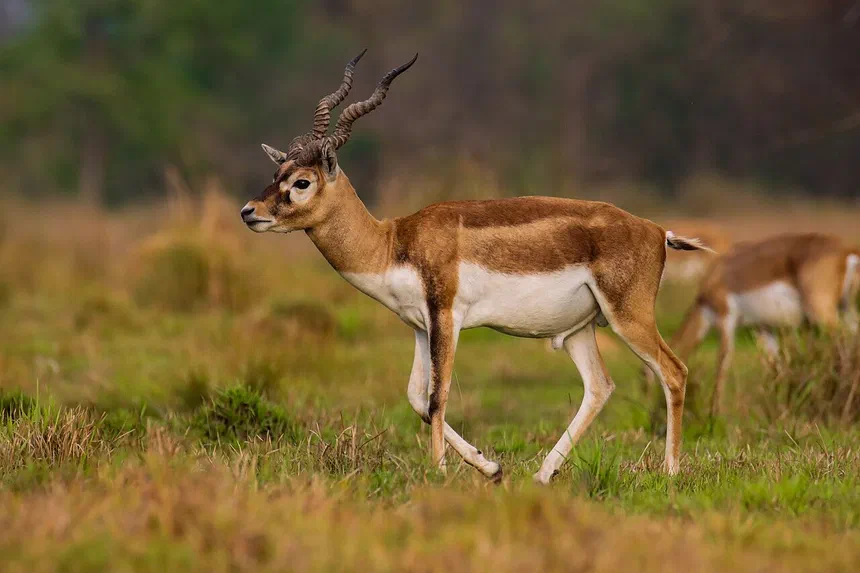
Image: Shadow Ayush — CC BY-SA 4.0 · source
What Is a Blackbuck?
The blackbuck (Antilope cervicapra) is a medium-sized antelope native to the grasslands and open plains of the Indian subcontinent. It is the sole living member of the genus Antilope and is instantly recognizable by the striking two-tone coat of adult males and their long, spiraling horns. Long celebrated in Indian culture and art, the blackbuck is one of the fastest land animals on the subcontinent.
Appearance and Identification
The blackbuck shows pronounced sexual dimorphism. Mature males develop a coat that darkens from tawny to deep brown or nearly black across the back and flanks as they age, contrasting sharply with white underparts, a white chin, and pale rings around the eyes. Females and juveniles remain a lighter yellowish-brown and lack horns. Only males carry the distinctive ringed horns, which spiral in a V-shape and can reach roughly 35-70 cm in length. Adults stand about 60-85 cm at the shoulder and weigh in the range of 20-35 kg, with males generally heavier and more robust than females.
Habitat and Range
Blackbuck favor open, flat country: grasslands, thorn scrub, semi-desert plains, and the margins of agricultural land. They avoid dense forest and thick cover, relying instead on open sightlines and speed to detect and evade predators. Historically abundant across much of India, the species also occurs in parts of Nepal and Pakistan, though its range has contracted considerably due to hunting and habitat loss. Protected populations thrive in reserves such as those in Gujarat, Rajasthan, and Andhra Pradesh. Introduced populations have also become established in Argentina and the United States, particularly in Texas.
Diet
Blackbuck are grazers that feed primarily on grasses, supplementing their diet with herbs, sedges, and occasionally the leaves of low shrubs and cultivated crops. They feed mostly in the cooler hours of morning and evening, resting during the heat of midday. Like many arid-adapted herbivores, they can obtain much of their water from the plants they eat, allowing them to persist in dry habitats where standing water is scarce.
Behavior
Blackbuck are diurnal and social, typically forming herds of a dozen to several dozen animals, though larger aggregations occur where food is plentiful. Herd structure often includes groups of females and young, bachelor groups of males, and territorial adult males. Dominant males establish and defend territories, especially during the breeding season, marking them and displaying to attract females. The blackbuck is renowned for its speed and stamina, capable of sustained running at high speeds and long, bounding leaps that help it outpace predators across open ground.
Life Cycle and Reproduction
Breeding can occur throughout much of the year but often peaks in certain seasons depending on local conditions. Territorial males compete for access to females, and courtship involves scent-marking and stylized posturing. After a gestation of roughly five to six months, a female usually gives birth to a single fawn, which she conceals in vegetation during its first vulnerable weeks. Young are weaned within a few months and reach sexual maturity in one to two years. In the wild, blackbuck typically live about 10-15 years, with some individuals surviving longer under protection.
Conservation Status
The blackbuck is currently classified as Least Concern by the IUCN, reflecting stable and recovering populations within protected areas. This status marks a recovery from earlier decades when hunting and habitat conversion caused sharp declines. The species remains legally protected in India, where it holds cultural significance and benefits from dedicated sanctuaries. Ongoing threats include habitat fragmentation, poaching, and conflict with agriculture, so continued protection of open grassland habitat remains important to its long-term security.
Frequently Asked Questions
Why do only male blackbuck have dark coats and horns? Sexual dimorphism is strong in this species. Males darken with age and grow long spiraling horns used in territorial displays and contests, while females stay tawny and hornless, which helps them blend into grassland surroundings.
How fast can a blackbuck run? Blackbuck are among the fastest antelopes, able to sprint at high speeds and sustain rapid running over long distances, using open terrain and leaping bounds to escape predators.
Where can blackbuck be seen today? They are found in grasslands and reserves across India, Nepal, and Pakistan, with well-known protected populations in states such as Gujarat, Rajasthan, and Andhra Pradesh, plus introduced herds in Argentina and Texas.
References
The conservation status and key facts in this profile are supported by these sources:
- Animal Diversity Web — Antilope cervicapra (blackbuck) (accessed 2026-07-29)
- ITIS — Antilope cervicapra (blackbuck) (accessed 2026-07-29)
Found an error, source problem, or image concern? Report this page.