Mammals Guide
Black Rhinoceros
What Is a Black Rhinoceros? The black rhinoceros (Diceros bicornis) is one of two rhino species native to Africa, distinguished from its larger relative the white rhino by its pointed, prehensile upper lip. Despite its …
At a glance
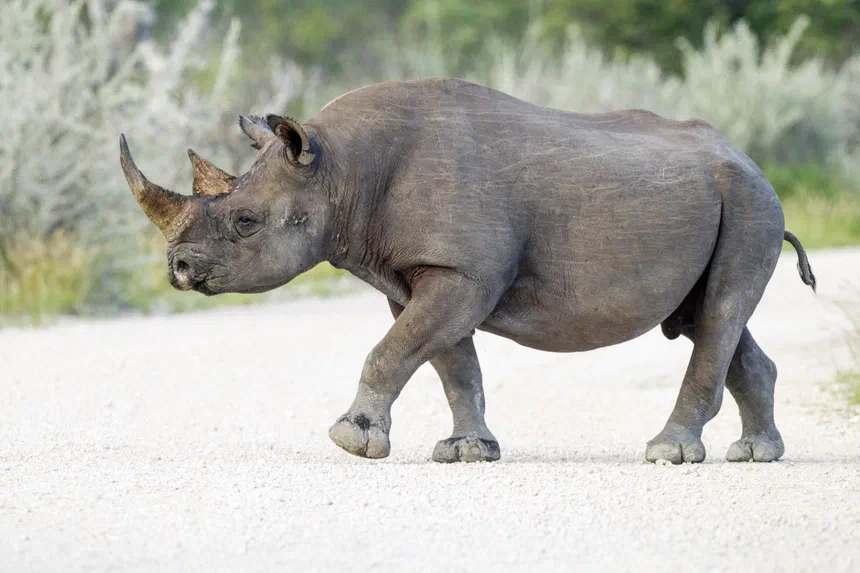
Image: Yathin S Krishnappa — CC BY-SA 3.0 · source
What Is a Black Rhinoceros?
The black rhinoceros (Diceros bicornis) is one of two rhino species native to Africa, distinguished from its larger relative the white rhino by its pointed, prehensile upper lip. Despite its name, it is not truly black but a gray-brown color that often reflects the soil it wallows in. It is a heavily built, thick-skinned herbivore best known for the two keratin horns on its snout.
Appearance and Identification
Black rhinos are stocky, barrel-bodied animals standing roughly 1.4 to 1.7 meters tall at the shoulder and measuring 3 to 3.8 meters in body length. Adults typically weigh between 800 and 1,400 kilograms, with males and females similar in size. The most reliable field marks are the hooked, pointed upper lip used for grasping vegetation and the two horns: a longer front horn, often 40 to 60 centimeters, and a shorter rear horn. Their skin is thick and largely hairless, gray to brown, and they have relatively poor eyesight offset by keen hearing and an excellent sense of smell.
Habitat and Range
The species occupies a variety of habitats across eastern and southern Africa, including savanna grasslands, thorny scrub, and open woodland where browse is plentiful. Historically widespread across much of sub-Saharan Africa, black rhinos are now restricted to fragmented populations concentrated in countries such as South Africa, Namibia, Kenya, Zimbabwe, and Tanzania. Many surviving animals live within protected reserves and fenced conservancies. Access to water for regular drinking and wallowing shapes where they settle.
Diet
Black rhinos are browsers rather than grazers, feeding on the leaves, shoots, twigs, and branches of shrubs and small trees. Their prehensile lip lets them strip foliage and pluck woody stems that grazing animals ignore, and they readily eat thorny and even mildly toxic plants that other browsers avoid. They feed most actively in the cooler hours of morning and evening. Where surface water is available they drink daily, but they can go several days between drinks when necessary.
Behavior
Adult black rhinos are largely solitary, with the strongest social bond being that between a mother and her calf. Individuals occupy home ranges that may overlap, and they mark territory with dung middens and scent. They have a reputation for being unpredictable and quick to charge when startled, relying on smell and hearing rather than their weak vision to assess threats. Wallowing in mud helps regulate body temperature and protects the skin from insects and sun. Oxpecker birds often ride along, feeding on ticks and alerting the rhino to disturbances.
Life Cycle and Reproduction
Females reach breeding age at around four to seven years, males somewhat later. After a gestation of roughly 15 to 16 months, a female gives birth to a single calf weighing around 35 to 45 kilograms. The calf can stand and follow its mother within hours and nurses for about a year, though it may remain with her for two to three years until the next calf is born. Females generally produce a calf every two and a half to four years. In the wild, black rhinos typically live 35 to 45 years.
Conservation Status
The black rhinoceros is classified as Critically Endangered by the IUCN. Relentless poaching for horn, driven by demand in traditional medicine and status markets, combined with habitat loss, caused populations to collapse dramatically through the twentieth century. Intensive protection, anti-poaching patrols, translocations, and managed breeding within conservancies have allowed numbers to recover partially from their lowest point, though several subspecies were lost and the species remains at serious risk. Its survival depends heavily on continued security and habitat management.
Frequently Asked Questions
Why is the black rhino called “black” if it is gray? The name likely arose to contrast it with the white rhino and does not describe its actual color, which is a gray-brown that varies with local mud and dust.
How can you tell a black rhino from a white rhino? The clearest difference is the mouth: black rhinos have a pointed, hooked upper lip for browsing, while white rhinos have a wide, square lip suited to grazing grass.
Are black rhinos dangerous to people? They can be. With poor eyesight and a tendency to charge when alarmed, a startled black rhino may act aggressively, so they are best observed from a safe distance.
References
The conservation status and key facts in this profile are supported by these sources:
- Animal Diversity Web — Diceros bicornis (accessed 2026-07-28)
- GBIF — Diceros bicornis (Linnaeus, 1758) (accessed 2026-07-28)
Found an error, source problem, or image concern? Report this page.