Mammals Guide
Black-Footed Ferret
What Is a Black-Footed Ferret? The black-footed ferret (Mustela nigripes) is a slender, weasel-like carnivore native to the grasslands of central North America. It is North America’s only native ferret species and one of …
At a glance
What Is a Black-Footed Ferret?
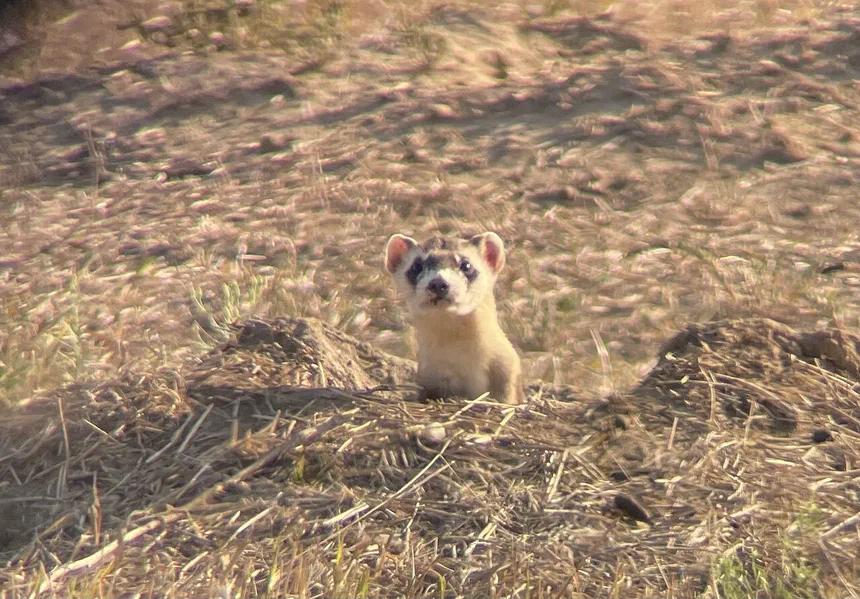
The black-footed ferret (Mustela nigripes) is a slender, weasel-like carnivore native to the grasslands of central North America. It is North America’s only native ferret species and one of the continent’s most endangered mammals, having twice come to the brink of extinction. Closely tied to prairie dogs, it depends almost entirely on these burrowing rodents for both food and shelter.
Appearance and Identification
This ferret has the long, tubular body and short legs typical of the weasel family. Its coat is generally pale tan to yellowish-buff, fading to lighter fur on the underside, while the feet, the tip of the tail, and a distinctive mask across the eyes are black. The face is otherwise pale, giving the animal a striking bandit-like appearance. Adults typically measure about 18 to 24 inches (46 to 61 cm) in total length, including a tail of roughly 5 to 6 inches, and weigh between about 1.4 and 2.5 pounds. Males tend to be somewhat larger than females.
Habitat and Range
Black-footed ferrets are creatures of the open prairie, historically ranging across the Great Plains from southern Canada down into the southwestern United States and northern Mexico. They are inseparable from prairie dog colonies, living in the extensive underground burrow systems that these rodents excavate. The ferret does not dig its own homes but instead occupies and modifies existing prairie dog tunnels for denning, sleeping, and raising young. Because of this dependence, their distribution mirrors that of healthy prairie dog towns, which have themselves been greatly reduced.
Diet
The species is a highly specialized predator. Prairie dogs make up the overwhelming majority of its diet, often estimated at around 90 percent, and a single ferret may eat many prairie dogs over the course of a year. It hunts mostly at night, slipping through burrows to ambush sleeping prey underground. When prairie dogs are scarce, ferrets will supplement their diet with other small animals such as mice, ground squirrels, rabbits, and occasionally birds, but they cannot thrive for long without abundant prairie dogs.
Behavior
Black-footed ferrets are solitary and largely nocturnal, spending the majority of their lives below ground. They are most active in the cooler hours of night, emerging to hunt and travel between burrows, and may spend days at a time underground during harsh weather. Outside of the breeding season, individuals defend loose home ranges and generally avoid one another. Sharp senses of smell and hearing help them navigate the dark tunnel systems where they hunt.
Life Cycle and Reproduction
Breeding usually takes place in spring, around March and April. After a gestation of roughly 40 to 45 days, females give birth to a litter that commonly numbers three to four kits, though larger litters occur. The young are born helpless and remain in the safety of the burrow, nursing and developing before emerging above ground in midsummer. Kits become independent by fall and disperse to establish their own territories. In the wild, black-footed ferrets typically live only three to four years, though individuals in managed care can live somewhat longer.
Conservation Status
The black-footed ferret is classified as Endangered and ranks among the rarest mammals in North America. The species was once thought extinct until a small surviving population was discovered in Wyoming in 1981. Facing collapse, the last known wild individuals were captured in the 1980s to found a captive-breeding program. Decades of intensive effort, including reintroduction to former prairie habitat, have re-established several wild populations. Ongoing threats include the loss of prairie dog colonies, habitat conversion to agriculture, and sylvatic plague, a non-native disease that devastates both ferrets and their prey. Continued recovery depends heavily on protecting prairie dog ecosystems.
Frequently Asked Questions
Are black-footed ferrets the same as pet ferrets? No. Pet ferrets are a domesticated form of the European polecat, a different species. The black-footed ferret is a wild North American animal and cannot be kept as a pet.
Why are they so endangered? Their survival is tightly linked to prairie dogs, which have declined sharply due to habitat loss, poisoning, and plague. When prairie dog numbers fall, ferret populations follow.
How many black-footed ferrets exist today? Thanks to captive breeding and reintroduction, several hundred survive across managed wild populations and breeding facilities, but the species remains highly vulnerable.
References
The conservation status and key facts in this profile are supported by these sources:
- Animal Diversity Web — Mustela nigripes (black-footed ferret) (accessed 2026-07-28)
- GBIF — Mustela nigripes (accessed 2026-07-28)
Found an error, source problem, or image concern? Report this page.