Mammals Guide
Binturong
What Is a Binturong? The binturong (Arctictis binturong) is a large, tree-dwelling mammal of the civet family, Viverridae, native to the forests of South and Southeast Asia. Often called the “bearcat,” it resembles …
At a glance
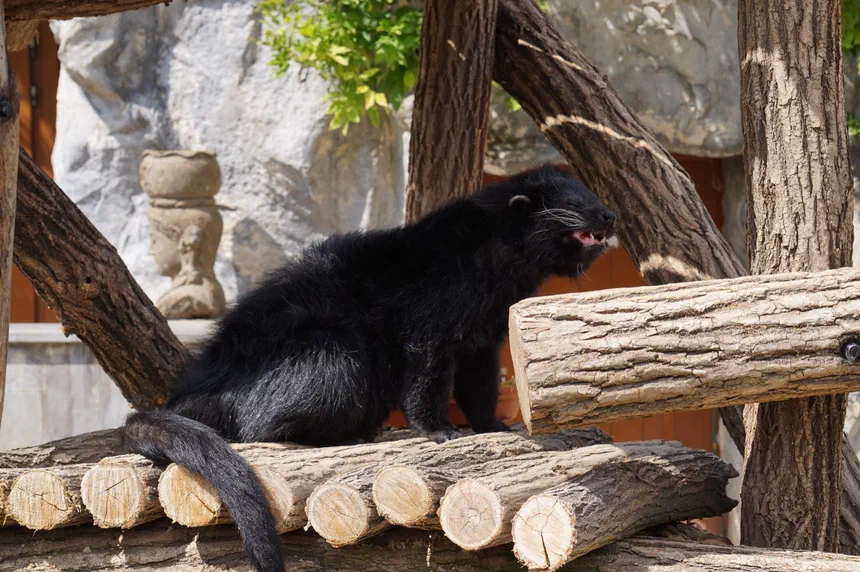
Image: Autharite — CC BY-SA 2.0 · source
What Is a Binturong?
The binturong (Arctictis binturong) is a large, tree-dwelling mammal of the civet family, Viverridae, native to the forests of South and Southeast Asia. Often called the “bearcat,” it resembles neither bears nor cats but is instead a shaggy, slow-moving carnivoran best known for its long, muscular tail and its curious popcorn-like scent.
Appearance and Identification
The binturong has a stocky body covered in coarse, shaggy black fur, with individual hairs often tipped in gray or silver that give the coat a grizzled look. Its rounded head bears a short muzzle, small dark eyes, and prominent white or reddish whiskers, along with distinctive tufts of hair sprouting from the ears. Adults measure roughly 24 to 38 inches (61 to 96 cm) in head-and-body length, with a thick prehensile tail nearly as long as the body itself. Weights vary widely, generally from about 20 to 70 pounds (9 to 32 kg), and females tend to be noticeably larger than males. The binturong is one of only a few carnivorans with a truly grasping tail, which it uses as a fifth limb while climbing.
Habitat and Range
Binturongs inhabit dense, tall tropical and subtropical rainforests where an unbroken canopy allows them to move through the treetops. Their range extends across parts of South and Southeast Asia, including northeastern India, Nepal, Bhutan, Myanmar, Thailand, Laos, Vietnam, Cambodia, peninsular Malaysia, and the islands of Sumatra, Borneo, Java, and Palawan in the Philippines. They depend heavily on mature, undisturbed forest and are rarely found far from continuous tree cover.
Diet
Though classified among the carnivorans, the binturong is largely omnivorous and leans heavily toward fruit. Figs are a particular favorite, and the animal plays an important ecological role as a seed disperser. It also eats leaves, shoots, birds, eggs, insects, small mammals, fish, and carrion when the opportunity arises. Notably, the binturong is one of very few animals whose digestive system can break down the tough outer coating of the strangler fig seed, helping those trees germinate.
Behavior
Binturongs are mainly solitary and most active around dawn, dusk, and night, though they may forage during the day as well. They are slow, deliberate climbers rather than agile leapers, using their prehensile tail and rotating hind ankles to grip branches and descend trees headfirst. A striking feature is their scent: a gland beneath the tail produces a musk that smells remarkably like buttered popcorn, thought to be caused by a compound also found in that snack. This scent marks territory and communicates reproductive status. Binturongs also produce a range of chuckles, grunts, and wailing calls.
Life Cycle and Reproduction
Female binturongs are among the few mammals capable of delayed implantation, allowing them to time births to favorable seasons. After a gestation of roughly 84 to 99 days, a female typically gives birth to one to three young, occasionally more, in a sheltered spot among the trees. Newborns are helpless at first but develop quickly, and young may remain with the mother for some months before dispersing. In the wild, binturongs generally live around 10 to 15 years, though individuals in captivity have lived substantially longer.
Conservation Status
The binturong is listed as Vulnerable on the IUCN Red List, and its numbers are believed to be declining. The chief threats are habitat loss from logging and the conversion of forest to agriculture, which fragments the continuous canopy these animals need. Binturongs are also hunted for meat, taken for the exotic pet trade, and captured for use in traditional medicine. Protecting large tracts of intact rainforest is central to their long-term survival.
Frequently Asked Questions
Why does a binturong smell like popcorn? A scent gland near the base of the tail releases a musky secretion containing a compound also produced when popcorn is made, giving the animal its trademark buttery aroma.
Is a binturong a type of bear or cat? No. Despite the nickname “bearcat,” it belongs to the civet family (Viverridae) and is not closely related to either bears or true cats.
Can a binturong hang from its tail? Its tail is prehensile and strong enough to grip branches and act as an anchor while climbing, though adults are generally too heavy to dangle from it for long.
References
The conservation status and key facts in this profile are supported by these sources:
- Animal Diversity Web — Arctictis binturong (accessed 2026-07-28)
- GBIF — Arctictis binturong (Raffles, 1821) (accessed 2026-07-28)
Found an error, source problem, or image concern? Report this page.