Mammals Guide
Bighorn Sheep
What Is a Bighorn Sheep? The bighorn sheep (Ovis canadensis) is a large wild sheep native to the mountains, foothills, and deserts of western North America. It takes its name from the massive curled horns carried by …
At a glance
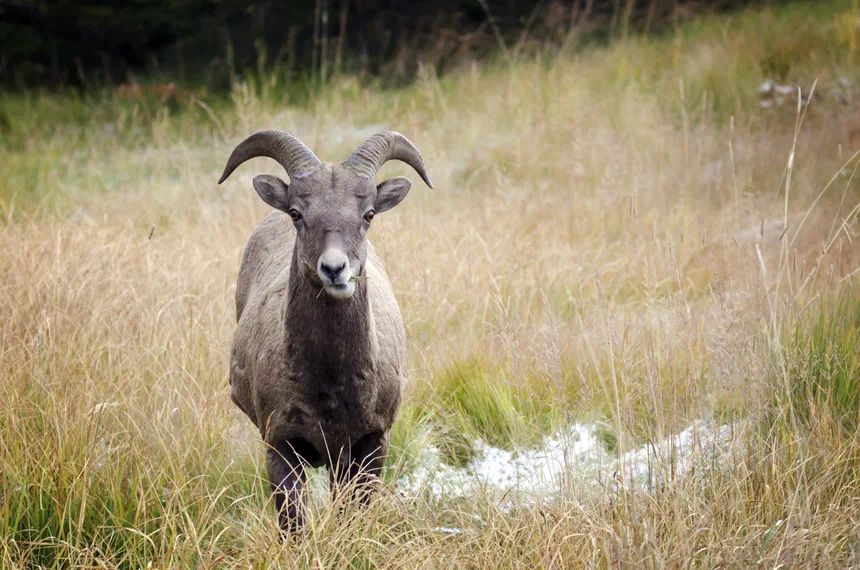
Image: Jakub Fryš — CC BY-SA 4.0 · source
What Is a Bighorn Sheep?
The bighorn sheep (Ovis canadensis) is a large wild sheep native to the mountains, foothills, and deserts of western North America. It takes its name from the massive curled horns carried by mature males, which are among the most recognizable features of any North American mammal. Sure-footed and powerfully built, the species is well adapted to steep, rocky terrain where few large predators can follow.
Appearance and Identification
Bighorn sheep have a stocky, muscular body covered in a coarse coat that ranges from chocolate brown to grayish tan, set off by a pale rump patch and a whitish muzzle and belly. Both sexes grow horns, but they differ sharply. Rams develop thick, spiraling horns that curl back and around the face and can weigh as much as all the bones in the rest of the body combined. Ewes have shorter, slender horns that curve only slightly. Adults typically measure about 1.5 to 1.8 meters in body length and stand roughly 0.8 to 1.0 meters at the shoulder, with rams noticeably larger and heavier than ewes.
Habitat and Range
The species occupies a broad swath of western North America, from the Rocky Mountains and Sierra Nevada south into the deserts of the American Southwest and northern Mexico. Populations favor open, rugged country: alpine meadows, grassy mountain slopes, rocky foothills, and arid canyon systems. A defining requirement is proximity to steep “escape terrain,” where the animals can flee predators using their exceptional climbing ability. Desert-dwelling forms are adapted to survive with little water, drawing much of their moisture from the plants they eat.
Diet
Bighorn sheep are herbivores that graze and browse depending on what their surroundings offer. In mountain habitats they feed heavily on grasses and sedges, while desert populations rely more on shrubs, forbs, and woody browse during dry periods. Like other ruminants, they have a multi-chambered stomach that lets them extract nutrients from tough, fibrous vegetation. They also visit mineral licks to supplement their diet with salts and other nutrients.
Behavior
These sheep are social animals that generally live in sex-segregated groups for much of the year, with ewes, lambs, and juveniles in one band and rams in another. They are most active during daylight, alternating between feeding and resting on high ground where they can watch for danger. Bighorns are famous for the head-butting contests staged by rams during the breeding season, in which two males charge and collide horns in clashes that can be heard from a distance. Their thickened skulls and horns help absorb the tremendous impact.
Life Cycle and Reproduction
The mating season, or rut, typically falls in autumn and early winter, when rams compete for access to ewes through dominance displays and horn-clashing duels. After a gestation of roughly six months, ewes give birth to a single lamb, usually in spring, seeking out secluded cliffs and ledges for protection. Lambs can stand and follow their mothers within hours and are weaned over the following months. Rams continue to grow their horns throughout life, and the horn rings can be used to estimate an individual’s age. Wild bighorns commonly live around 10 to 15 years.
Conservation Status
The bighorn sheep is currently listed as Least Concern by the IUCN, though this broad rating masks a more complicated history. The species suffered dramatic declines in the nineteenth and twentieth centuries due to overhunting, competition with domestic livestock, and especially diseases such as pneumonia transmitted from domestic sheep. Some regional subspecies and populations remain small and vulnerable, and they are the focus of ongoing management, translocation, and habitat-protection programs across the western states.
Frequently Asked Questions
How big can a ram’s horns get? A mature ram’s horns can form a full curl and together weigh on the order of 10 to 14 kilograms, roughly equal to the combined weight of all the other bones in its body.
Why do bighorn rams butt heads? Rams clash horns to establish dominance and win breeding rights during the fall rut. Their reinforced skulls and heavy horns absorb the shock of these high-speed collisions.
Are bighorn sheep endangered? As a species they are classed as Least Concern, but certain populations and subspecies remain at risk from disease and habitat loss and are actively managed to aid their recovery.
References
The conservation status and key facts in this profile are supported by these sources:
- Animal Diversity Web — Ovis canadensis (Bighorn Sheep) (accessed 2026-07-28)
- GBIF — Ovis canadensis Shaw, 1804 (accessed 2026-07-28)
Found an error, source problem, or image concern? Report this page.