Mammals Guide
Bengal Tiger
What Is a Bengal Tiger? The Bengal tiger (Panthera tigris tigris) is a subspecies of tiger native to the Indian subcontinent and the most numerous of the world’s surviving tiger populations. It is one of the largest …
At a glance
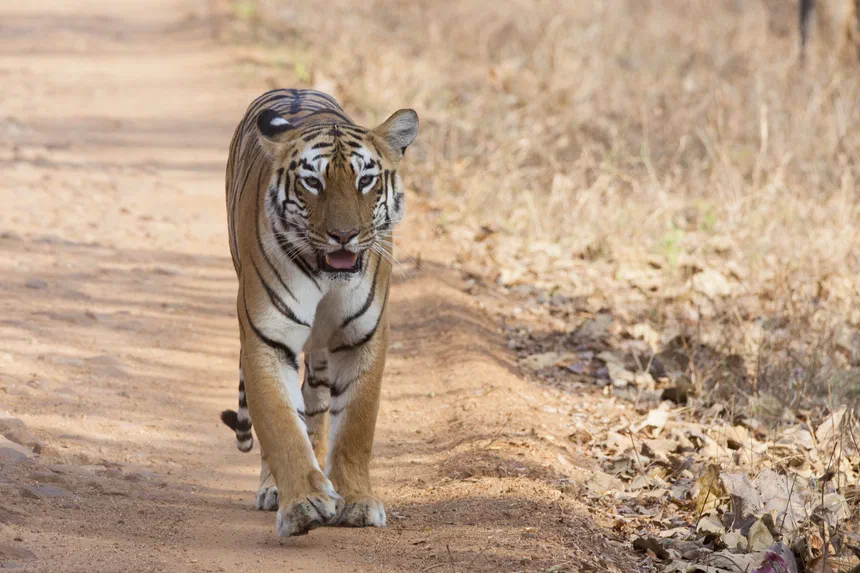
Image: Stephenekka — CC BY-SA 4.0 · source
What Is a Bengal Tiger?
The Bengal tiger (Panthera tigris tigris) is a subspecies of tiger native to the Indian subcontinent and the most numerous of the world’s surviving tiger populations. It is one of the largest living cats and serves as the national animal of both India and Bangladesh. Renowned for its powerful build and striking coat, it sits at the top of the food chain in the ecosystems it inhabits.
Appearance and Identification
Bengal tigers wear a coat that ranges from yellow to a rich reddish-orange, marked with dark vertical stripes that vary in width and spacing. The chest, belly, and inner limbs are white, and the pattern of stripes is unique to each individual, much like a fingerprint. Adult males typically measure 8.5 to 10 feet in total length including the tail and can weigh roughly 400 to 570 pounds, while females are noticeably smaller at around 220 to 350 pounds. Their muscular forelimbs, retractable claws, and long canine teeth make them formidable hunters. A rare recessive gene occasionally produces white tigers with pale coats and dark stripes.
Habitat and Range
This subspecies is found across India, Bangladesh, Nepal, and Bhutan. Bengal tigers occupy a wide variety of environments, including tropical and subtropical moist forests, dry deciduous woodlands, grasslands, and the mangrove swamps of the Sundarbans delta shared by India and Bangladesh. Access to water and dense cover for stalking prey are important features of suitable habitat. Individual tigers hold large territories, which males mark and defend against rivals.
Diet
Bengal tigers are obligate carnivores that rely on large ungulates for the bulk of their diet. Preferred prey includes chital and sambar deer, wild boar, gaur, and nilgai, though they will also take smaller animals when larger prey is scarce. Hunting is done largely by stealth: a tiger approaches quietly and delivers a burst of speed over a short distance, seizing the throat or nape. A single successful kill can sustain an adult for several days, and a large tiger may consume tens of pounds of meat in one feeding.
Behavior
Tigers are primarily solitary and largely nocturnal or crepuscular, being most active during cooler hours. Unlike many big cats, they are strong swimmers and readily enter water to cool off or cross rivers. Communication relies on scent marking, scratch marks on trees, and vocalizations that include roars, moans, and chuffing sounds used at close range. Each adult maintains a home range whose size depends on prey density, and territorial boundaries are advertised rather than constantly patrolled.
Life Cycle and Reproduction
Mating can occur throughout the year, with a peak during cooler months in much of the range. After a gestation of roughly 3.5 months, a female gives birth to a litter of two to four cubs in a sheltered den. Cubs are born blind and helpless, depending entirely on their mother for the first weeks of life. They begin accompanying her on hunts at several months old and gradually learn to kill for themselves, typically becoming independent at around 18 months to two years. Females usually reach breeding age near three years, males a little later.
Conservation Status
The Bengal tiger is listed as Endangered by the IUCN. Habitat loss and fragmentation, depletion of prey, and poaching for skins and body parts used in traditional medicine are the primary threats. Conservation efforts, including India’s network of tiger reserves and anti-poaching programs, have helped stabilize and in some areas increase numbers, making the Bengal population the largest of any tiger subspecies. Continued protection of habitat corridors and reduction of human-wildlife conflict remain central to the animal’s survival.
Frequently Asked Questions
How many Bengal tigers are left in the wild? Estimates place the wild Bengal tiger population in the low thousands, with India holding the majority. Population surveys continue to refine these figures.
Are Bengal tigers dangerous to humans? Tigers generally avoid people, but conflict can occur where habitat overlaps with settlements. The Sundarbans region is historically noted for occasional attacks.
What is a white Bengal tiger? A white tiger is not a separate species but a Bengal tiger with a rare recessive gene that reduces orange pigment, producing a pale coat with dark stripes.
References
The conservation status and key facts in this profile are supported by these sources:
- IUCN Red List — Panthera tigris (Tiger) assessment (accessed 2026-07-28)
- Animal Diversity Web — Panthera tigris (accessed 2026-07-28)
Found an error, source problem, or image concern? Report this page.