Mammals Guide
North American Beaver
What Is a North American Beaver? The North American beaver (Castor canadensis) is the largest rodent in North America and one of the few animals capable of reshaping entire landscapes. Renowned for building dams and …
At a glance
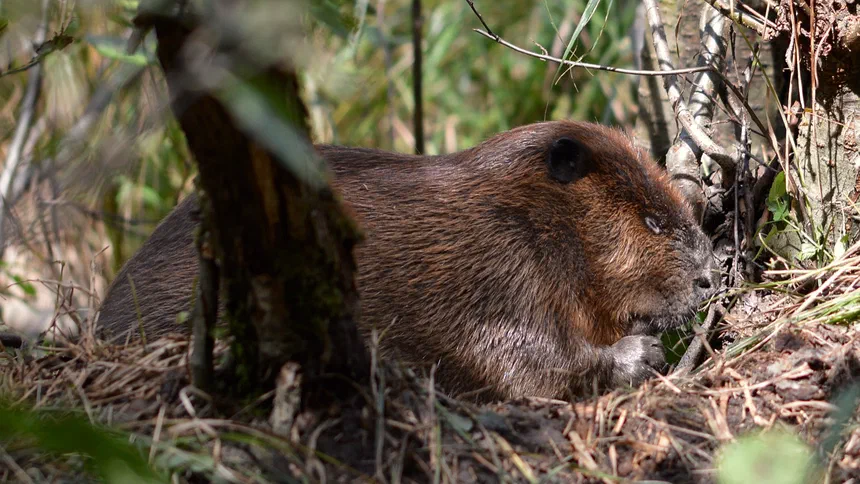
Image: Ryan Hodnett — CC BY-SA 4.0 · source
What Is a North American Beaver?
The North American beaver (Castor canadensis) is the largest rodent in North America and one of the few animals capable of reshaping entire landscapes. Renowned for building dams and lodges, this semiaquatic mammal creates ponds and wetlands that benefit countless other species. It is often described as a keystone species and a natural “ecosystem engineer.”
Appearance and Identification
The beaver has a stocky, rounded body covered in dense, waterproof brown fur, with a coat that is darker along the back and lighter beneath. Its most distinctive feature is a broad, flat, scaly tail that acts as a rudder in water, a prop on land, and a warning device when slapped against the surface.
Beavers have small ears and eyes, webbed hind feet for powerful swimming, and dexterous front paws for handling branches. Their large, chisel-like incisors grow continuously and are coated with hard orange enamel on the front, giving the teeth a distinctive color. Transparent membranes protect the eyes underwater, and valves close off the ears and nostrils when the animal dives.
Habitat and Range
North American beavers live throughout most of the continent, from the forests of Canada and Alaska south through the United States and into parts of northern Mexico. They are absent only from the far north, deserts, and southern Florida.
Their preferred habitats are freshwater environments lined with trees and shrubs: slow-moving rivers, streams, ponds, lakes, and marshes. Where water is too shallow or unstable, beavers build dams from branches, mud, and stones to create the deeper, calmer ponds they need for safety and food storage. Within these ponds they construct dome-shaped lodges with underwater entrances.
Diet
Beavers are strict herbivores. In warmer months they feed heavily on leaves, roots, and soft aquatic vegetation such as water lilies and pondweed. During fall and winter, they rely on the inner bark, or cambium, of trees like aspen, willow, birch, cottonwood, and maple.
To prepare for winter, beavers cut and stockpile branches underwater near their lodge, creating a food cache they can reach even when the pond surface is frozen. Their gnawing on trees is not only for food but also supplies the raw material for dams and lodges.
Behavior
Beavers are mainly nocturnal and crepuscular, doing most of their building, foraging, and repair work under cover of darkness. They are strong, graceful swimmers that can remain submerged for several minutes at a time, though they move more awkwardly on land.
Their engineering behavior is remarkable: they fell trees, dig canals to float branches, and maintain dams that can stretch for many yards. Beavers are territorial and communicate through scent mounds, vocalizations, and the famous tail slap, which alerts family members to danger before the animal dives.
Life Cycle and Reproduction
Beavers are monogamous and typically mate for life, forming close family groups called colonies. A colony usually consists of an adult pair, the current year’s young (kits), and yearlings from the previous litter, all sharing a single lodge.
Mating generally occurs in winter, and after a gestation of about three and a half months, the female gives birth to a litter of usually two to four kits in spring. Kits are born furred, with open eyes, and can swim within days. They remain with the family for around two years, helping with maintenance and caring for younger siblings, before dispersing to establish territories of their own. In the wild, beavers commonly live about 10 to 15 years.
Conservation Status
The North American beaver is listed as Least Concern on the IUCN Red List. Once heavily trapped for its fur and the scent gland secretion castoreum, the species was pushed to low numbers across much of its range by the 1800s. Trapping regulations and reintroduction programs allowed populations to recover strongly, and beavers are now widespread and locally abundant. In many regions they are valued for restoring wetlands, improving water quality, and boosting biodiversity, though their dam-building can sometimes conflict with human land use.
Frequently Asked Questions
Why do beavers build dams? Beavers build dams to raise and stabilize water levels, creating deep ponds that protect them from predators, allow safe underwater lodge entrances, and give them access to stored food during winter.
What is a beaver’s tail used for? The flat, scaly tail serves multiple purposes: it acts as a rudder and stabilizer while swimming, a support prop when the beaver stands to gnaw trees, a fat store for winter, and an alarm signal when slapped loudly against the water.
Are beavers good for the environment? Yes. As keystone ecosystem engineers, beavers create wetlands that filter water, reduce flooding and erosion, recharge groundwater, and provide habitat for fish, amphibians, birds, and many other species.
References
The conservation status and key facts in this profile are supported by these sources:
- IUCN Red List — Castor canadensis (North American Beaver) assessment (accessed 2026-07-28)
- Animal Diversity Web — Castor canadensis (American beaver) (accessed 2026-07-28)
Found an error, source problem, or image concern? Report this page.