Mammals Guide
Barbary Macaque
What Is a Barbary Macaque? The Barbary macaque (Macaca sylvanus) is a tailless monkey native to the mountains of North Africa, with a famous introduced population on the Rock of Gibraltar. It is the only macaque species …
At a glance
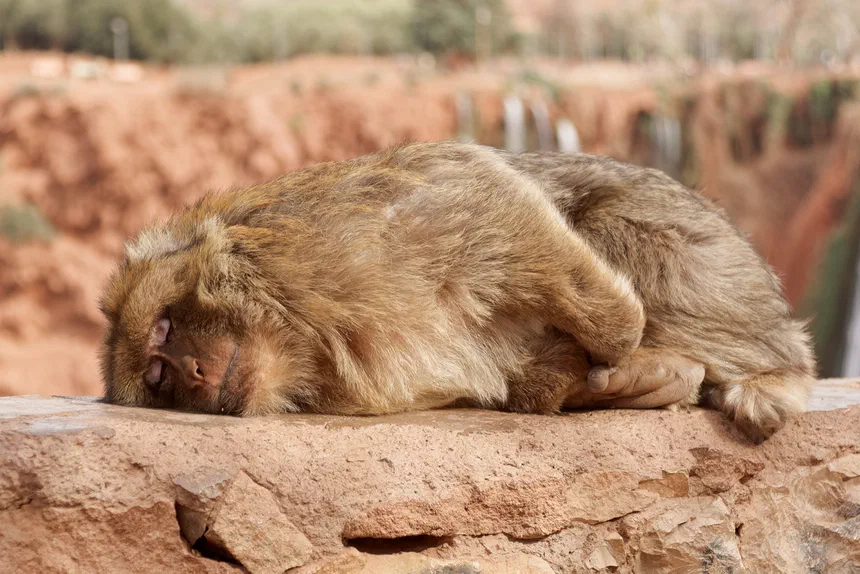
What Is a Barbary Macaque?
The Barbary macaque (Macaca sylvanus) is a tailless monkey native to the mountains of North Africa, with a famous introduced population on the Rock of Gibraltar. It is the only macaque species found outside of Asia and the only wild primate, other than humans, living in Europe. Highly social and adaptable, it has been closely tied to people for centuries.
Appearance and Identification
Barbary macaques are stocky, medium-sized monkeys covered in thick fur that ranges from yellowish-brown to gray, fading to a paler shade on the belly. Their faces are hairless and dark pink, framed by a fringe of longer hair around the cheeks. Unlike most monkeys, they have only a small vestigial tail, which is often mistaken for none at all and has earned them the misleading nickname “Barbary ape.”
Males are noticeably larger and heavier than females. The dense coat is well suited to the cold, snowy winters of their mountain habitat, and it grows thicker in the colder months before molting in spring. Cheek pouches allow them to gather food quickly and store it for later chewing.
Habitat and Range
The species survives in scattered populations across the Atlas and Rif mountain ranges of Morocco and Algeria. It favors cedar and oak forests but also occupies scrubland, rocky gorges, and high-elevation slopes where few other primates could endure the climate. Some groups live at elevations exceeding 6,000 feet, coping with winter snow and summer heat.
A separate population lives on Gibraltar, at the southern tip of Europe. These monkeys were introduced or maintained by people over past centuries and are now a well-known local attraction, forming the continent’s only free-ranging primates besides humans.
Diet
Barbary macaques are opportunistic omnivores with a varied, seasonal diet. They eat leaves, fruit, seeds, flowers, roots, bark, and fungi, supplementing plant matter with insects and other small invertebrates. In cedar forests they strip bark and feed on cedar needles when other foods are scarce, a habit that sometimes brings them into conflict with foresters.
Their flexible feeding habits help them survive in a harsh, changeable environment. In Gibraltar and near towns, some groups have grown reliant on food from tourists, which alters their natural behavior and can cause health problems.
Behavior
These monkeys live in troops of many individuals that include multiple males, females, and young. Social bonds are maintained through frequent grooming, and the group has a complex dominance hierarchy. Barbary macaques are notable among primates for the strong role males play in caring for infants, often carrying and grooming young that may not be their own.
They are active during the day, foraging on the ground and in trees, and communicate through a range of calls, facial expressions, and body postures. During cold nights, troop members huddle together for warmth in sheltered spots among rocks or trees.
Life Cycle and Reproduction
Breeding is seasonal, and after a gestation of roughly five to six months a female usually gives birth to a single infant. Newborns have dark fur that lightens as they grow. Infants are a focus of intense interest within the troop, handled and carried by many adults, including males.
Young macaques are weaned within about a year but continue to learn social skills from the group for several more years. Females typically remain in their birth troop for life, while males often disperse to join other groups. In the wild, individuals may live around 20 years or more.
Conservation Status
The Barbary macaque is listed as Endangered on the IUCN Red List, with wild numbers declining across its North African range. The main threats are habitat loss from logging and grazing, drought linked to a changing climate, and the illegal capture of infants for the pet trade, which has taken a heavy toll on some populations.
Conservation efforts include forest protection, anti-poaching work, and campaigns to discourage tourists from feeding or buying the animals. The well-studied Gibraltar population, though small and managed, has helped raise public awareness of the species.
Frequently Asked Questions
Why is the Barbary macaque called an ape if it is a monkey? Its very short, barely visible tail led people to call it the “Barbary ape,” but it is a true monkey. The nickname is a long-standing misnomer rather than a scientific classification.
Where can you see Barbary macaques in the wild? They live in the mountain forests of Morocco and Algeria, and a famous free-ranging group inhabits the Rock of Gibraltar, the only wild monkeys in Europe.
Are Barbary macaques endangered? Yes. They are classified as Endangered, with populations falling due to habitat loss, drought, and illegal capture of infants for the pet trade.
References
The conservation status and key facts in this profile are supported by these sources:
- IUCN Red List — Macaca sylvanus assessment (accessed 2026-07-28)
- Animal Diversity Web — Macaca sylvanus (accessed 2026-07-28)
Found an error, source problem, or image concern? Report this page.