Mammals Guide
Banded Mongoose
What Is a Banded Mongoose? The banded mongoose (Mungos mungo) is a small, highly social carnivore native to much of sub-Saharan Africa. It takes its name from the series of dark transverse bands that run across the lower …
At a glance
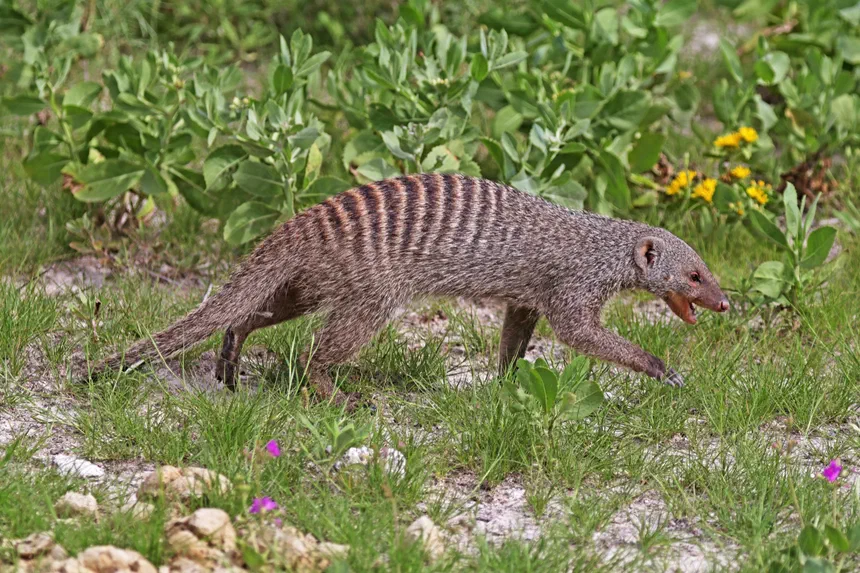
Image: Charles J. Sharp — CC BY-SA 4.0 · source
What Is a Banded Mongoose?
The banded mongoose (Mungos mungo) is a small, highly social carnivore native to much of sub-Saharan Africa. It takes its name from the series of dark transverse bands that run across the lower back and rump, a marking that sets it apart from the many solitary mongoose species. Unlike most of its relatives, this animal lives in tight-knit groups and forages together throughout the day.
Appearance and Identification
Banded mongooses are stocky, ground-dwelling animals with a coarse coat that appears grizzled gray to grayish-brown. The defining feature is a set of roughly 10 to 15 dark bands stretching horizontally across the back between the shoulders and the base of the tail. They have short legs, strong curved claws suited to digging, a pointed snout, and small rounded ears. Adults typically measure about 12 to 18 inches (30 to 45 cm) in head-and-body length, with a tapering tail nearly as long as the body, and weigh roughly 3 to 5 pounds (1.3 to 2.3 kg). Males and females look broadly similar in size and coloration.
Habitat and Range
The species occupies a wide belt of sub-Saharan Africa, from parts of West Africa across the east and down into southern regions. It favors savanna, open woodland, grassland, and scrub, and is often found near rivers, thickets, or rocky outcrops that provide shelter. Termite mounds are a preferred refuge, and groups will also use hollow logs, burrows dug by other animals, and crevices as dens. Banded mongooses adapt well to areas near human settlement and are sometimes seen in cultivated or park landscapes where cover and food are available.
Diet
Banded mongooses are primarily insectivorous, and beetles and their larvae make up a large share of the diet. They also take millipedes, grasshoppers, termites, ants, and other invertebrates, along with occasional small vertebrates such as reptiles, amphibians, birds, eggs, and rodents. Foraging is done by scratching and digging through leaf litter and loose soil with the claws and snout. Some individuals learn to break open hard-shelled prey or eggs by hurling them backward against a rock or other hard surface.
Behavior
This mongoose is intensely social, living in groups that commonly number from around 10 to 30 individuals, though larger packs occur. The group forages as a loose, mobile band during daylight, keeping in near-constant contact through a variety of chirps, twitters, and calls. Group members share sentinel duty, with individuals watching for predators such as raptors, snakes, and larger carnivores while the others feed. Mongooses cooperate in defending the group and will mob threats collectively. They move between den sites every few days rather than staying in one place, and grooming and huddling help reinforce social bonds.
Life Cycle and Reproduction
Reproduction in banded mongooses is notably communal. Several females in a group often come into breeding condition around the same time and give birth within a few days of one another, producing a synchronized litter. Gestation lasts roughly two months, and litters typically contain two to six pups. Because births are synchronized, pups are reared in a shared den and cared for by the wider group. Adults act as “escorts,” with a particular helper often bonding with and provisioning a single pup until it can forage on its own. This cooperative care improves pup survival, and young reach independence within a few months.
Conservation Status
The banded mongoose is listed as Least Concern by the IUCN. It has a broad range, tolerates a variety of habitats, and remains common across much of that range. It faces no major species-wide threats, though local populations can be affected by habitat change and disease. In some areas the species is studied intensively, and long-term research groups have made it one of the better-understood social mammals in Africa.
Frequently Asked Questions
Are banded mongooses dangerous to people? No. They are small, shy of humans, and pose no real threat, though like any wild animal they may bite if cornered or handled.
Do banded mongooses really eat snakes? They occasionally take small snakes, but their diet is dominated by insects and other invertebrates rather than the large snakes popularly associated with mongooses.
Why do they live in such large groups? Group living provides shared vigilance against predators, cooperative defense, and communal care of young, all of which improve survival in open habitats.
References
The conservation status and key facts in this profile are supported by these sources:
- Animal Diversity Web — Mungos mungo (banded mongoose) (accessed 2026-07-28)
- GBIF — Mungos mungo (Gmelin, 1788) (accessed 2026-07-28)
Found an error, source problem, or image concern? Report this page.