Mammals Guide
Bactrian Camel
What Is a Bactrian Camel? The Bactrian camel (Camelus bactrianus) is a large, two-humped mammal native to the cold deserts and steppes of Central and East Asia. It is one of the world’s few surviving true camels and is …
At a glance
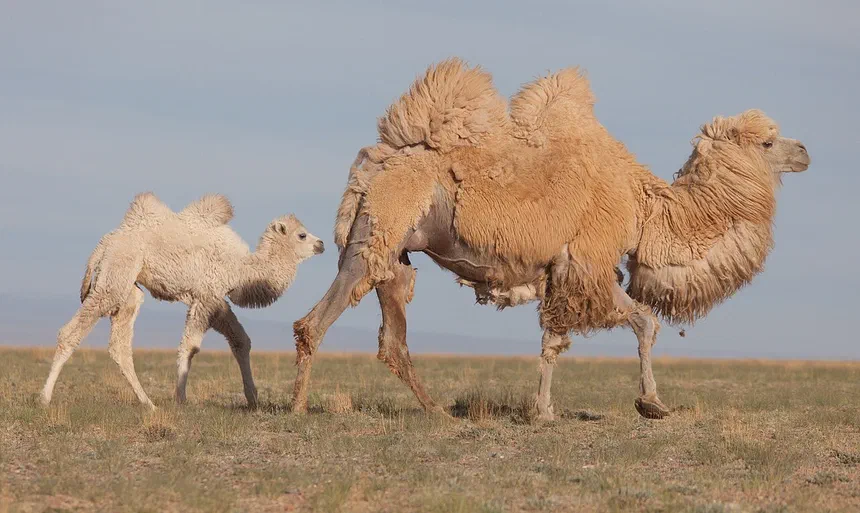
Image: Alexandr frolov — CC BY-SA 4.0 · source
What Is a Bactrian Camel?
The Bactrian camel (Camelus bactrianus) is a large, two-humped mammal native to the cold deserts and steppes of Central and East Asia. It is one of the world’s few surviving true camels and is easily distinguished from the single-humped dromedary by its pair of fatty humps. Most Bactrian camels today are domesticated, though a small, separately recognized wild population persists in remote regions of Mongolia and China.
Appearance and Identification
The most striking feature of this camel is its two humps, which store fat rather than water and can flop to one side when the animal is undernourished. Bactrian camels are heavily built, standing roughly 1.6 to 1.8 meters at the shoulder and weighing anywhere from about 300 to 1,000 kilograms depending on sex and condition. Their coat is thick and shaggy, ranging from sandy brown to dark brown, and it grows long in winter for insulation before being shed in ragged patches during warmer months. Adaptations to harsh environments include long eyelashes, sealable nostrils that keep out blowing sand, and broad, tough footpads that spread across loose ground.
Habitat and Range
Bactrian camels are built for extremes. They inhabit arid steppe, rocky desert, and semi-desert where temperatures can swing from bitterly cold winters to scorching summers. The domestic form is found across a wide belt of Central and East Asia, including Mongolia, northern China, Kazakhstan, and neighboring regions. The remaining wild population is restricted to isolated pockets of the Gobi Desert and adjacent areas in Mongolia and China, where surface water is scarce and vegetation is sparse.
Diet
As herbivores, Bactrian camels browse and graze on a wide variety of plants, including grasses, shrubs, leaves, and dry or thorny vegetation that many other animals avoid. Their tough mouths and specialized digestive systems allow them to process coarse, low-nutrient forage. They are remarkably tolerant of salty plants and brackish water, and can go long periods without drinking. When water is available, a thirsty camel can take in a very large quantity in a single session to rehydrate.
Behavior
Bactrian camels are generally social animals, often moving in small groups. Domestic herds are managed by people for transport, wool, milk, and meat, while wild individuals form loose bands led by a dominant male. They are well adapted to conserving energy and water, tolerating dehydration and large fluctuations in body temperature that would endanger many mammals. Camels communicate through a range of grunts, bellows, and moans, and males can become aggressive during the breeding season.
Life Cycle and Reproduction
Breeding is seasonal, typically timed so that births coincide with more favorable conditions. After a gestation of roughly 13 months, a female usually gives birth to a single calf, which is able to stand and walk within hours. Calves nurse for over a year and remain closely associated with their mothers during that time. Sexual maturity is reached at around three to five years of age. In captivity and under good care, Bactrian camels can live for several decades.
Conservation Status
The domesticated Bactrian camel is common and classified as Least Concern, but the wild Bactrian camel (often treated as Camelus ferus) is a distinct and gravely threatened animal, listed as Critically Endangered. Only a small number of wild individuals remain, threatened by habitat loss, hunting, competition with livestock, and hybridization with domestic camels. Protected areas and captive-breeding programs in Mongolia and China aim to safeguard the last of these truly wild camels.
Frequently Asked Questions
How is a Bactrian camel different from a dromedary? A Bactrian camel has two humps and a thick, shaggy coat suited to cold deserts, while the dromedary has a single hump and is adapted to hot desert regions.
Do the humps store water? No. The humps store fat, which the camel can draw on for energy when food is scarce. This is why the humps shrink and may droop when the animal is poorly fed.
Are wild Bactrian camels the same as the ones people ride? Not quite. The wild population is genetically distinct and critically endangered, and is often classified separately as Camelus ferus, while most camels people use are domesticated Camelus bactrianus.
References
The conservation status and key facts in this profile are supported by these sources:
- IUCN Red List — Camelus ferus (Wild Camel) assessment (accessed 2026-07-28)
- Animal Diversity Web — Camelus bactrianus (Bactrian camel) (accessed 2026-07-28)
Found an error, source problem, or image concern? Report this page.