Mammals Guide
Baboon
What Is a Baboon? Baboons are large, ground-dwelling monkeys belonging to the genus Papio, among the biggest and most widespread primates in Africa. The olive baboon (Papio anubis), sometimes called the anubis baboon, is …
At a glance
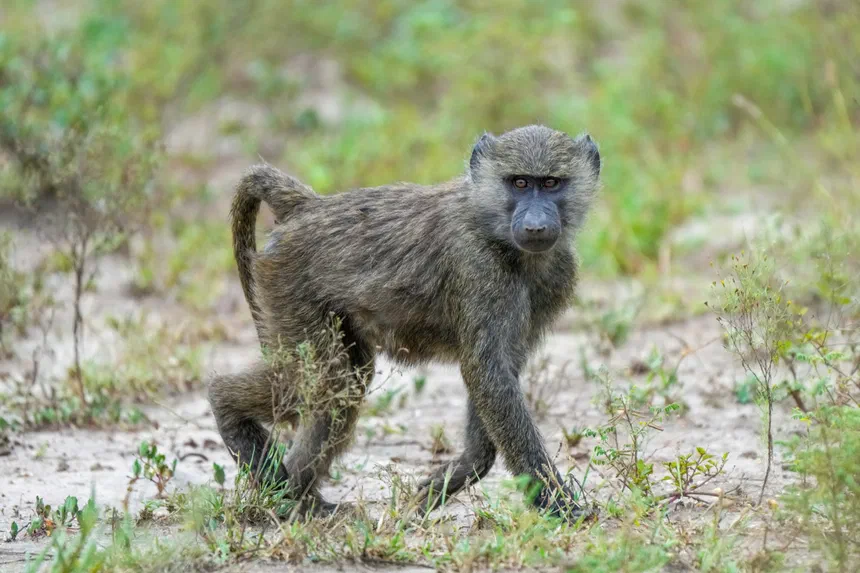
Image: Giles Laurent — CC BY-SA 4.0 · source
What Is a Baboon?
Baboons are large, ground-dwelling monkeys belonging to the genus Papio, among the biggest and most widespread primates in Africa. The olive baboon (Papio anubis), sometimes called the anubis baboon, is one of the most common species and ranges across a broad band of central Africa. Highly social and adaptable, baboons thrive in habitats where many other primates cannot.
Appearance and Identification
Baboons are robustly built with a distinctive dog-like muzzle, powerful jaws, and long canine teeth, especially in males. The olive baboon takes its name from its greenish-gray to olive-brown coat, which appears speckled up close due to banded hairs. Males are considerably larger than females, often weighing nearly twice as much, and sport a cape of longer hair over the shoulders. Both sexes have close-set eyes, prominent brow ridges, and a hairless, dark-skinned face. Their hindquarters feature tough, calloused sitting pads called ischial callosities. The tail is carried in a characteristic arch, rising sharply near the base before drooping toward the tip.
Habitat and Range
Olive baboons occupy the largest geographic range of any baboon species, stretching across roughly two dozen African countries from Mali and Guinea in the west to Ethiopia, Kenya, and Tanzania in the east. They favor open savannas, grasslands, and light woodland but also tolerate rocky hills, forest edges, and semi-arid scrub. Access to water and safe sleeping sites, such as tall trees or cliffs, strongly shapes where troops settle. Baboons have proven remarkably flexible, and some populations live close to farmland and human settlements.
Diet
Baboons are opportunistic omnivores with an unusually varied diet. They forage for grasses, seeds, roots, tubers, fruits, flowers, and pods, digging with their hands for underground bulbs during dry seasons. They also eat insects, birds’ eggs, shellfish, and small vertebrates, and troops will occasionally hunt young antelope, hares, or other small mammals. This dietary breadth is a key reason baboons survive in environments ranging from lush riverbanks to arid plains. Their strong cheek pouches let them gather food quickly and process it later in safer surroundings.
Behavior
Baboons live in large, complex social groups called troops, which can range from a dozen to well over a hundred individuals. These troops are organized around overlapping hierarchies of related females and competing males, and rank strongly influences access to food, mates, and grooming partners. Communication is rich and varied, involving grunts, barks, screams, facial expressions, and postures. Grooming reinforces social bonds and helps maintain alliances. Troops travel together during the day to forage and return to sleeping sites at dusk, where numbers offer protection from predators such as leopards, lions, and hyenas.
Life Cycle and Reproduction
Baboons breed throughout the year rather than in a fixed season. Females signal fertility with conspicuous swelling and reddening of the skin around the hindquarters, which attracts males and often triggers competition. After a gestation of roughly six months, a female typically gives birth to a single infant, which clings to her belly at first and later rides on her back. Infants are cared for intensively and may nurse for a year or more. Young females usually remain in their birth troop for life, while males disperse to other troops as they mature. In the wild, baboons commonly live 20 to 30 years.
Conservation Status
The olive baboon is currently listed as Least Concern by the IUCN, reflecting its wide range, large population, and adaptability. Unlike many primates, baboons are not immediately threatened by habitat loss and can persist in modified landscapes. However, they frequently come into conflict with farmers when they raid crops, and are sometimes killed as pests. Localized hunting and habitat fragmentation can pressure individual populations, but the species as a whole remains abundant across much of sub-Saharan Africa.
Frequently Asked Questions
Are baboons dangerous to humans? Baboons are powerful animals with long canines and can be aggressive if cornered or if food is involved, but they generally avoid people and attacks are uncommon. Problems most often arise where baboons have learned to associate humans with easy food.
What is the difference between an olive baboon and other baboons? The olive baboon is distinguished mainly by its greenish-gray coat and by having the widest distribution of any baboon. Other species, such as the yellow, chacma, and Guinea baboons, differ in color, size, and range, and all belong to the same genus, Papio.
How intelligent are baboons? Baboons are highly intelligent primates with excellent memories and sophisticated social knowledge. They can recognize dozens of individuals, track social relationships, and solve problems related to foraging and group living.
References
The conservation status and key facts in this profile are supported by these sources:
- IUCN Red List — Papio anubis (Olive Baboon) assessment (accessed 2026-07-28)
- Animal Diversity Web — Papio anubis (Anubis / Olive Baboon) (accessed 2026-07-28)
Found an error, source problem, or image concern? Report this page.