Mammals Guide
Axis Deer
What Is a Axis Deer? The axis deer (Axis axis), also widely known as the chital or spotted deer, is a medium-sized member of the deer family native to the Indian subcontinent. It is easily recognized by its bright …
At a glance
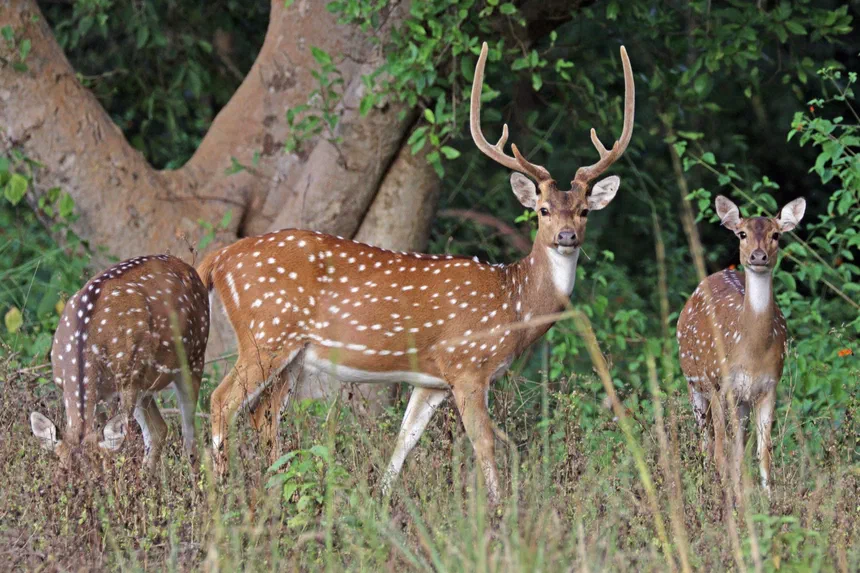
Image: Charles J. Sharp — CC BY-SA 4.0 · source
What Is a Axis Deer?
The axis deer (Axis axis), also widely known as the chital or spotted deer, is a medium-sized member of the deer family native to the Indian subcontinent. It is easily recognized by its bright reddish coat marked with rows of white spots that persist throughout adult life. Highly social and adaptable, it is one of the most abundant wild deer across much of India.
Appearance and Identification
The axis deer has a striking golden to reddish-brown coat scattered with white spots arranged in loose rows along the flanks and back, with a paler white underside, throat, and inner legs. A dark stripe often runs down the spine. Males are larger than females and carry slender, lyre-shaped antlers that typically bear three tines per side and can reach lengths of around 60 to 90 cm (24 to 35 in). Adults generally stand about 60 to 100 cm (24 to 39 in) at the shoulder and weigh roughly 30 to 75 kg, with males at the heavier end of that range. Unlike some deer, the axis deer retains its spotted pattern into adulthood, making it distinctive year-round.
Habitat and Range
Native to India, Nepal, Sri Lanka, and Bangladesh, the axis deer favors open deciduous and semi-evergreen forests, woodland edges, and grassy clearings, usually staying within reach of water. It thrives in mosaics of forest and grassland where grazing and cover are both available. The species has been widely introduced beyond its native range, with established populations in places such as Hawaii, Texas, parts of Australia, Argentina, and several other regions, where it sometimes competes with native wildlife and livestock.
Diet
Axis deer are herbivores and largely grazers, feeding heavily on grasses, especially fresh growth after rains. They also browse on leaves, shoots, herbs, and fallen fruit, and will consume flowers and mushrooms when available. They often forage beneath fruiting trees and are known to follow troops of langur monkeys, feeding on foliage and fruit the monkeys drop from the canopy. Access to drinking water is important, and herds typically visit waterholes regularly.
Behavior
Highly gregarious, axis deer form herds that can range from a few individuals to several dozen, and much larger aggregations gather where food is plentiful. Herds are often loosely structured, with females and young forming the core and males associating more variably. They are active mainly during the cooler hours of morning and late afternoon, resting in shade during midday heat. Alert and vocal, they give sharp alarm barks when predators such as tigers, leopards, or dholes are detected, and their calls are often used by other animals as warning signals. Their keen senses and speed are their main defenses.
Life Cycle and Reproduction
Axis deer can breed throughout the year, though local peaks in births are common depending on climate and food availability. Males compete for access to females, using their antlers in sparring contests and vocal displays during the rut. After a gestation of roughly seven to seven and a half months, a female usually gives birth to a single fawn, occasionally twins. Fawns are spotted from birth and are hidden in vegetation during their earliest days before joining the herd. Sexual maturity is reached at around one to two years of age. In the wild, axis deer typically live about 8 to 14 years, with longer lifespans recorded in captivity.
Conservation Status
The axis deer is listed as Least Concern by the IUCN, reflecting its large population and wide distribution across the Indian subcontinent. It remains common within protected reserves and national parks, where it is an important prey species for large predators. Localized pressures include habitat loss, poaching, and competition with livestock, but none currently threaten the species overall. In regions where it has been introduced, the axis deer can become abundant enough to be managed as an invasive species.
Frequently Asked Questions
Is the axis deer the same as the chital? Yes. “Chital” and “spotted deer” are common names for the same species, Axis axis, native to the Indian subcontinent.
Do axis deer keep their spots as adults? Yes. Unlike many deer that lose their juvenile spots, axis deer retain their white spotted coat throughout their lives.
Where are axis deer found outside India? Introduced populations are established in places such as Hawaii, Texas, Australia, and Argentina, where they were brought largely for hunting and ornamental purposes.
References
The conservation status and key facts in this profile are supported by these sources:
- IUCN Red List — Axis axis (Chital) assessment (accessed 2026-07-28)
- Animal Diversity Web — Axis axis (chital) (accessed 2026-07-28)
Found an error, source problem, or image concern? Report this page.