Mammals Guide
Asiatic Black Bear
What Is a Asiatic Black Bear? The Asiatic black bear (Ursus thibetanus) is a medium-sized forest bear native to a broad swath of southern and eastern Asia. It is easily recognized by the pale, crescent-shaped mark across …
At a glance
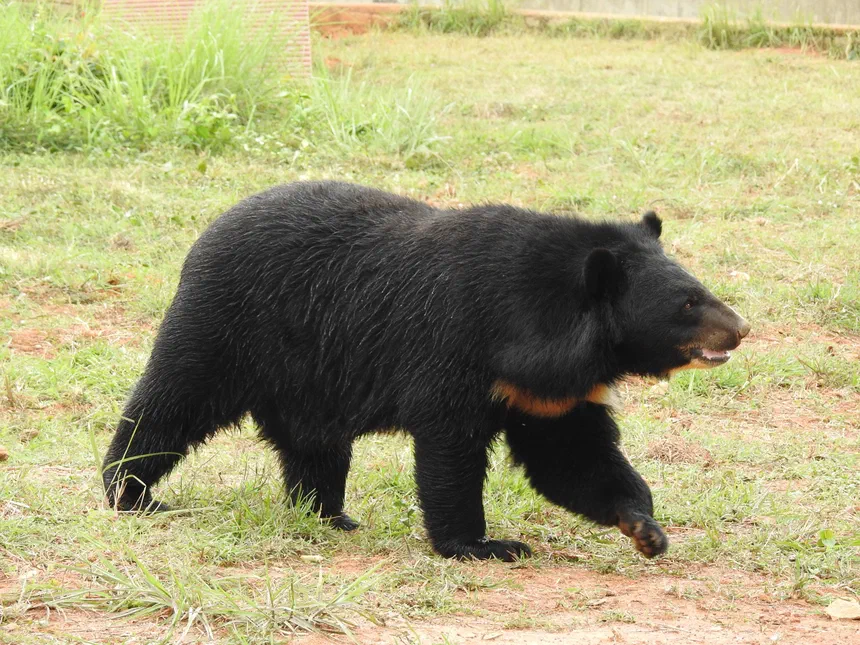
Image: Dr. Raju Kasambe — CC BY-SA 4.0 · source
What Is a Asiatic Black Bear?
The Asiatic black bear (Ursus thibetanus) is a medium-sized forest bear native to a broad swath of southern and eastern Asia. It is easily recognized by the pale, crescent-shaped mark across its chest, which has earned it the common nicknames “moon bear” and “white-chested bear.”
Appearance and Identification
Asiatic black bears have a sleek black coat, though some individuals appear dark brown. The most distinctive feature is the cream or yellowish V- or crescent-shaped patch on the chest, which varies in size and shape from one bear to the next. The fur around the neck and shoulders is often longer, forming a shaggy ruff or mane.
Compared with many other bears, this species has a lighter build, a rounded head, and notably large, rounded ears set well apart. Adults typically stand about 2.5 to 3.5 feet (0.7 to 1 meter) at the shoulder. Males are considerably heavier than females. Strong, curved claws and flexible limbs make these bears among the most capable tree climbers in the bear family.
Habitat and Range
The Asiatic black bear ranges widely across Asia, from Iran and Afghanistan through the Himalayas and the Indian subcontinent, into Southeast Asia, China, the Korean Peninsula, the Russian Far East, and parts of Japan and Taiwan. Populations are patchy and often separated by human development.
These bears favor forested hills and mountains, including broadleaf and mixed woodlands. In warmer months they may move to higher elevations, descending to lower, milder forests as winter approaches and food becomes scarce. Access to trees and dense cover is important throughout their range.
Diet
Asiatic black bears are opportunistic omnivores with a seasonal diet. Much of their food is plant-based, including fruits, berries, acorns and other nuts, buds, and succulent green vegetation. In autumn they feed heavily on energy-rich nuts and fruit to build fat reserves before the colder months.
They also consume insects such as ants and bee larvae, along with honey, and will take small vertebrates or carrion when available. On occasion they raid crops or beehives, which can bring them into conflict with farmers living near forest edges.
Behavior
These bears are generally solitary outside of mating and mother-cub groups. They are skilled climbers and spend considerable time in trees, where they feed and sometimes build rough platforms of bent branches to reach fruit. Activity is often greatest around dawn and dusk, though patterns shift with season and food supply.
In colder parts of their range, Asiatic black bears enter a winter dormancy, denning in tree hollows, caves, or dug-out shelters. In milder southern regions they may remain active year-round. Though usually shy and inclined to avoid people, they can be defensive if surprised or when protecting cubs.
Life Cycle and Reproduction
Mating generally takes place in the warmer months, and females give birth during the winter denning period, often to two cubs. As in other bears, development of the embryo can be delayed so that birth is timed to the safety of the den. Newborn cubs are tiny and helpless, relying entirely on their mother.
Cubs remain with their mother for well over a year, learning to forage and climb before becoming independent. Females typically breed only every couple of years. In the wild these bears may live for two to three decades, with some individuals reaching greater ages in protected settings.
Conservation Status
The Asiatic black bear is listed as Vulnerable by the IUCN, with populations broadly declining. The two greatest threats are habitat loss from logging and land conversion, and poaching. Bears are hunted for their gallbladders, bile, paws, and other body parts used in some traditional medicine and trade.
Conservation efforts include protected areas, anti-poaching enforcement, rescue and rehabilitation of bears from illegal captivity, and programs to reduce conflict between bears and rural communities.
Frequently Asked Questions
Why is it called a moon bear? The name refers to the pale, crescent- or moon-shaped patch of light fur on the animal’s chest, a hallmark of the species.
Are Asiatic black bears related to American black bears? Yes, they are close relatives within the same genus, but they are separate species found on different continents.
Do Asiatic black bears hibernate? Bears in colder, northern parts of the range enter winter dormancy in a den, while those in warmer southern regions may stay active through the year.
References
The conservation status and key facts in this profile are supported by these sources:
- IUCN Red List — Ursus thibetanus (Asiatic Black Bear) assessment (accessed 2026-07-28)
- Animal Diversity Web — Ursus thibetanus (Asiatic black bear) (accessed 2026-07-28)
Found an error, source problem, or image concern? Report this page.