Mammals Guide
Asian Small-Clawed Otter
What Is a Asian Small-Clawed Otter? The Asian small-clawed otter (Aonyx cinereus) is the smallest of the world’s otter species and one of the most social. Native to the wetlands of South and Southeast Asia, it is easily …
At a glance
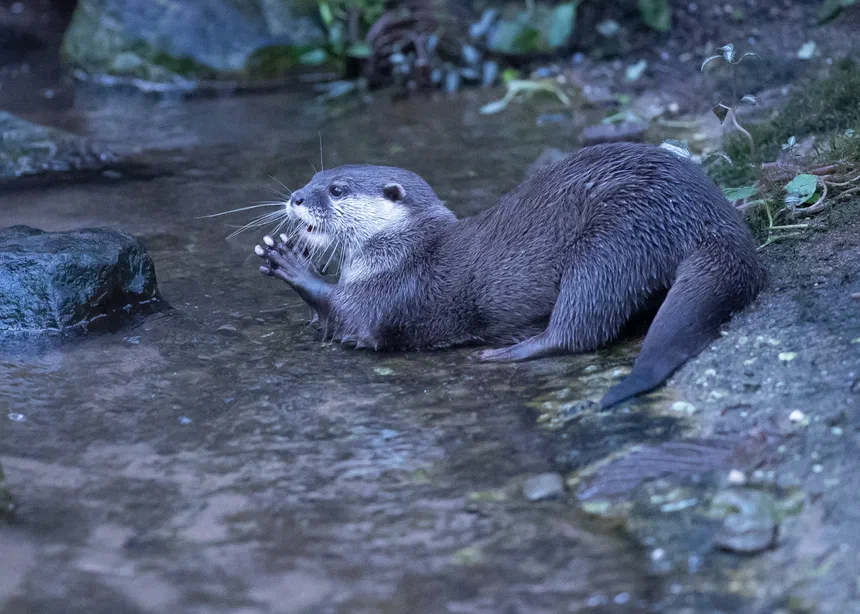
Image: Theo Kruse Burgers' Zoo — CC BY-SA 4.0 · source
What Is a Asian Small-Clawed Otter?
The Asian small-clawed otter (Aonyx cinereus) is the smallest of the world’s otter species and one of the most social. Native to the wetlands of South and Southeast Asia, it is easily recognized by its compact body, expressive face, and remarkably dexterous, partly clawed paws that it uses much like hands.
Appearance and Identification
As its name suggests, this otter is small and slender, with adults rarely exceeding about a yard in total length including the tail. The dense fur is dark grayish-brown across the back and sides, fading to a lighter cream or grayish tone on the throat, cheeks, and underside. This double-layered coat traps air and keeps the animal warm and buoyant in the water.
The species’ most distinctive feature is its feet. Unlike most otters, it has only partial webbing and short, blunt claws that do not extend past the fleshy tips of the toes. This gives the paws exceptional sensitivity and grip, allowing the otter to probe mud, turn over stones, and manipulate prey with fine control. A broad, whiskered muzzle and small rounded ears complete its appearance.
Habitat and Range
Asian small-clawed otters live across a wide swath of South and Southeast Asia, from parts of India and Nepal through southern China and down into Indonesia and the Philippines. They favor shallow freshwater habitats, including slow rivers and streams, marshes, swamps, and mangrove estuaries. In many regions they also thrive in human-shaped landscapes such as flooded rice paddies and irrigation channels.
These otters depend on healthy, food-rich wetlands with plenty of cover along the banks. They tend to stay close to water, using vegetation, root tangles, and burrows for shelter and resting sites.
Diet
This otter is a carnivore with a diet built around small aquatic animals. Crabs, snails, mussels, and other shellfish make up a large share of its meals, supplemented by small fish, insects, frogs, and the occasional egg. Its sensitive forepaws are ideal for feeling out prey hidden in mud or beneath rocks.
Rather than relying on sharp claws to seize food, the small-clawed otter often catches prey with its paws and uses its strong, broad rear teeth to crush hard shells. Some individuals have been observed setting shellfish aside to let the shells open in the sun before eating.
Behavior
Asian small-clawed otters are highly social and typically live in extended family groups that may include a breeding pair and their offspring from several litters. Group members communicate through a varied range of chirps, whistles, and other calls, and they reinforce social bonds through play, grooming, and shared use of communal latrine sites that also mark territory.
They are active and agile both in water and on land, and are known for their playful behavior, including sliding and object handling. Much of their day is spent foraging, grooming their insulating fur, and resting together in secure spots near the water.
Life Cycle and Reproduction
Small-clawed otters usually form long-term breeding pairs, and the group cooperates to raise the young. After a gestation of roughly two months, the female gives birth to a litter that commonly ranges from one to several pups, born blind and helpless in a den near the water.
Older siblings and the father often help by bringing food and guarding the den, an unusual level of family cooperation among otters. Pups open their eyes after a few weeks, begin swimming lessons soon after, and are weaned within a few months, gradually learning to forage before becoming independent. Individuals may live around 10 to 15 years in the wild and sometimes longer in managed care.
Conservation Status
The Asian small-clawed otter is listed as Vulnerable on the IUCN Red List, and its populations are believed to be declining. Major threats include the loss and degradation of wetland habitat, water pollution, and reduced prey from overfishing. The species is also affected by hunting and by capture for the illegal pet trade, which has grown in some regions. Protecting clean, connected wetlands is central to securing its future.
Frequently Asked Questions
How big is an Asian small-clawed otter? It is the smallest otter in the world, with adults generally weighing only a few pounds and measuring roughly a yard from nose to tail tip.
What does it eat? Its diet centers on shellfish such as crabs and mollusks, along with small fish, insects, and amphibians, which it locates using its sensitive front paws.
Why is it called “small-clawed”? Unlike most otters, its claws are short and blunt and do not project beyond the toes, leaving nimble, partly webbed paws that work almost like hands.
References
The conservation status and key facts in this profile are supported by these sources:
- IUCN Red List — Aonyx cinereus (Asian Small-clawed Otter) assessment (accessed 2026-07-28)
- Animal Diversity Web — Aonyx cinereus (accessed 2026-07-28)
Found an error, source problem, or image concern? Report this page.