Mammals Guide
Asian Palm Civet
What Is a Asian Palm Civet? The Asian palm civet (Paradoxurus hermaphroditus) is a small, cat-sized carnivore native to South and Southeast Asia. Despite its slender, feline appearance, it is not a cat but a member of …
At a glance
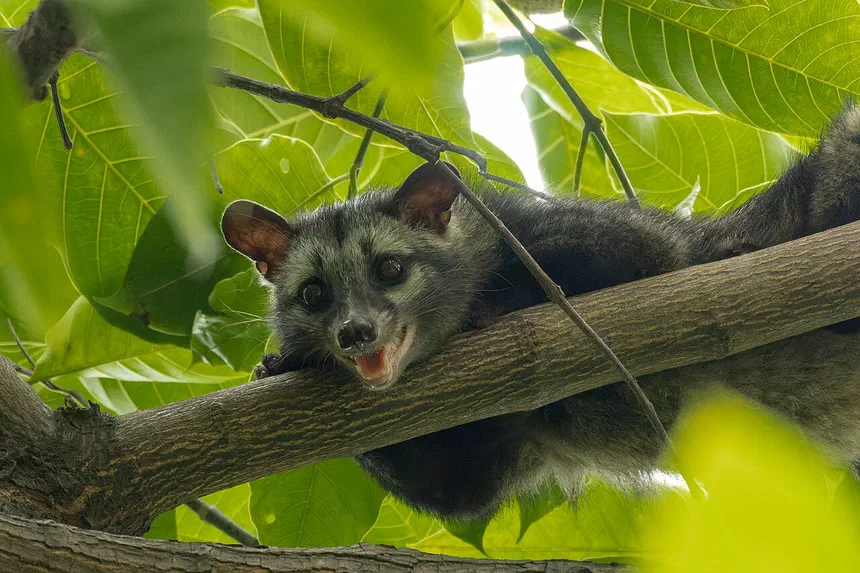
Image: Tisha Mukherjee — CC BY-SA 4.0 · source
What Is a Asian Palm Civet?
The Asian palm civet (Paradoxurus hermaphroditus) is a small, cat-sized carnivore native to South and Southeast Asia. Despite its slender, feline appearance, it is not a cat but a member of the family Viverridae, which includes the civets and genets. It is well known for its nocturnal, tree-climbing lifestyle and for its close and sometimes uneasy relationship with people.
Appearance and Identification
The Asian palm civet has a long, low-slung body, short legs, and a bushy tail that is nearly as long as the rest of the animal. Its coarse coat ranges from grayish to dark brown, marked with darker spots along the flanks and lengthwise stripes down the back. A distinctive dark “mask” runs across the face, with pale patches beneath the eyes and around the muzzle.
The head is broad with a pointed snout, rounded ears, and prominent whiskers suited to sensing its surroundings in the dark. Its feet bear semi-retractable claws that give a strong grip for climbing. Both males and females carry scent glands near the base of the tail, which they use to mark territory and communicate.
Habitat and Range
This adaptable animal occurs widely across South and Southeast Asia, from India and Sri Lanka through southern China and into the Malay Peninsula, Indonesia, and the Philippines. It favors tropical and subtropical forests but is remarkably flexible in its choice of home.
The Asian palm civet is often found close to human settlements, living in plantations, orchards, gardens, and even the roof spaces of buildings. This tolerance for modified landscapes has helped it remain common across much of its range, though it also brings it into frequent contact, and occasional conflict, with people.
Diet
The Asian palm civet is an omnivore with a strong preference for ripe fruit. It feeds heavily on figs, palm fruits, and other soft, sugary fruits, and in doing so acts as an important seed disperser for many forest plants. It also drinks the sap of palm flowers, a habit that earns it the local name “toddy cat” in some regions.
Beyond fruit, the civet takes a variety of small animals, including insects, worms, small reptiles, rodents, and birds. Its willingness to eat a wide range of foods allows it to thrive in disturbed and agricultural habitats where more specialized species struggle.
Behavior
Asian palm civets are mostly nocturnal and solitary, spending the day resting in tree hollows, dense foliage, or sheltered nooks before becoming active after dark. They are skilled and agile climbers, moving confidently through the branches in search of fruit, though they also forage on the ground.
Individuals maintain home ranges that they mark with secretions from their scent glands. They are generally quiet and secretive, but can produce growls and other calls during encounters. In areas near people, they sometimes raid fruit crops or take up residence in attics, which can make them unpopular neighbors.
Life Cycle and Reproduction
Asian palm civets do not have a strict breeding season across much of their range and may reproduce at various times of the year. Females typically give birth to a small litter, often around two to four young, after a gestation of roughly two months.
The young are usually raised in a sheltered den such as a tree hollow. They develop over several weeks under the mother’s care before becoming independent. In the wild, individuals commonly live for about a decade or more, though many face threats from predators, road traffic, and habitat loss.
Conservation Status
The Asian palm civet is listed as Least Concern by the IUCN, reflecting its wide distribution, large population, and ability to live alongside humans. It remains common in many areas and is not considered at immediate risk of extinction.
Nonetheless, the species faces localized pressures. It is hunted in some regions and captured for the trade in “civet coffee,” in which partly digested coffee cherries are collected from the animals. Concerns have been raised about the poor conditions of civets kept for this purpose, making animal welfare a growing conservation issue.
Frequently Asked Questions
Is the Asian palm civet a type of cat? No. Although it looks cat-like and is sometimes called a “toddy cat,” it belongs to the family Viverridae, a group of small carnivores separate from true cats.
What is its connection to coffee? The civet eats ripe coffee cherries, and beans recovered from its droppings are used to make a costly specialty coffee. The practice has drawn criticism over the treatment of captive animals.
Are Asian palm civets dangerous to people? They are generally shy and avoid humans. Conflict is usually limited to raiding fruit crops or nesting in buildings rather than any real threat to people.
References
The conservation status and key facts in this profile are supported by these sources:
- IUCN Red List — Paradoxurus hermaphroditus assessment (accessed 2026-07-28)
- Animal Diversity Web — Paradoxurus hermaphroditus (accessed 2026-07-28)
Found an error, source problem, or image concern? Report this page.