Mammals Guide
Asian Elephant
What Is a Asian Elephant? The Asian elephant (Elephas maximus) is the largest living land animal in Asia and the only surviving member of its genus. Smaller than its African relatives, it is a highly intelligent, deeply …
At a glance
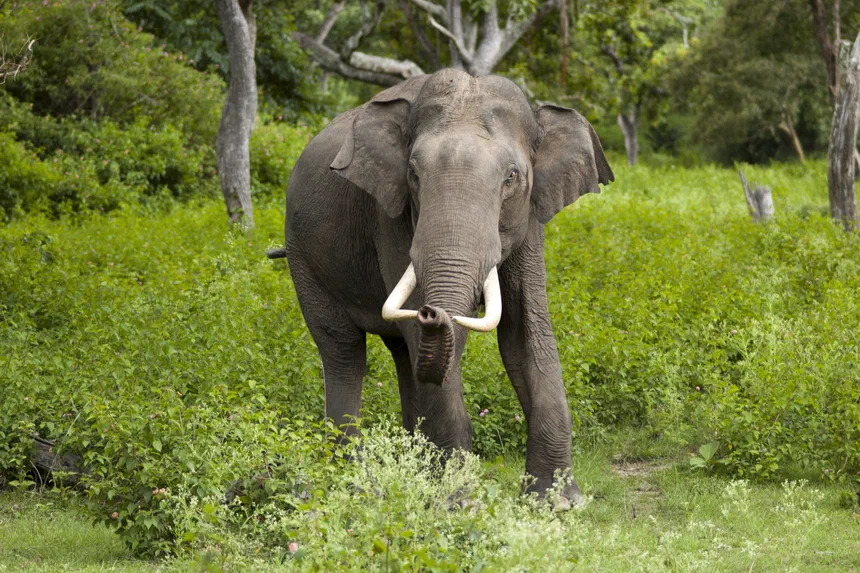
Image: Yathin S Krishnappa — CC BY-SA 3.0 · source
What Is a Asian Elephant?
The Asian elephant (Elephas maximus) is the largest living land animal in Asia and the only surviving member of its genus. Smaller than its African relatives, it is a highly intelligent, deeply social mammal that has lived alongside people for thousands of years, playing a lasting role in the region’s cultures, religions, and working traditions.
Appearance and Identification
Asian elephants are massive, gray to brownish animals with thick, wrinkled skin that is often flecked with pink or depigmented patches, especially around the ears, trunk, and forehead. Adults generally stand between 6.5 and 11 feet tall at the shoulder, and bulls (males) are noticeably larger and heavier than cows (females).
Several features distinguish this species from African elephants. Asian elephants have smaller, rounded ears, a more arched or humped back, and a trunk that ends in a single finger-like projection rather than two. The head has two prominent domes on top. Tusks are typically carried only by some males, while females and many males have short tusks or none at all. The trunk, a fusion of nose and upper lip, is remarkably versatile, capable of both delicate picking and heavy lifting.
Habitat and Range
Asian elephants inhabit a range of environments across South and Southeast Asia, including tropical and subtropical forests, grasslands, and scrublands. Their range is now highly fragmented, with populations scattered across countries such as India, Sri Lanka, Thailand, Myanmar, and parts of Indonesia and Malaysia. India holds the largest share of the wild population.
These elephants favor areas that offer a mix of forest cover, open feeding grounds, and reliable water. They must drink regularly and rely on water and mud for cooling and skin care. Herds often move seasonally between feeding areas, though expanding farmland and settlements have increasingly confined and divided their habitat.
Diet
Asian elephants are herbivores with enormous appetites, feeding for much of the day and night. A single adult can eat well over 300 pounds of vegetation daily and drinks large volumes of water. Their diet is varied and shifts with the seasons, including grasses, leaves, bark, stems, roots, and fruit, along with cultivated crops when wild food is scarce.
Because their digestive systems process plant matter inefficiently, elephants must consume large quantities to meet their needs. As they feed, they disperse seeds in their dung and open up dense vegetation, helping to shape and maintain the forests and grasslands they inhabit.
Behavior
Asian elephants are intensely social. The core group is a family herd of related females and their young, usually led by an experienced older female, the matriarch, whose knowledge of resources and routes benefits the whole herd. Adult bulls tend to leave their birth herd as they mature and live alone or in loose associations, joining females mainly to breed.
Communication is complex, involving trumpets, rumbles, body postures, touch, and low-frequency infrasound that can carry over long distances. Elephants show signs of strong social bonds and high intelligence, including cooperation, problem-solving, and apparent care for injured or dead herd members.
Life Cycle and Reproduction
Asian elephants reproduce slowly. Gestation lasts around 18 to 22 months, among the longest of any mammal, and normally produces a single calf. Newborns are large and depend heavily on their mothers and other herd females, who help protect and guide them.
Calves nurse for several years and continue learning survival skills well into youth. Females typically become able to breed in their early teens, while bulls may not compete successfully for mates until later in life. This slow reproductive pace means populations recover only gradually from losses.
Conservation Status
The Asian elephant is classified as Endangered on the IUCN Red List. Its main threats are the loss and fragmentation of habitat as forests are cleared for agriculture and development, which in turn fuels conflict with people when elephants raid crops or enter settlements. Poaching for ivory, skin, and other parts, along with the capture of animals from the wild, adds further pressure. Protecting large, connected habitats and reducing human-elephant conflict are central to the species’ long-term survival.
Frequently Asked Questions
How can you tell an Asian elephant from an African elephant? Asian elephants are generally smaller, with smaller rounded ears, a more arched back, twin domes on the head, and a trunk tip with a single finger-like lip. Prominent tusks are usually limited to some males.
Are Asian elephants endangered? Yes. The IUCN lists them as Endangered, mainly due to habitat loss and fragmentation, human-elephant conflict, and poaching.
What do Asian elephants eat? They are strict herbivores, feeding on grasses, leaves, bark, stems, roots, and fruit, and sometimes on crops such as rice, sugarcane, and bananas.
References
The conservation status and key facts in this profile are supported by these sources:
- Animal Diversity Web — Elephas maximus (Asian Elephant) (accessed 2026-07-28)
- ITIS — Elephas maximus (Asian Elephant) (accessed 2026-07-28)
Found an error, source problem, or image concern? Report this page.