Mammals Guide
Nine-Banded Armadillo
What Is a Nine-Banded Armadillo? The nine-banded armadillo (Dasypus novemcinctus) is a small, armored mammal named for the flexible bands of bony plates that ring the middle of its body. It is the most widespread of all …
At a glance
What Is a Nine-Banded Armadillo?
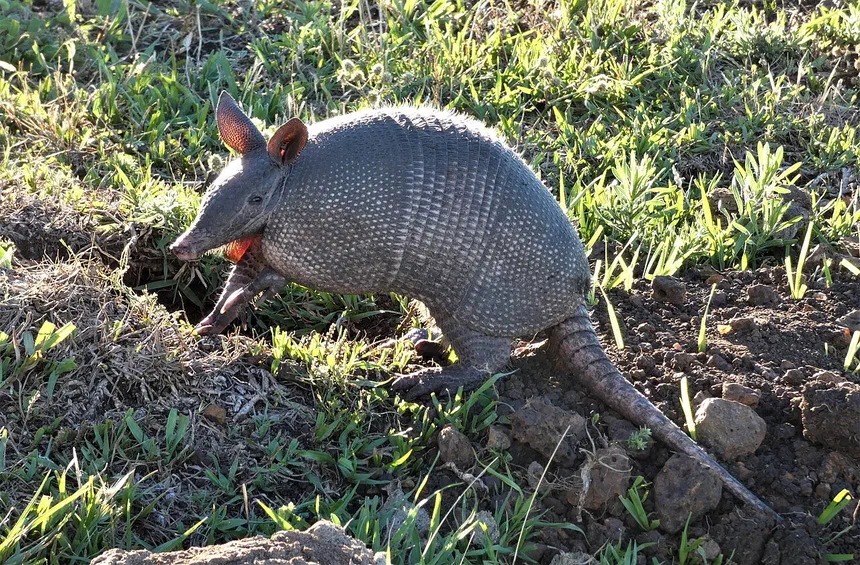
The nine-banded armadillo (Dasypus novemcinctus) is a small, armored mammal named for the flexible bands of bony plates that ring the middle of its body. It is the most widespread of all armadillo species and the only one that lives in the United States. Despite its name, the number of movable bands can vary somewhat from one individual to the next.
Appearance and Identification
This animal is easily recognized by its distinctive shell, a covering of tough, leathery skin reinforced with small bony plates called scutes. Rigid shields protect the shoulders and hips, while the hinged central bands allow the body to bend and twist. The coloration is generally grayish-brown, blending well with soil and leaf litter.
An adult typically measures roughly 15 to 23 inches in head and body length, with a long, tapering, armored tail that can nearly double its overall size. The head is narrow and cone-shaped, ending in a pointed snout, and the ears are prominent. The legs are short but sturdy, and the strong front feet carry large claws well suited to digging. Weight usually falls somewhere between 6 and 14 pounds.
Habitat and Range
Nine-banded armadillos occupy a broad range that stretches from the south-central and southeastern United States down through Mexico, Central America, and much of South America. Over the past century their range has expanded steadily northward in the U.S., a shift often linked to milder winters and few natural predators.
They favor areas with loose, workable soil where they can dig burrows and probe for food. Suitable habitats include woodlands, brushy thickets, grasslands, scrub, and the margins of wetlands and streams. Because they tolerate cold poorly and cannot store much fat, their spread is limited mainly by harsh winters and prolonged drought.
Diet
The nine-banded armadillo is primarily an insectivore and opportunistic omnivore. The bulk of its diet consists of insects and their larvae, especially beetles, ants, termites, and grubs, along with earthworms, spiders, and other small invertebrates. It will also eat some plant material such as fruit and roots, and occasionally small amphibians, reptile eggs, or carrion.
Armadillos forage mainly by smell, using their keen noses to detect prey hidden in the soil. They root through leaf litter and dig shallow, cone-shaped pits with their claws, then lap up exposed insects with a long, sticky tongue. Much of their feeding takes place at dawn, dusk, or after dark.
Behavior
These animals are mostly solitary and spend a large part of their lives underground. Each individual may maintain several burrows within its home range, using them for shelter, resting, and raising young. They are strong, prolific diggers, and their tunnels also provide refuge for many other wildlife species.
Nine-banded armadillos have poor eyesight but a sharp sense of smell and good hearing. When startled they can move surprisingly fast, and they are capable swimmers. To cross water they may either float by gulping air to increase buoyancy or simply walk along the bottom of a shallow stream. A well-known escape response is a sudden vertical leap into the air, which unfortunately makes them prone to collisions with vehicles.
Life Cycle and Reproduction
Reproduction in this species involves a remarkable quirk: a single fertilized egg routinely splits to produce genetically identical quadruplets, so a typical litter consists of four same-sex young. Females can also delay implantation, holding the fertilized egg in a dormant state for months before development begins.
The young, called pups, are born with soft, leathery skin that hardens as they grow. They can walk within hours and begin foraging with the mother before long, becoming independent after a few months. Sexual maturity is generally reached within the first year or two, and individuals may live roughly 7 to 15 years in the wild.
Conservation Status
The nine-banded armadillo is listed as Least Concern by the IUCN. It is abundant across much of its range and, if anything, continues to expand its territory. Vehicle strikes and habitat changes affect local numbers, but the species overall faces no major threat and adapts well to human-altered landscapes.
Frequently Asked Questions
Can a nine-banded armadillo roll into a ball? No. Unlike the three-banded armadillos of South America, this species cannot fully enclose itself in its shell. It relies on digging, fleeing, or wedging into a burrow to escape danger.
Why do armadillos always have four identical babies? A single embryo splits into four, producing identical quadruplets of the same sex. This unusual trait is consistent in the species and makes them useful in some areas of scientific research.
Are nine-banded armadillos dangerous to people? They are shy and harmless by nature. They are, however, one of the few animals besides humans known to carry the bacterium that causes leprosy, so handling wild individuals is best avoided.
References
The conservation status and key facts in this profile are supported by these sources:
- Animal Diversity Web — Dasypus novemcinctus (nine-banded armadillo) (accessed 2026-07-28)
- ITIS — Dasypus novemcinctus (TSN 180103) (accessed 2026-07-28)
Found an error, source problem, or image concern? Report this page.