Mammals Guide
Arctic Wolf
What Is a Arctic Wolf? The Arctic wolf (Canis lupus arctos) is a subspecies of the gray wolf that lives in the frozen reaches of the far north. Also called the white wolf or polar wolf, it is superbly adapted to survive …
At a glance
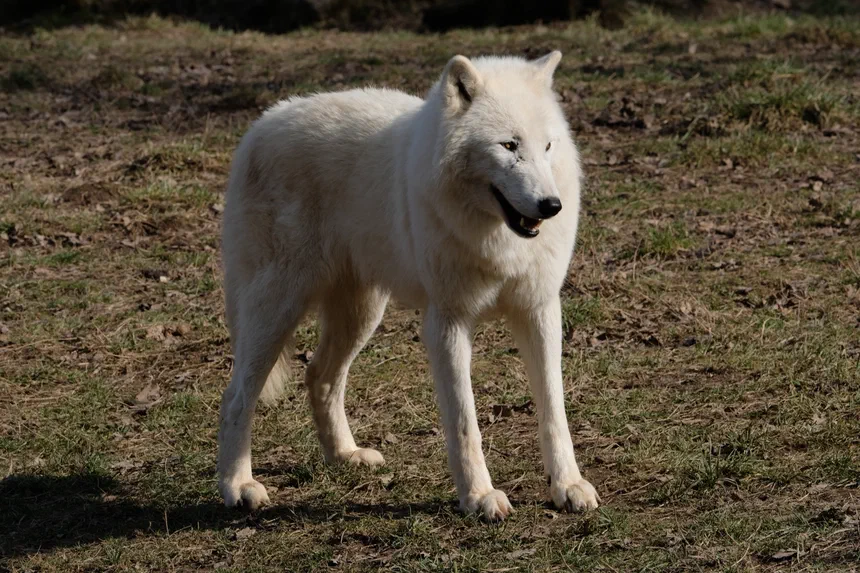
Image: Musicaline — CC BY-SA 4.0 · source
What Is a Arctic Wolf?
The Arctic wolf (Canis lupus arctos) is a subspecies of the gray wolf that lives in the frozen reaches of the far north. Also called the white wolf or polar wolf, it is superbly adapted to survive one of the harshest environments on Earth, where temperatures plunge and darkness can last for months. Because of the remoteness of its range, it rarely encounters people and has largely avoided the persecution suffered by wolves farther south.
Appearance and Identification
Arctic wolves are best known for their thick, pale coats, which range from pure white to a faint grayish tint and provide camouflage against snow and ice. Their fur is denser than that of other wolves, forming an insulating double layer that traps body heat. Compared with more southerly gray wolves, they tend to have shorter legs, smaller and more rounded ears, and a stockier build, all features that reduce heat loss.
Adults generally measure three to five and a half feet in body length, not counting the bushy tail, and stand roughly two to three feet at the shoulder. Weights typically fall between about 70 and 125 pounds, with males averaging larger than females. Their compact muzzles, padded feet, and heavy fur all reflect the demands of life in extreme cold.
Habitat and Range
This subspecies inhabits the high Arctic, including the islands of the Canadian Arctic Archipelago and the northern and eastern coasts of Greenland. It lives on open tundra, rocky slopes, and windswept plains that remain snow-covered for much of the year.
The Arctic wolf endures conditions few mammals can tolerate, including prolonged winter darkness, ground that stays frozen year-round, and bitter winds. Prey is thinly scattered across this vast landscape, so packs may range over enormous territories in search of food.
Diet
Arctic wolves are carnivores that hunt whatever the tundra offers. Their principal large prey are muskoxen and Arctic hares, but they also take caribou when available and catch smaller animals such as lemmings, ground-nesting birds, and other rodents.
Because large prey like muskoxen are formidable and dangerous, hunting is usually a cooperative pack effort. Wolves may travel long distances between meals and can consume large amounts in a single feeding, since food can be scarce and unpredictable in such a demanding environment.
Behavior
Like other gray wolves, Arctic wolves are social animals that live and hunt in packs, typically built around a breeding pair and their offspring. Pack sizes are often small, reflecting the low density of prey, though larger groups do form. Cooperation is essential for bringing down big prey and for raising young.
Wolves communicate through howls, body postures, scent marking, and facial expressions, all of which help maintain the pack’s social bonds and defend its territory. Their tolerance of humans is unusual among wolves, a consequence of living where they seldom meet people.
Life Cycle and Reproduction
In most packs only the dominant pair breeds. After a gestation of roughly two months, the female gives birth in late spring to a litter that commonly numbers two to four pups, fewer than many wolves produce farther south. Dens may be dug into the ground, tucked among rocks, or placed in shallow caves, since permafrost limits deep burrowing.
Pups are born blind and helpless and depend entirely on the pack. Adults bring food back to the den, and older pack members help guard and feed the young. The pups grow quickly through the brief Arctic summer and join the pack’s travels as they mature. In the wild, Arctic wolves generally live around seven to ten years.
Conservation Status
The Arctic wolf is not evaluated separately by the IUCN, but the gray wolf as a species is listed as Least Concern. Thanks to its isolation, this subspecies has escaped the widespread hunting and habitat loss that reduced wolf numbers elsewhere, and its populations are considered relatively stable.
The main long-term concern is climate change, which is altering Arctic ecosystems and can affect the muskoxen and hares the wolves depend on. Extreme weather events that reduce prey numbers can, in turn, sharply lower wolf survival and pup production in a given year.
Frequently Asked Questions
Are Arctic wolves a separate species from gray wolves? No. The Arctic wolf is a subspecies of the gray wolf (Canis lupus), adapted through its white coat and compact body to life in the high Arctic.
Why are Arctic wolves white? Their pale coats provide camouflage in a landscape dominated by snow and ice, helping them approach prey and blend into their surroundings.
Are Arctic wolves dangerous to humans? They are generally wary but far less fearful of people than other wolves, simply because they rarely encounter humans in their remote range. Attacks on people are extremely rare.
References
The conservation status and key facts in this profile are supported by these sources:
- IUCN Red List — Canis lupus (Grey Wolf) assessment (accessed 2026-07-28)
- Animal Diversity Web — Canis lupus (gray wolf) (accessed 2026-07-28)
Found an error, source problem, or image concern? Report this page.