Mammals Guide
Arctic Fox
What Is a Arctic Fox? The Arctic fox (Vulpes lagopus) is a small, cold-adapted member of the dog family, Canidae, native to the tundra of the far Northern Hemisphere. Compact, thickly furred, and remarkably hardy, it is …
At a glance
What Is a Arctic Fox?
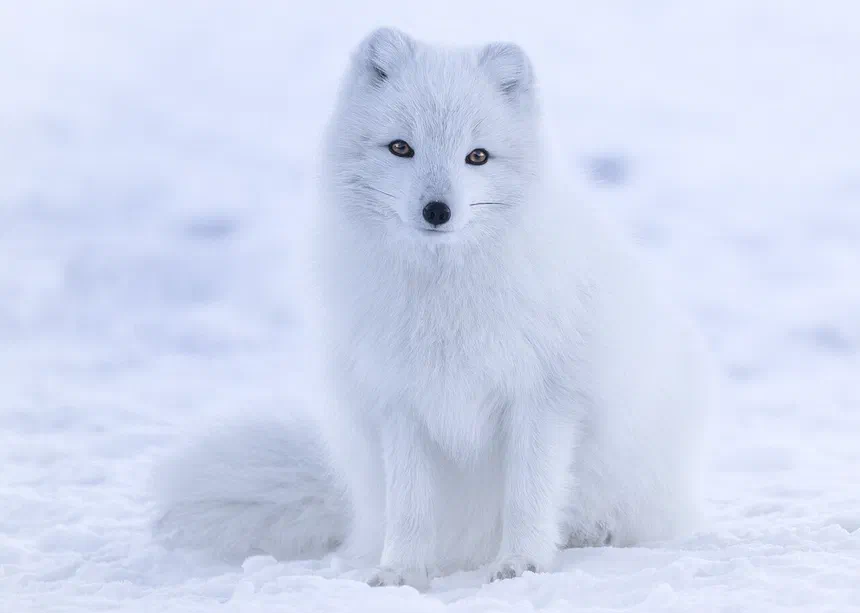
The Arctic fox (Vulpes lagopus) is a small, cold-adapted member of the dog family, Canidae, native to the tundra of the far Northern Hemisphere. Compact, thickly furred, and remarkably hardy, it is one of the few land mammals that can thrive through the brutal Arctic winter. It is best known for a dense seasonal coat that turns snow-white in winter and brown-gray in summer.
Appearance and Identification
The Arctic fox has a rounded body, short legs, small ears, and a shortened muzzle, all features that reduce heat loss in extreme cold. Its most famous trait is a color-changing coat. In winter, most individuals grow a luxuriant, pure-white pelage that provides both insulation and camouflage against snow; in summer this molts to a shorter brown or gray coat. A less common “blue” color morph remains dark bluish-gray or charcoal throughout the year and is more frequent in coastal populations. Adults measure roughly 46 to 68 cm in head-and-body length, with a bushy tail adding another 25 to 40 cm, and typically weigh between 3 and 8 kilograms. Thick fur even covers the soles of the feet, which is reflected in the scientific name lagopus, meaning “hare-foot.”
Habitat and Range
The Arctic fox has a circumpolar distribution, occurring across the Arctic and subarctic regions of North America, Greenland, Iceland, Scandinavia, and northern Russia. It occupies open tundra, rocky coastlines, mountain slopes, and the frozen sea ice. During winter, some individuals travel enormous distances over pack ice in search of food, and long-range movements of hundreds or even thousands of kilometers have been recorded. Dens are often dug into low mounds, riverbanks, or eskers, and traditional den sites may be reused and expanded by generations of foxes over many years.
Diet
The Arctic fox is an opportunistic carnivore whose diet shifts with the seasons and location. Inland, small rodents such as lemmings and voles are the dietary mainstay, and fox numbers often rise and fall in step with cyclical booms and crashes in lemming populations. The foxes also take ground-nesting birds, eggs, fish, and insects, while coastal individuals rely heavily on seabirds, marine invertebrates, and material washed up along the shore. In winter, when live prey is scarce, the Arctic fox is an important scavenger, frequently following polar bears to feed on the remains of seal kills. Surplus food is commonly cached beneath snow or in dens for leaner times.
Behavior
Arctic foxes are active year-round and do not hibernate, enduring winter temperatures that can plunge far below freezing. Their extraordinarily dense fur, compact shape, and countercurrent blood flow in the limbs allow them to conserve body heat with little energy expense. They are generally solitary or live in small family groups, communicating through vocalizations, scent marking, and body posture. To locate prey hidden beneath snow, a fox listens carefully, then leaps and punches through the surface with its forelegs. When resting in blizzards, it may curl into a tight ball, wrapping its bushy tail around its face and feet for added insulation.
Life Cycle and Reproduction
Arctic foxes usually form monogamous breeding pairs that share a territory and cooperate in raising young. Mating occurs in early spring, and after a gestation of about 49 to 57 days the female gives birth in a den to one of the largest litters of any wild carnivore, sometimes exceeding a dozen pups, especially in years when lemmings are abundant. Both parents feed and guard the young, which are born blind and helpless. Pups emerge from the den in early summer, are weaned within several weeks, and disperse before their first winter. In the wild, most Arctic foxes live only about three to six years, with harsh conditions and food shortages limiting survival.
Conservation Status
Globally, the Arctic fox is listed as Least Concern by the IUCN, and it remains common across most of its vast circumpolar range. However, some regional populations are critically small. In mainland Scandinavia the species was heavily reduced by historical fur hunting and has been slow to recover, remaining endangered and the focus of active conservation programs. Emerging threats include a warming climate, which reduces snow cover and tundra habitat, and competition from the larger red fox, which is expanding northward.
Frequently Asked Questions
How does the Arctic fox survive such extreme cold? It has one of the warmest coats of any mammal, along with a compact body, small ears, and furred feet that minimize heat loss, allowing it to remain active through the Arctic winter without hibernating.
Are Arctic foxes always white? No. The white coat is a winter feature that molts to brown or gray in summer, and a “blue” morph stays dark bluish-gray all year.
What do Arctic foxes eat in winter? When live prey is scarce, they scavenge widely, often trailing polar bears to feed on seal carcasses, and they rely on food cached earlier in the year.
References
The conservation status and key facts in this profile are supported by these sources:
- Animal Diversity Web — Vulpes lagopus (Arctic fox) (accessed 2026-07-28)
- GBIF — Vulpes lagopus (Arctic fox) (accessed 2026-07-28)
Found an error, source problem, or image concern? Report this page.