Mammals Guide
Aoudad
What Is a Aoudad? The aoudad (Ammotragus lervia), also widely known as the Barbary sheep, is a rugged, wild caprine native to the mountains and rocky deserts of North Africa. Despite the “sheep” nickname, it sits …
At a glance
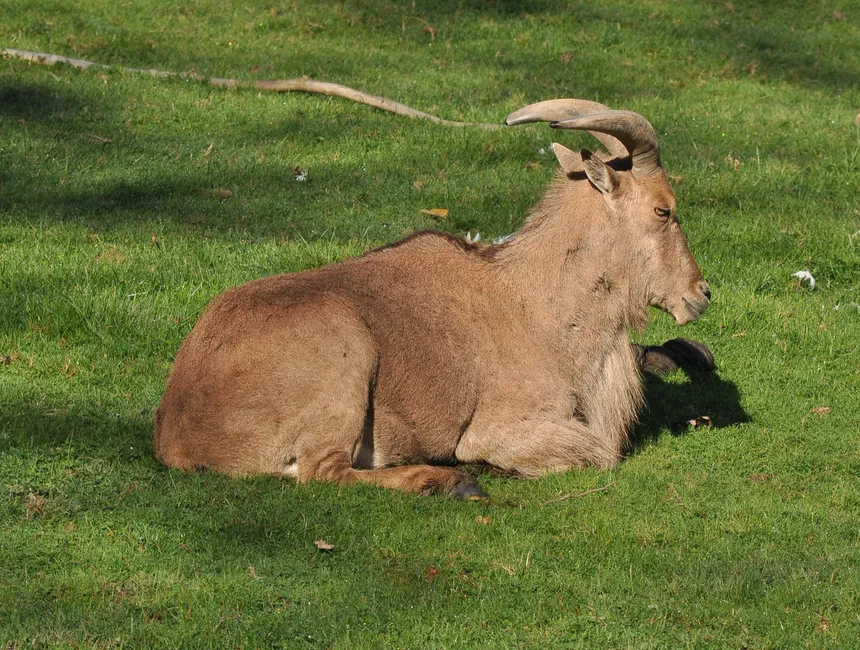
Image: The High Fin Sperm Whale — CC BY-SA 3.0 · source
What Is a Aoudad?
The aoudad (Ammotragus lervia), also widely known as the Barbary sheep, is a rugged, wild caprine native to the mountains and rocky deserts of North Africa. Despite the “sheep” nickname, it sits taxonomically between true sheep and goats, forming its own genus. It is best recognized by the long, shaggy fringe of hair that drapes from its throat, chest, and upper forelegs.
Appearance and Identification
Aoudads have a short, sandy tan to reddish-brown coat that blends almost perfectly with the parched, stony terrain they inhabit. The underparts are paler, and the coat lacks the dark markings seen in many other wild sheep. The animal’s signature feature is the long “chaps” of hair hanging from the neck, chest, and forelegs, which is more pronounced in mature males. Both sexes carry sturdy, backward-curving horns that sweep out and then inward; males’ horns are noticeably thicker and can exceed 30 in (75 cm) along the curve. Males are considerably larger and heavier than females, standing roughly 30-40 in (75-100 cm) at the shoulder.
Habitat and Range
The species is adapted to dry, mountainous country. In its native North African range it occupies rugged terrain across parts of Morocco, Algeria, Tunisia, Libya, Egypt, and the Sahel fringe, favoring rocky slopes, canyons, and arid foothills with sparse vegetation. Aoudads are superb climbers, using cliffs and boulder fields to escape predators. Beyond their homeland, they have been introduced and now roam free in the southwestern United States (notably Texas and New Mexico), parts of Spain, Mexico, and elsewhere, where they sometimes thrive as an established wild population.
Diet
Aoudads are herbivores with a flexible, opportunistic palate. They graze on grasses and forbs and browse the leaves, twigs, and buds of shrubs and small trees, shifting between food types with the seasons and available moisture. They are remarkably well suited to desert life and can go long stretches without drinking, obtaining much of their water from the plants they eat and from dew. When free water is present, they will drink readily.
Behavior
These are largely crepuscular animals, most active in the cooler hours around dawn and dusk and resting in shade during the heat of the day. They live in small family groups, typically a female and her young or loose bands of several animals, though larger aggregations can form. When threatened, an aoudad’s first instinct is to freeze and rely on its camouflage; if pressed, it bounds away with impressive agility across steep, broken ground that would stop most predators. Mature males compete for mates with head-to-head clashes, charging and locking horns.
Life Cycle and Reproduction
Aoudads can breed more than once a year under favorable conditions. After a gestation of roughly five to five and a half months, a female usually gives birth to one or two young, occasionally more. Newborns are precocial and able to negotiate rocky ground within days, an essential trait in their cliffside home. Females may reach breeding condition before their second year. In the wild, aoudads typically live around 10 to 15 years, with individuals in captivity sometimes living longer.
Conservation Status
In its native North African range the aoudad is classified as Vulnerable by the IUCN, with populations fragmented and declining due to overhunting, competition with domestic livestock, and habitat loss. Ironically, the species is abundant and even considered invasive where it has been introduced, particularly in the American Southwest, where free-ranging herds compete with native wildlife such as desert bighorn sheep. Conservation efforts in North Africa focus on protected areas and anti-poaching measures.
Frequently Asked Questions
Is an aoudad a sheep or a goat? Neither exactly. The aoudad occupies its own genus, Ammotragus, and shares features with both true sheep and goats, sitting evolutionarily between the two.
Why do aoudads have long hair on their necks and legs? This shaggy fringe, or “chaps,” is a distinctive display feature that is most developed in adult males and helps identify the species.
Where can you find wild aoudads today? They are native to North Africa’s mountains and deserts but have also become established as free-ranging wild populations in the southwestern United States, Spain, and Mexico.
References
The conservation status and key facts in this profile are supported by these sources:
- Animal Diversity Web — Ammotragus lervia (accessed 2026-07-28)
- GBIF — Ammotragus lervia (Pallas, 1777) (accessed 2026-07-28)
Found an error, source problem, or image concern? Report this page.