Mammals Guide
Amur Leopard
What Is a Amur Leopard? The Amur leopard (Panthera pardus orientalis) is one of the rarest big cats in the world, a subspecies of leopard adapted to the cold, forested landscapes of the Russian Far East and adjacent …
At a glance
What Is a Amur Leopard?
The Amur leopard (Panthera pardus orientalis) is one of the rarest big cats in the world, a subspecies of leopard adapted to the cold, forested landscapes of the Russian Far East and adjacent parts of northeast China. Unlike its tropical relatives, this cat endures harsh, snowy winters and is prized for its exceptionally thick, richly patterned coat. Decades of habitat loss and poaching pushed it to the brink, and it remains among the most threatened cats on the planet.
Appearance and Identification
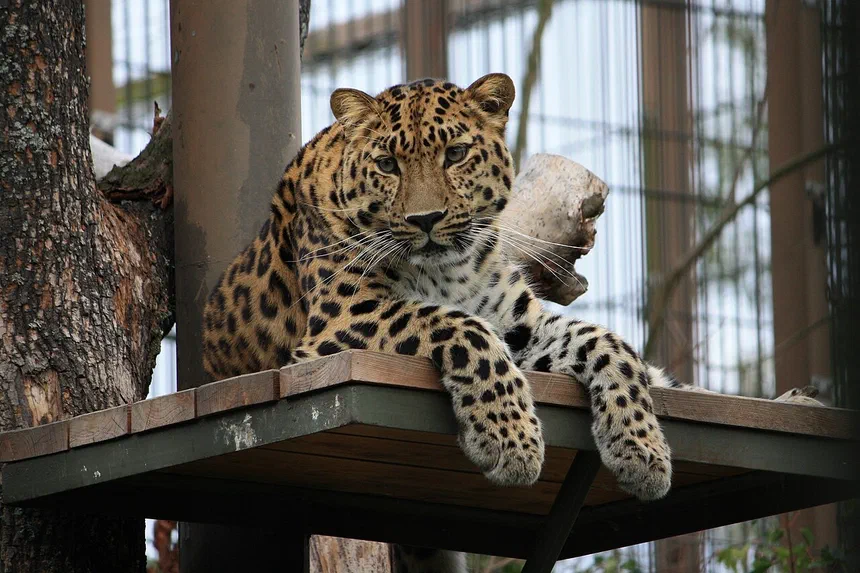
The Amur leopard is instantly recognizable by its long, dense fur, which grows notably thicker and paler in winter to help it survive freezing temperatures. Its coat ranges from a soft cream in the cold months to a warmer, rusty-gold in summer, marked throughout with large, widely spaced rosettes that have thick black rings.
Compared with leopards from warmer climates, the Amur leopard has longer legs, which are well suited to walking through deep snow. Individuals can be told apart by their unique rosette patterns, a feature researchers use to identify specific animals from camera-trap images. The long, well-furred tail helps the cat balance and can be wrapped around the body for warmth.
Habitat and Range
This subspecies lives in temperate broadleaf and mixed forests, a very different environment from the savannas and jungles most people associate with leopards. Its stronghold is the Land of the Leopard region in Russia’s Primorsky Province, with a smaller population ranging across the border into China’s Jilin and Heilongjiang provinces.
These forests provide dense cover for hunting and rocky outcrops for shelter and denning. The Amur leopard’s range once extended much farther across the Korean Peninsula and northeast Asia, but human activity has reduced it to a small fraction of its former territory.
Diet
The Amur leopard is a pure carnivore and an ambush hunter. Its primary prey includes roe deer and sika deer, supplemented by hares, badgers, raccoon dogs, and other small mammals, along with the occasional bird. Where wild prey is scarce, individuals sometimes take young livestock, which can bring them into conflict with people.
A successful leopard often drags its kill into cover or up onto rocks and returns to feed over several days. Because prey density in these northern forests is relatively low, each cat requires a large hunting territory to find enough food.
Behavior
Amur leopards are solitary and largely nocturnal, resting by day and hunting under cover of darkness or in the low light of dawn and dusk. They are territorial, with individuals patrolling and scent-marking home ranges that can span many square miles. These ranges are typically larger than those of leopards in richer, warmer habitats because prey is more thinly spread.
Powerful and agile, the Amur leopard is an excellent climber and can leap considerable distances. It relies on stealth, using the forest’s cover to approach prey closely before a short, explosive rush. Outside of the breeding season and mothers with cubs, these cats generally avoid one another.
Life Cycle and Reproduction
After a gestation of roughly three months, a female gives birth to a small litter, commonly two or three cubs, in a sheltered den. The cubs are born blind and helpless and depend entirely on their mother during their early weeks. She raises them alone, nursing them and later bringing them meat as they grow.
Young leopards begin to accompany their mother on hunts and learn to catch prey before becoming independent at around one and a half to two years of age. Females typically reach breeding age at about three years. In the wild, Amur leopards may live for roughly ten to fifteen years, with individuals in managed care sometimes living longer.
Conservation Status
The Amur leopard is listed as Critically Endangered on the IUCN Red List and is one of the world’s most endangered cats. Its population fell to only a few dozen individuals in the wild, though coordinated conservation efforts, including the creation of protected areas and anti-poaching patrols, have helped numbers recover modestly in recent years.
The main threats are habitat loss from logging, fires, and development, along with poaching of both the leopards and their prey. A small, isolated population is also vulnerable to inbreeding and disease. Ongoing protection, prey recovery, and plans for reintroduction are seen as essential to the subspecies’ long-term survival.
Frequently Asked Questions
How many Amur leopards are left in the wild? Estimates put the wild population at roughly 100 or so individuals, mostly in the Russian Far East with a smaller number in northeast China. This is a marked improvement from a low point of only a few dozen animals.
Why does the Amur leopard have such thick fur? It lives in a cold, snowy climate, so it grows a long, dense winter coat for insulation. Its fur becomes paler and thicker in winter and shorter and more richly colored in summer.
How is the Amur leopard different from other leopards? It is a northern subspecies adapted to cold forests rather than tropical habitats, with longer legs for deep snow, a thicker coat, and larger, more widely spaced rosettes than leopards from warmer regions.
References
The conservation status and key facts in this profile are supported by these sources:
- IUCN Red List — Amur Leopard (Panthera pardus ssp. orientalis) assessment (accessed 2026-07-28)
- Animal Diversity Web — Panthera pardus (accessed 2026-07-28)
Found an error, source problem, or image concern? Report this page.